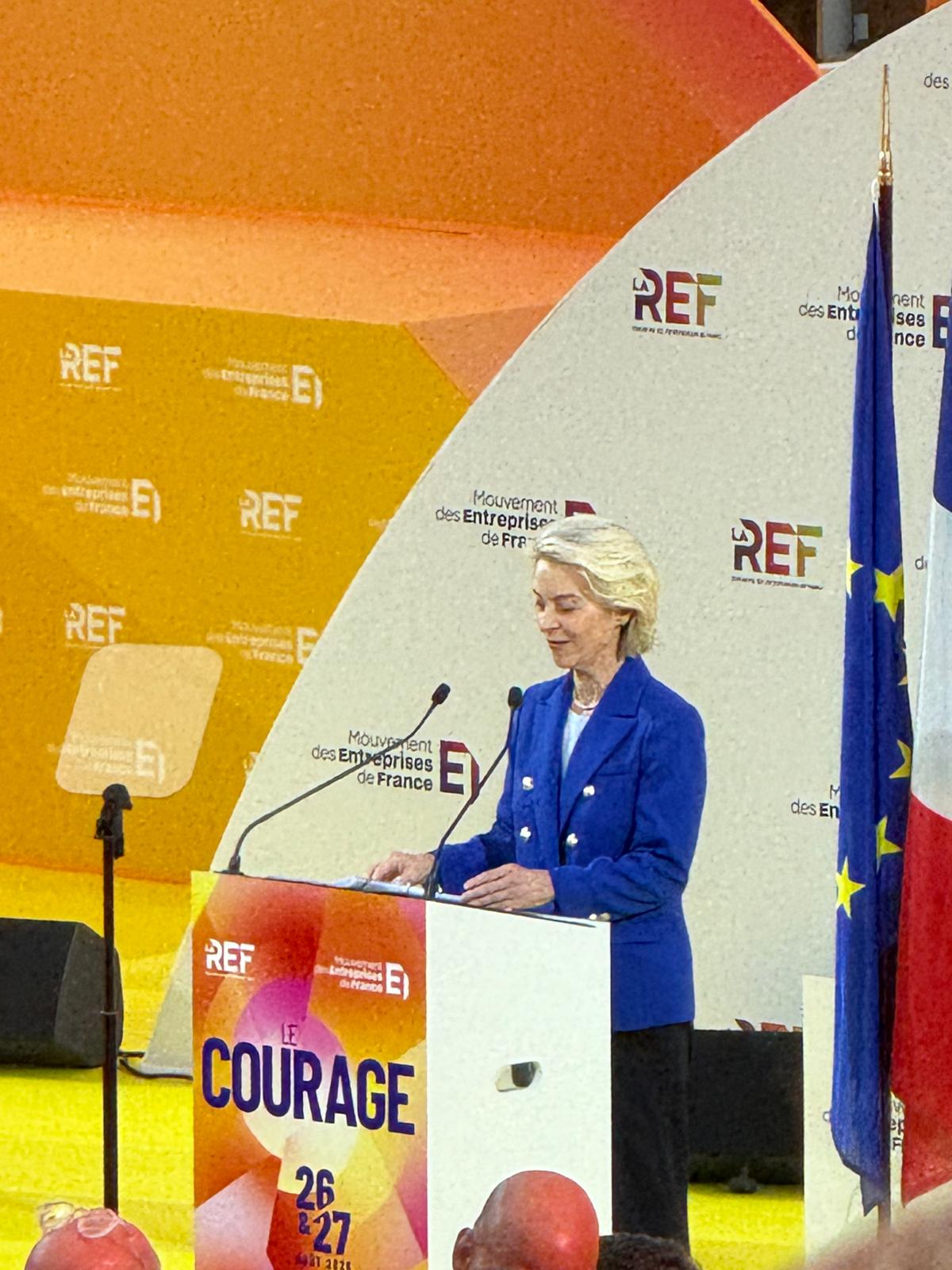
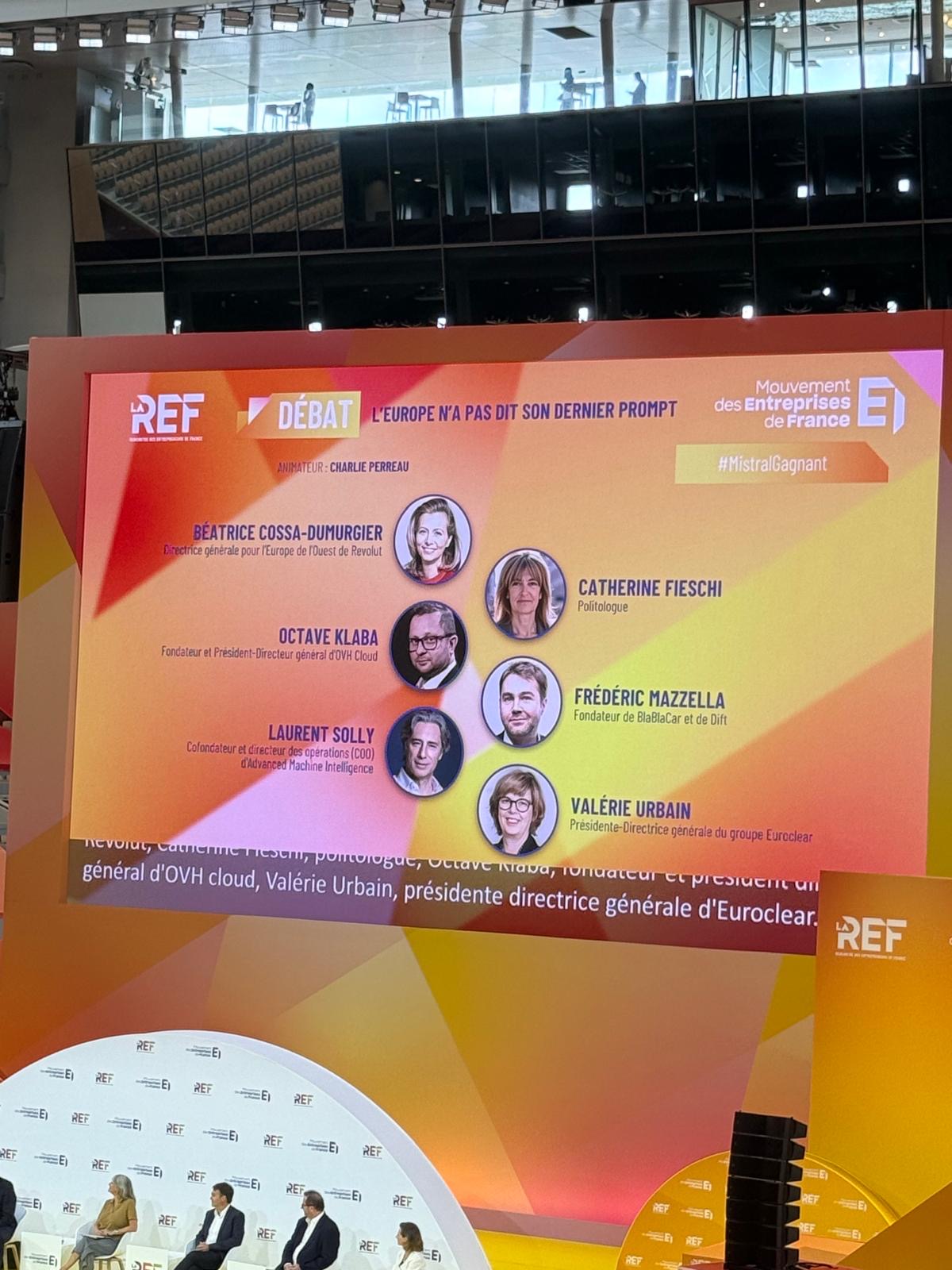
At La REF, the panel discussion titled “Europe hasn’t said its last prompt,” moderated by Charline Perrault, journalist at Les Échos, brought together Béatrice Cossa-Dumurgier, Catherine Fieschi, Octave Klaba, Frédéric Mazzella, Laurent Solly and Valérie Urbain. The exchanges focused on a question that has become central: what does European sovereignty still mean at a time when artificial intelligence relies on infrastructure, models, capital and computing capacity that are largely globalized? The debate quickly went beyond the technological realm. It posed a much more direct question for businesses: how far can we accept dependence when it becomes likely to affect business continuity?
A wake-up call that doesn’t yet change decisions
Charline Perrault opens the discussion with the results of a Sia/OpinionWay study cited that very morning in Les Échos. According to the figures she presents on stage, 73% of the executives surveyed say that recent restrictions on access to certain Anthropic models have not changed their position. Sovereignty would garner only 16% of citations among the criteria for choosing an artificial intelligence solution.
The finding is striking. Even when an event makes visible the possibility that a foreign power could intervene in access to a technology that has become strategic, behaviors change little. Companies continue to make decisions based on much more immediate criteria: performance, price, availability and deployment speed.
It is precisely this paradox that makes the debate so interesting. A company’s purpose is not to choose a technology based on its nationality. It seeks an effective, competitive product adapted to its needs. Frédéric Mazzella makes this very clear: economic actors reason first and foremost rationally. They choose what allows them to operate, produce, serve their customers and remain competitive. He compares this attitude to the one we adopt toward insurance risk. As long as the accident hasn’t occurred, we tend to think it will remain unlikely. Technological sovereignty often still works this way. The risk is identified, but it remains abstract as long as it doesn’t directly disrupt activity.
From geopolitical risk to operational risk
Octave Klaba nevertheless gives this risk a very concrete dimension when he evokes the concept of “kill switch.” Behind this expression lies a simple possibility: a supplier can cut off a service, interrupt access or make a technology inaccessible. As long as the economy depended relatively little on digital, this hypothesis could seem limited. It completely changes in scope when companies rely on the cloud, data and now artificial intelligence.
Octave Klaba goes so far as to mention SNCF infrastructure to illustrate what technological dependence can mean when it affects critical activities. Sovereignty is then no longer just an industrial or geopolitical question. It becomes a question of business continuity.
This evolution should directly interest executives. If a critical technology supplier became inaccessible tomorrow, which functions would actually continue to work? How long would it take to migrate to an alternative solution? Is the data recoverable? Were the systems designed to allow reversibility? Sovereignty thus gradually enters the classic field of risk governance.
Catherine Fieschi provides at this stage one of the most interesting definitions of the panel. No country can reasonably control the entire technological chain. It is illusory to imagine a Europe producing alone all the chips, all the software, all the models and all the infrastructure it needs. The relevant question is therefore not to eliminate all dependencies, but to determine which ones are acceptable.
A dependency becomes problematic when the cost of change becomes too high, when there is no longer a credible alternative, or when an external actor has the ability to cut off access. Catherine Fieschi then formulates an essential idea: “The problem is not dependence, it’s dependence without an exit option.”
This sentence could become a governance principle for companies. The right question is no longer simply whether a technology is European, American or Chinese. It consists of determining whether the company still retains the ability to change it.
Data, technology, operations: three sovereignties to distinguish
Octave Klaba distinguishes three forms of sovereignty. The first concerns data: who can see it and who can access it? The second concerns technology: who develops the system and who can make it evolve? The third concerns operations: who operates the infrastructure on a daily basis and who actually has the ability to keep it running?
This distinction forces us to move beyond a simplistic vision of sovereignty. An organization can use an American model while limiting its risk if it controls its data, knows its alternatives and maintains a sufficiently reversible architecture. Conversely, choosing a European technology does not automatically guarantee complete sovereignty if certain essential building blocks remain dependent on external actors.
For executives, this framework can be summarized in three questions: who controls my data? Who controls the technology on which my activity depends? Who is capable of continuing to operate the system?
The debate then shifts to European industrial weakness. Octave Klaba describes a particularly important mechanism: when a European technology is not sufficiently performant, customers don’t choose it. The absence of customers reduces revenue. Lower revenue limits investment capacity. And insufficient investments slow down technology improvement.
The circle is simple: technology, customers, revenue, investments, better technology. Conversely, already dominant actors benefit from a cumulative effect. The more customers they have, the more revenue they generate, the more they can invest, and the harder their lead becomes to close.
Europe knows how to create, but still struggles to scale
Laurent Solly recalls that artificial intelligence is not limited to models. It functions as a complete ecosystem. It requires data, computing power, energy, researchers, engineers, companies capable of deploying technologies and sufficient capital. Europe possesses some of these building blocks. It has recognized talent, entrepreneurs and important industrial players. But it remains more fragile when looking at the entire chain and especially its ability to transform these resources into companies capable of reaching global scale.
Frédéric Mazzella emphasizes precisely this point. France has more than 1,100 startups related to artificial intelligence, representing several tens of thousands of jobs and several billion euros raised since their creation. The entrepreneurial ecosystem exists. The problem is therefore not the birth of companies, but their growth.
His formula brutally summarizes the problem: “Americans bought American. The Chinese bought Chinese and Europeans bought American and Chinese.” Behind this sentence appears a difficult question to avoid: who bought European?
This is not about turning this remark into a call for protectionism. Frédéric Mazzella emphasizes on the contrary that it would be inconsistent to ask private companies to take sole responsibility for a continental industrial policy. A company selects the solution that best serves its interest. Public authorities have other levers.
Public procurement can notably help create the necessary demand to enable European companies to reach the growth thresholds they need. Octave Klaba illustrates this situation with OVHcloud. According to the orders of magnitude he cites during the conference, the group achieves approximately 1.2 to 1.3 billion euros in revenue, of which only 50 to 60 million with the State. He simultaneously highlights the weight of European spending with major American cloud providers.
The reasoning deserves attention: it’s not necessarily about finding new billions. Part of the demand already exists. It’s simply directed elsewhere.
From AI tool to AI-designed company
Béatrice Cossa-Dumurgier’s intervention brings a particularly interesting perspective for executives. Revolut was designed from the outset as a platform capable of operating at large scale, rather than as a juxtaposition of national organizations. This architecture now facilitates the integration of artificial intelligence.
But the essence of her point does not lie in the list of use cases developed by the company. It lies in the very way of conceiving AI. Revolut is not simply seeking to add artificial intelligence tools to existing processes. The company wants to integrate this technology deeply into its platform architecture.
This distinction deserves to be noted. Many organizations are still in the first phase of adoption: they add a chatbot, a copilot, an assistant or automation to an existing process. The next step is more ambitious: rethinking processes and sometimes the organization itself around the new capabilities offered by AI.
The question for executives is therefore no longer just which tools to use. It becomes: is our organization actually designed to function with artificial intelligence?
Europe has capital, but doesn’t direct it enough toward its champions
The debate then returns to financing. Valérie Urbain recalls that Europe does not necessarily lack capital. Savings there are considerable. The problem lies more in its transformation into productive investment and in the persistent fragmentation of European financial markets.
Tax, legal and regulatory differences further complicate the circulation of capital. When a European startup enters a growth phase requiring much larger financing, American markets have particularly attractive depth and liquidity.
Technological sovereignty then directly meets financial sovereignty. A continent can hardly hope to bring forth global technological champions if it cannot finance their growth.
It is precisely from this observation that Béatrice Cossa-Dumurgier formulates one of the most memorable proposals of the panel. She recalls that European savings are significant, but that part of these savings is invested in the United States and therefore indirectly contributes to financing American technology companies. The paradox is obvious: Europe partly finances the technologies whose dependence it then deplores.
She then returns to the history of the Livret A and proposes a deliberately simple idea: why not create a “European AI savings account”? The principle would be to direct part of savings toward financing the European artificial intelligence ecosystem.
The regulatory and financial feasibility of such a mechanism would naturally need to be studied. But the interest of the proposal lies above all in the question it poses: how can we transform European savings into European technological capacity? Sovereignty is not only at stake in data centers or research laboratories. It is also at stake in the circuits that decide where capital is invested.
In AI, the lag also becomes decisional
Another theme runs through the exchanges: speed. Laurent Solly recalls that European difficulties are widely known. The lack of capital market integration is documented. Regulatory fragmentation is identified. Obstacles to scaling are known. The reports exist. The diagnoses too.
The problem is now one of decision and especially its execution.
This question becomes particularly critical in artificial intelligence. The technology available at the beginning of 2025 is no longer exactly the one we use today. Reasoning models are progressing, agents are beginning to transform architectures and new capabilities are continuously emerging.
A policy designed today, but applied several years later, can therefore respond to a technological reality that has already changed.
In AI, the European lag is no longer just technological. It is becoming decisional.
Octave Klaba nevertheless refuses fatalism. OVHcloud also wants to progress in the artificial intelligence value chain. The company is investing in certain startups and wants to develop specialized models in several areas, including agentic and reasoning systems, software development, and offensive and defensive cybersecurity.
The example opens an interesting path for Europe. It may not need to seek to reproduce exactly each American giant. It can also identify sectors in which it already possesses industrial assets, data, infrastructure and expertise strong enough to develop differentiating advantages.
Sovereignty could then consist less in wanting to dominate all layers of the chain than in choosing those on which a strategic position must absolutely be preserved.
Automating without breaking skills transmission
Catherine Fieschi finally broadens the reflection to the social consequences of artificial intelligence. She poses a question rarely formulated this way: how do you enter a profession when some of the tasks traditionally entrusted to beginners are automated?
Entry-level functions play an essential role in building skills. They allow observation, practice, mistakes and the gradual acquisition of expertise. If these stages disappear, how will organizations train their future experts?
The issue therefore goes beyond the simple question of the number of jobs destroyed or created. A company can improve its productivity in the short term while unintentionally weakening its skills transmission mechanisms.
AI thus forces organizations to simultaneously rethink automation and learning. Replacing a task does not mean eliminating the need to build the expertise associated with it.
Catherine Fieschi also insists on a political and democratic dimension. A state can legally retain the power to decide while gradually losing the technical means necessary for the actual exercise of this power. She also raises the question of authority and credibility at a time when artificial intelligence systems increasingly participate in the production and circulation of information.
Who determines what is credible? How do we fight interference? How do we preserve a common information space when synthetic content becomes massive?
The question also touches on values. Models are trained on corpora, languages and particular cultural contexts. They are therefore never completely independent of the representations of the world from which they learn.
Catherine Fieschi does not advocate for a technologically closed Europe. She rather defends a form of agility: being able to use different models, to change, to pivot and to maintain alternatives. We find here her initial idea. Sovereignty does not necessarily consist of eliminating dependencies, but of preventing them from becoming irreversible.
Sovereignty becomes an executive committee topic
For executives, this is probably the main takeaway from this panel. Digital sovereignty is no longer just a subject reserved for governments or IT departments. It becomes a governance question.
An executive committee should today know the technologies the company can no longer do without, identify truly critical suppliers, understand where data is located, know available alternatives and assess the cost of migration. It should also know how long the organization could continue to operate if one of its main AI or cloud suppliers became inaccessible.
The question can ultimately be formulated simply: if tomorrow your most critical technology supplier disappeared, would your company still have a choice?
At the end of the debate, Octave Klaba makes a remark that summarizes the European situation quite well. He notes that it sometimes still takes courage for certain customers to choose a European solution. His wish is precisely that this courage no longer be necessary. Choosing European should not be an activist act. It should become a natural economic decision because the technologies offered are competitive, performant and credible.
This is perhaps where the real challenge lies. Europe will not build its sovereignty by asking companies to give up their competitiveness. It will build it if it creates the conditions enabling its actors to offer alternatives sufficiently performant to be chosen based on their value.
The study cited by Charline Perrault at the opening then takes on its full meaning. Despite growing awareness of dependencies, economic decisions still change little. One can see in this a lack of sensitivity to sovereignty. One can also see something much more rational: the alternatives are not yet always strong enough to change the decision.
Europe largely knows its diagnosis. It has researchers, engineers, entrepreneurs, capital, savings and certain strategic infrastructure. What it still lacks is the ability to transform these dispersed resources quickly enough into industrial power.
Sovereignty probably does not consist of becoming independent of everyone. In a profoundly interdependent digital economy, this objective seems hardly realistic. It consists rather of understanding one’s dependencies, choosing those one accepts and systematically preserving exit options.
For companies as for Europe, the real risk begins when choice disappears.
And in an industry evolving at the speed of artificial intelligence, a second risk now appears clearly: understanding what needs to be done, but deciding too late.