

AI in business: why adoption is first and foremost a leadership issue
In Prague, Tracy Sheen's speech at the 73rd FCEM World Congress highlighted a still-common confusion. Putting artificial intelligence tools in the hands of employees does not mean they are actually adopted, nor that the company is transforming. Between governance, skills and value creation, the real challenge now lies in leaders' ability to organize this transition....
AI creates capability. Why organizations create value
From AI capability to organizational transformation and value creation Pascale Caron AI Strategy Advisor | Founder & CEO, Yunova Consulting | Co-author of EntrepreneurIA It has never been easier to use artificial intelligence in business. In just a few months, tools have multiplied, uses have become commonplace, and experiments have spread across almost all functions....
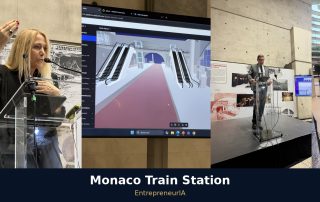
Digital twins: when AI begins to understand the physical world
In Monaco, SNCF Gares & Connexions and Akila are experimenting with a station capable of cross-referencing its data, monitoring its equipment, anticipating passenger flows and simulating its evolution. Behind the technological demonstration emerges a much more strategic question for businesses: how to make their physical operations intelligible to artificial intelligence? The physical world, AI's next...
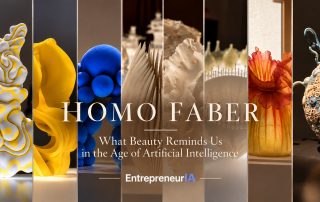
After three years of artificial intelligence, Homo Faber reminded me of the power of beauty
EntrepreneurIA Article • Pascale Caron When beauty compels us to slow down This week, in Venice, Homo Faber offered me a true aesthetic shock. I went there to discover the excellence of art craftsmanship. I came out with a much broader reflection on our relationship to creation, matter, time and human value. For three years,...
OECD and AI agents: what 25 organizations reveal about the shift from promise to execution
Limited autonomy, ROI still difficult to measure, open architectures, cost control and new governance models: the OECD's 2026 study shows how the agentic enterprise is actually beginning to take shape. For the past two years, AI agents have been presented as one of the next major breakthroughs in enterprise artificial intelligence. They are expected to...
DIRIGEO: Jean-Bernard Thonus wants to make AI the strategic right hand of SME leaders
SME leaders often face the same legal, financial, social, or strategic issues as large organizations, without having the same internal resources to address them. With DIRIGEO, Jean-Bernard Thonus wants to use artificial intelligence to reduce this asymmetry. His ambition: to create a "strategic right hand" capable of helping leaders understand a situation, identify risks, and...