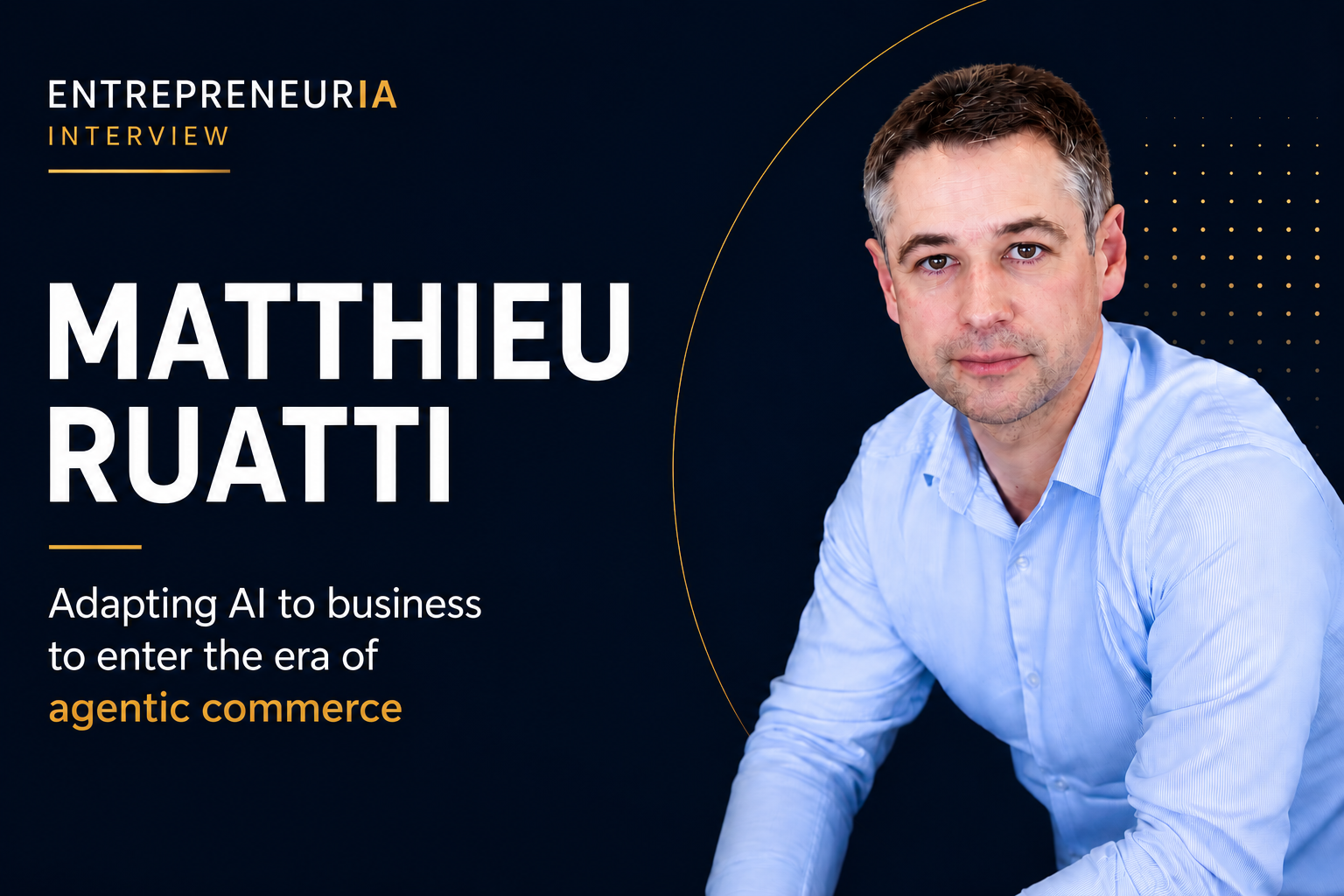
“Changing my entire business to make it good for AI doesn’t make sense.”
This sentence summarizes the vision that Matthieu Ruatti defends with MULTI and MyMULTI.ai. According to him, artificial intelligence should not impose its constraints on businesses. It must understand their trade, their priorities, their processes and their limits.
AI was first adopted as an assistant. It writes, synthesizes, analyzes and supports teams in their daily tasks. Matthieu Ruatti believes that a new stage is now opening, that of agents capable of understanding a business context, executing certain actions and learning from the results obtained.
“A well-crafted prompt is very important, but we’ve moved past that. We’ve moved to skills, we’ve moved to Markdown files,” he explains.
Skills here refer to structured capabilities and instructions that agents can mobilize to accomplish tasks. The challenge is therefore no longer just to formulate a good question to a model. It must be given a stable context, define what it can do and organize its learning over time.
AI can then become an operational infrastructure of the company. It can support the leader’s reflection, execute certain processes and contribute to revenue creation.
With MULTI, Matthieu Ruatti seeks to make this evolution accessible to freelancers, very small businesses and SMEs. His starting point is simple: the company should not transform itself to fit into the boxes of a tool.
From technological anticipation to company building
Matthieu Ruatti’s background illuminates this approach. A graduate of École des Mines de Paris and HEC Entrepreneurs, he began his career at Essilor. He joined a small Corporate Venture Capital (CVC) team directly attached to the group’s general management.
His mission consisted of identifying technologies and economic models likely to transform, in the long term, the optical professions.
“Our mission was to go after everything that revolved around Essilor’s core business, to say: this will perhaps be Essilor’s core business in ten or twenty years.”
The teams then worked on low vision, neuroscience, wearable sensory devices, head-up displays, connected glasses and augmented reality.
Matthieu Ruatti then held commercial and operational positions. Based in Dubai, he participated in Essilor’s development in the Middle East and Africa, then contributed to creating a medical equipment activity exporting to 35 countries. He then joined a leading family office in Kuwait and in cross-border with the West, before pursuing investment activities from London.
Settled in the British capital, he became Operating Partner of the startup studio Founders Ventures, which had been launched by repeat-entrepreneur Jean-Christophe Ramos Galver, and which had been joined by Julien Audibert, PhD in Mathematics and AI. The team developed a venture building model, or co-construction of startups. It didn’t just identify promising companies. It participated in their strategy and development, brought AI and/or Blockchain technological building blocks, invested actively and structured their governance.
“We’re not an incubator or an accelerator. When we enter a company because we believe in it and become an investor, we stay.”
Founders Ventures notably participated in the development of Humanlinker, a generative and behavioral AI solution for sales teams, Telaqua in AgriTech and Ledgity in wealth management. This experience nourishes a conviction that Matthieu Ruatti formulates clearly:
“Venture building/capital is an infinitely human profession.”
AI can accelerate research, prototyping and market analysis. It replaces neither trust between partners, nor leadership, nor sectoral expertise.
AI accelerates creation without solving the human equation
Artificial intelligence has also modified Founders Ventures’ methods. The team estimates that it can accelerate market analysis, value proposition testing and the design of first product versions. AI shortens certain development cycles. On the other hand, it chooses neither the founders, nor the markets, nor the partners. It can facilitate research and reduce certain production costs. It does not, by itself, transform an idea into a viable company.
It is in this context that the team developed MULTI, a platform designed to help SME leaders integrate agentic capabilities into their business. The project presents itself as an application layer independent of the various AI models available on the market.
The Business.md, a structured memory of the company
For Matthieu Ruatti, everything starts with the Business.md. This file describes the company, its activity, its customers, its products, its processes and its priorities. It is readable by a human, but above all exploitable by artificial intelligence agents.
“Through a few targeted questions and answers, the company creates its Business.md. It will become the DNA—for AI—of its own company.”
In the approach developed by MULTI, the Business.md constitutes the starting point of the agentic enterprise. Its role is not limited to describing the activity. It must allow several agents to work from the same context and support, in particular, commercial functions and revenue creation.
Is a company today capable of clearly explaining to an AI what it does, who it works for, what its priorities are and what it refuses to delegate? How can an AI discover a real economy company, interact and trade with it? These questions are paramount, in the opening era of agentic commerce.
Generalist assistants can produce a relevant response at a given moment, then adopt a different orientation a few days later, for lack of sufficiently structured business memory. Matthieu Ruatti wants instead to guarantee continuity.
“There’s no question of AI responding today with something completely different from last week or a month ago. Consistency, persistence over time of AI is key for the business leader.”
The Business.md does not constitute a definitive photograph of the company. It serves as a starting point, then evolves with results, decisions made and learning generated by the activity.
From advisor to the leader to operational agent
MULTI is designed around two uses.
A first issue concerns the discoverability of the company in the agentic economy. Matthieu Ruatti draws a parallel with the infrastructures that accompanied previous transformations of commerce: the telephone number made it possible to reach a company, the email address to write to it. In his vision, the company must now be able to be identified, understood and solicited by AI agents. MULTI thus seeks to structure its identity, its offering and the information necessary to allow both humans and agents to interact with it.
The second offers the company its own economic Operating System, capable of organizing the company’s data, its memory, its authorizations, its preferences, its mandates, its consented relationships, its agent, its history and its economic actions. The company can then act and build value in the agentic economy.
For example, support for reflection. The leader can submit an open question, analyze a difficulty or explore an opportunity. The platform keeps the company’s context and proposes actions consistent with its objectives.
Matthieu Ruatti uses an evocative image:
“A leader is always too alone, in a way, even when they have co-founders. The goal is to create a kind of Jiminy Cricket for the leader, boosted by AI, to be able to create the agentic twin of their company.”
The platform then becomes a permanent interlocutor. It doesn’t necessarily decide in place of the leader. It helps them structure their choices and transform a reflection into an action plan. Then comes the time for action. A leader can ask the system to prepare a commercial campaign, search for prospects, qualify them and start contacting them.
“Find me relevant targets, qualify them, contact them and test their interest. You hand back to me for closing.”
MULTI is among other things designed to transmit to the entrepreneur a selection of already analyzed prospects, so that the entrepreneur can focus on their expertise, their judgment, their ability to close, then their execution. The human role is therefore not eliminated. It is moved to the moments when it remains most decisive.
Autonomy is built in stages
One of the most sensitive issues concerns the level of autonomy granted to agents. Matthieu Ruatti considers that the leader must be able to adjust it according to the tasks and according to the confidence acquired in the system.
“Where do I place the cursor between me and AI? Human, leader, I’m responsible for the company, so do I check and validate everything, or do I want to let AI do such and such a thing autonomously?”
A company could let an agent prepare a publication or a follow-up, while keeping human validation on a quote, a contract or an invoice.
This gradual delegation seems more realistic than generalized automation. The level of autonomy depends on the reversibility of the action, its financial impact, its legal scope and the sensitivity of the data mobilized. Autonomy is not decreed. It is built progressively, from observed results and the risks that the company accepts to take.
Towards a continuously improving company
MULTI also carries the notion of “self-improving business,” or continuously improving company. The system is designed to regularly analyze the lessons from operations. It distinguishes positive and negative results, then transforms them into rules intended to enrich the Business.md.
“AI constantly churns, typically every night, on the day’s learning. It makes rules from it that improve the business.”
The initial file, built in a few minutes, is therefore only a first version.
“Behind it, this file will improve every day, every week. It will ensure that the company becomes self-learning and generating new growth.”
This promise raises a governance question. A company can learn from its results. It can also optimize a bad indicator. A sales agent could favor the volume of contacts to the detriment of their relevance. A marketing system could seek immediate conversion without measuring its effects on the company’s reputation. What should the agent learn then? And according to what criteria?
The company must define what it wants to improve, but also what it refuses to sacrifice in the name of performance. The Business.md is also there for that, to define a framework and healthy limits to the company’s activities.
Who controls the agents, the data and the learning?
Matthieu Ruatti finally establishes a distinction between using AI and building a mastered agentic capability. For him, this capability assumes keeping control of the business context, rules, data and reversibility mechanisms.
He defines MyMULTI.ai as a “business agentic twin.” It is an agentic twin of the company intended to reduce the gap between those who use AI and those who retain control of their agents, their data and their processes. A company can rent functionalities from several suppliers. It can also seek to constitute its own asset, nourished by its data, its processes and its business knowledge. Still, it must know what can be shared.
“We give far too much to an AI model that we don’t control. When we talk about company data, it’s possibly very serious. Giving control back to the business leader, as we do with MULTI, is how we recreate individual independence and ultimately collective sovereignty.”
Matthieu Ruatti warns in particular about shadow AI, that is to say the uncontrolled use of artificial intelligence tools within the company.
“What should not leave the company should not end up in an AI, at least not without safeguards.”
The Business.md and the MULTI protocol help formalize the rules that agents must respect: what they can exploit, what must remain under control and what must never leave the company’s perimeter.
The presented architecture combines proprietary and open source components, environments segmented by company and European hosting. The objective is to reduce dependence on a single supplier and maintain better control of data. This is not absolute sovereignty. It is rather about increasing the capacity for choice, control and reversibility.
The MyMULTI.ai platform is now live, in beta phase, on use cases from various companies. At the time of the interview, no consolidated metrics had yet been published.
“The infrastructure is already global. Its activation begins via a network of geographical or sectoral field experts, notably in franchising, who activate MULTI business by business, company by company. Like in the past with the telephone, when an expert came to pull the line, or with the Internet, when they came to install it in the company.”
Three tips for entrepreneurs
At the end of the interview, Matthieu Ruatti formulates three recommendations.
The first consists of surrounding yourself and giving up on exhaustiveness.
“Everything is moving too fast. Even for you, even for me, even for us.”
It is impossible to test each model and follow all the new features. Leaders must identify reliable interlocutors and focus their attention on applications that are truly useful to their activity.
The second recommendation concerns data. The company must define what it accepts to transmit to an external system, what this external system does with its data, and what it must imperatively keep under its control.
The third is the most structural:
“You have to reconnect with your business. Changing my entire business to make it good for AI doesn’t make sense.”
This position reverses a still frequent logic. Companies discover a tool, then look for a problem to which to apply it. They modify their processes to correspond to its constraints, without always questioning its real contribution to the strategy.
For Matthieu Ruatti, historic companies, businesses, artisans and service companies should not be left aside from AI on the pretext that they are not technological.
“What makes sense is all the businesses of the real economy that must enter the age of AI because AI adapts, not because the business must adapt to AI.”
This is undoubtedly where his point goes beyond the single case of MULTI.
The agentic enterprise does not consist of building a new profession around a technology. It assumes building a technology capable of understanding, respecting and strengthening this profession.
Behind the promise of AI agents is finally a much older question: does a company know its own profession well enough to be able to transmit it, without distorting it, to a machine?