Lessons from Laurence Genevet and Julien Espinosa at the ISCAE Meetings
A team can bring together excellent professionals, share ambitious goals and maintain good relationships without achieving high collective performance. Conversely, some groups marked by strong personalities and significant tensions manage to produce exceptional results. How can we explain this paradox?
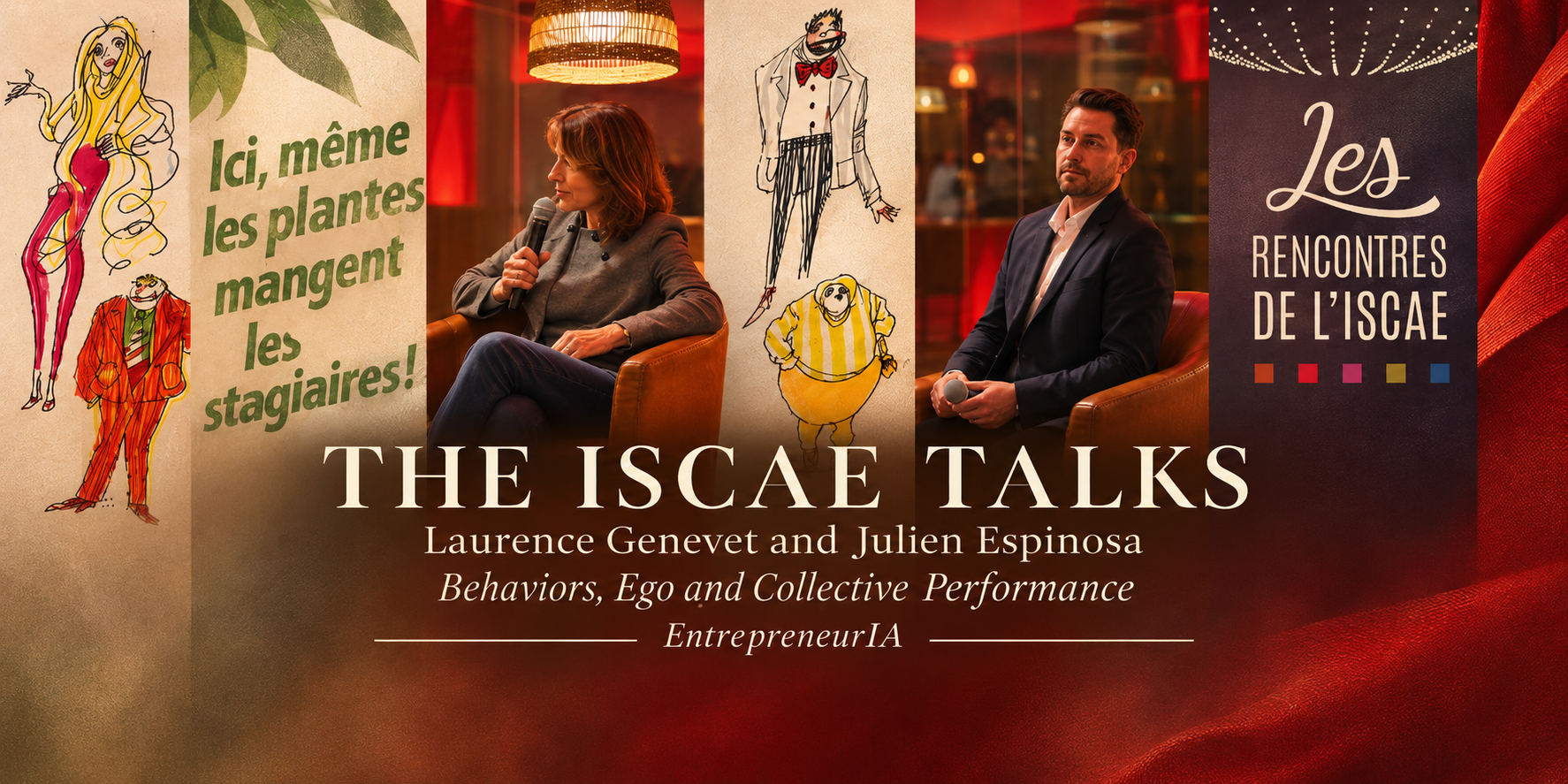
At the ISCAE Meetings, held on November 5, 2026 at the Nice Lawn Tennis Club, two speakers offered complementary answers. Laurence Genevet, a former executive and author of Ici, même les plantes mangent les stagiaires !, explored with humor the behaviors and power dynamics in companies. Julien Espinosa, a former professional basketball coach who became an executive coach, explained why cohesion alone is not enough to produce sustainable performance.
From their discussions with Bruno Valentin, co-founder of the Pole Company agency and lecturer in higher education, an essential reflection emerges for entrepreneurs.
Collective success depends not only on the talents assembled, but on an organization’s ability to create the conditions for their cooperation, constructive confrontation and development.
Laurence Genevet: understanding behaviors that weaken cooperation
Before examining the conditions for performance, we must first understand the human behaviors that shape the daily life of organizations.
 Laurence Genevet knows this world from the inside. After a marketing career at Coca-Cola and Unilever, she held management positions in the regional press, notably at Midi Libre and Nice-Matin, then at Crédit Agricole. She has also developed consulting activities in communication and strategy.
Her book, Ici, même les plantes mangent les stagiaires !, subtitled Manuel de survie dans la jungle de l’entreprise bienveillante, was published in May 2026 by Éditions Ovadia. Illustrated by Virginie Broquet, a Nice-based artist and illustrator, the work transforms professional behaviors into a gallery of caricatured characters borrowed from the animal and plant worlds.
The idea was born from her discussions with students facing their first experiences in companies. Many discovered an environment far removed from idealized representations of management, where talk of benevolence sometimes coexists with rivalries, power plays and practices that are difficult to understand.
Rocco the rooster embodies an ambitious and authoritarian manager, but one capable of supporting his colleagues. Gaston the gudgeon represents another profile, particularly familiar to organizations: one who knows how to appropriate the ideas and results produced by others, especially in front of management.
Behind the humor lies a serious issue for leaders. How can we develop a culture of cooperation when opportunistic behaviors are implicitly rewarded? How can we preserve trust when an employee can derive more benefits from his visibility than from his actual contribution?
For Laurence Genevet, understanding corporate codes first requires knowing how to observe, listen and take a step back. She also emphasizes loyalty, which she considers a fundamental quality of an employee.
This position deserves nuance, however. In a high-performing organization, loyalty should not mean systematic adherence to a superior’s decisions. It also requires the ability to point out an error, defend a conviction and protect the collective interest.
It is precisely this tension between conformity, loyalty and individual assertion that Julien Espinosa will explore in the second part of the meeting.
Julien Espinosa: performance is not decreed, it is built
 A former professional basketball coach, Julien Espinosa notably led the Sharks d’Antibes, whom he led to the Pro B French championship title in 2013. Two years later, he won the Pro B Leaders Cup and achieved another promotion to the elite in 2015. Now a coach for executives and management teams, he applies the lessons from his sports career to the business world.
His presentation begins with a reality rarely mentioned in leadership discourse: the solitude of the person in charge. At the head of a team, the coach can consult, listen and surround himself with advisors, but he remains the one who must make decisions and assume their consequences. This experience resonates particularly with entrepreneurs, often faced with strategic choices without having all the necessary information.
But Julien Espinosa mainly proposes to shift the focus on performance. In sports as in business, results remain essential. Victories, rankings, margins, turnover or EBITDA constitute success criteria that no leader can sustainably avoid. The risk appears when attention to results ends up reducing the ability to act.
“The game takes precedence over the stakes,” he says.
A team exclusively concerned with victory can lose its spontaneity, creativity and ability to experiment. Similarly, a company entirely focused on its financial objectives risks neglecting the human and organizational mechanisms that precisely enable them to be achieved.
The leader’s role then consists less of constantly recalling expected results than of building the conditions that enable the collective to produce them.
“There is no I in team, but there is an I in win”: should we be wary of egos?
To explain what distinguishes a functional team from a truly high-performing team, Julien Espinosa introduces two complementary concepts: Team Glue and Team Stretch.
Team Glue refers to what enables the group to function as a team. Three ingredients seem essential to him: a shared objective, clearly defined responsibilities and trust relationships.
At this stage, individual egos can become obstacles. Personal rivalries and territorial conflicts prevent employees from focusing on their common goal. But once this cohesion is established, a second dynamic becomes necessary: Team Stretch, in other words the collective ability to progress, to leave one’s comfort zone and to question oneself. To reach this stage, personalities must be able to assert themselves. Employees must dare to defend their ideas, express their disagreements and take initiatives.
This tension is illustrated in a famous quote from Michael Jordan, cited by Julien Espinosa:
“There is no I in team, but there is an I in win.”
This response, reported by Jordan during his induction into the Basketball Hall of Fame in 2009, answered a remark by Tex Winter, assistant coach of the Chicago Bulls. The latter reminded him that there is no “I,” the English pronoun meaning “je,” in the word team. Jordan replied that there is however an “I” in win, victory. Beyond the play on words, this anecdote challenges a deeply rooted belief in management: strong individualities would necessarily constitute an obstacle to the collective. Yet a high-performing team is not an organization in which personalities have disappeared. It is a collective capable of transforming individual ambitions into useful contributions. For a leader, the question is therefore not to suppress egos, but to build an environment in which their expression does not come at the expense of others.
Why team buildings are not enough to create a high-performing team
Julien Espinosa illustrates this distinction through his experience with the Sharks d’Antibes during the 2014-2015 season. The team brought together players with very different backgrounds, generations and temperaments. Despite its sporting potential, relationships were initially difficult. Cohesion activities, particularly group outings, gradually improved personal relationships without necessarily resolving professional tensions. The real change occurred when players began to understand their teammates’ motivations and recognize the value of their differences.
“It’s not the same thing to know each other well and to understand each other well,” observes Julien Espinosa.
He mentions in particular Will Solomon, a particularly demanding player, whose personality could destabilize his teammates. What initially appeared as a difficult behavior to accept gradually became, once trust was built, a strength capable of pulling the group upward. The anecdote offers an important lesson for leaders. A team can enjoy time spent together without having the necessary mechanisms to cooperate effectively.
Research in organizational psychology provides an interesting nuance. A meta-analysis published in 2022 by Rebecca Grossman and her colleagues, covering 12,023 participants, confirms the existence of a positive relationship between cohesion and collective performance. This relationship appears stronger when cohesion is based on commitment to tasks and cooperative behaviors than on social affinities alone.
In other words, conviviality has its place, but it does not replace either clarity of responsibilities or the quality of collective work.
Constructive disagreement: an organizational skill
One of Julien Espinosa’s strongest ideas concerns how teams handle their disagreements. He distinguishes several common behaviors: avoiding difficult subjects, wrapping criticisms in compliments to the point of making the message incomprehensible, or letting tensions accumulate until they provoke an open conflict. In each of these cases, the absence of immediate confrontation can give the illusion of a calm climate, while the problems remain.
However, conflict is not automatically beneficial. The work of Carsten De Dreu and Laurie Weingart, published in 2003 in the Journal of Applied Psychology, shows that relationship conflicts are generally associated with a degradation of performance. Even task-related disagreements can produce negative effects when they turn into personal confrontations. The challenge is therefore to organize constructive confrontation rather than to value conflict for its own sake.
This requires an environment where everyone can point out a difficulty, express a divergent opinion or acknowledge an error without systematically fearing negative interpersonal consequences. This capacity relates to the notion of psychological safety studied by Amy Edmondson. For management teams, this distinction is essential. A management committee in which no one contradicts the leader is not necessarily an aligned collective. It can also be a group in which disagreements no longer find space for expression.
From leadership to membership: performance is also the group’s responsibility
Julien Espinosa also puts into perspective the predominance of leadership in management discourse. Organizations invest in their leaders’ skills: deciding, mobilizing, delegating, communicating and uniting. But this approach can lead to underestimating members’ responsibility in collective functioning. He then introduces the notion of membership, which refers to employees’ commitment and active responsibility toward the team. The manager cannot be the sole guarantor of high standards. Members must also be able to help each other, share their learning and give each other sincere feedback.
For a management committee, this approach significantly changes the nature of cooperation. Functional managers must no longer simply defend their respective objectives. They become co-responsible for the company’s overall performance. This evolution requires going beyond silo logic and building a true cooperation contract between functions.
It also invites rethinking evaluation practices. If rewards are based exclusively on individual results, how can collective behaviors be sustainably encouraged?
Participatory management does not suit all teams
Another particularly interesting lesson for leaders: Julien Espinosa acknowledges having made a mistake by introducing participatory management too early in a team. The problem, he explains, did not lie in the method itself, but in the collective’s level of maturity. A newly formed team, whose members do not yet have sufficiently clear responsibilities or solid trust relationships, may have difficulty exercising significant collective autonomy.
He thus distinguishes five levels of development: the group, the constituted team, the functional team, the high-performance team and finally the team capable of sustaining its success over time. This classification is a reading grid drawn from his professional experience, not a universally validated scientific model. It nevertheless serves to recall an essential principle: management practices must be adapted to the team’s actual functioning. For a leader, introducing more participation therefore does not simply consist of asking for proposals. One must also specify responsibilities, arbitration rules and the conditions under which collective decisions will be made.
Preparing succession to preserve performance
The question of succession also occupies an important place in Julien Espinosa’s presentation. In his sports teams, he favored a distribution combining experienced players, professionals at the peak of their potential and young talents called to gradually take on more responsibilities. He cites in particular the example of Mahamutu Diarra, an experienced player, and Timothé Luwawu-Cabarrot, then a young prospect at Antibes. The progressive organization of their playing time was meant to allow the latter to progress while benefiting from the former’s experience.
This logic directly challenges skills management in companies. A sustainable organization cannot indefinitely depend on the same experts. It must organize the transmission of knowledge and allow new generations to question certain established practices. Julien Espinosa mentions in this regard artificial intelligence, which young employees can use to question old working methods.
The benefit lies not in an opposition between generations, but in the ability to combine professional experience, mastery of new tools and questioning of habits.
KPIs measure results, but who measures the ability to progress?
In conclusion, Julien Espinosa uses a particularly telling sports comparison. In tennis, a player must watch the ball rather than the scoreboard. Similarly, while driving, the driver must watch the road rather than concentrate all his attention on the speedometer. KPIs, key performance indicators, fulfill an essential function. But they mainly provide information on results obtained, not necessarily on the conditions that will enable them to continue to be produced.
Julien Espinosa therefore invites us to also focus on Key Development Indicators, as well as Key Emotional Indicators, intended to assess human dynamics.
These concepts need to be operationalized before becoming true management tools. In a company, they could lead to monitoring, for example, the progression of critical skills, the quality of exchanges between functions, the resolution of recurring problems or teams’ ability to learn from their mistakes.
The objective is not to multiply dashboards, but to identify signals that allow anticipating difficulties rather than noting results when it is already too late.
“Build the team, it will do the rest,” concludes Julien Espinosa.
A sustainable team knows how to progress without constantly depending on its leader
The perspectives of Laurence Genevet and Julien Espinosa converge toward the same observation. Individual behaviors shape organizations, but their performance depends on how these behaviors are understood, framed and put at the service of a common ambition. The former reminds us that professional relationships never simply boil down to institutional discourse on benevolence. The latter demonstrates, based on his sports experience, that cohesion is an important but insufficient condition for collective success.
For entrepreneurs, the challenge therefore goes beyond simply seeking a good atmosphere or improving short-term results. It involves developing teams capable of taking initiatives, expressing their disagreements, learning together and transmitting their skills.
The fundamental question then becomes that of collective autonomy.
Isn’t a truly high-performing team, ultimately, one that retains its ability to decide, progress and renew itself even when its leader no longer intervenes?
It is perhaps by this capacity that sustainable performance is recognized.