EntrepreneurIA | Economy and entrepreneurship | November 8, 2026
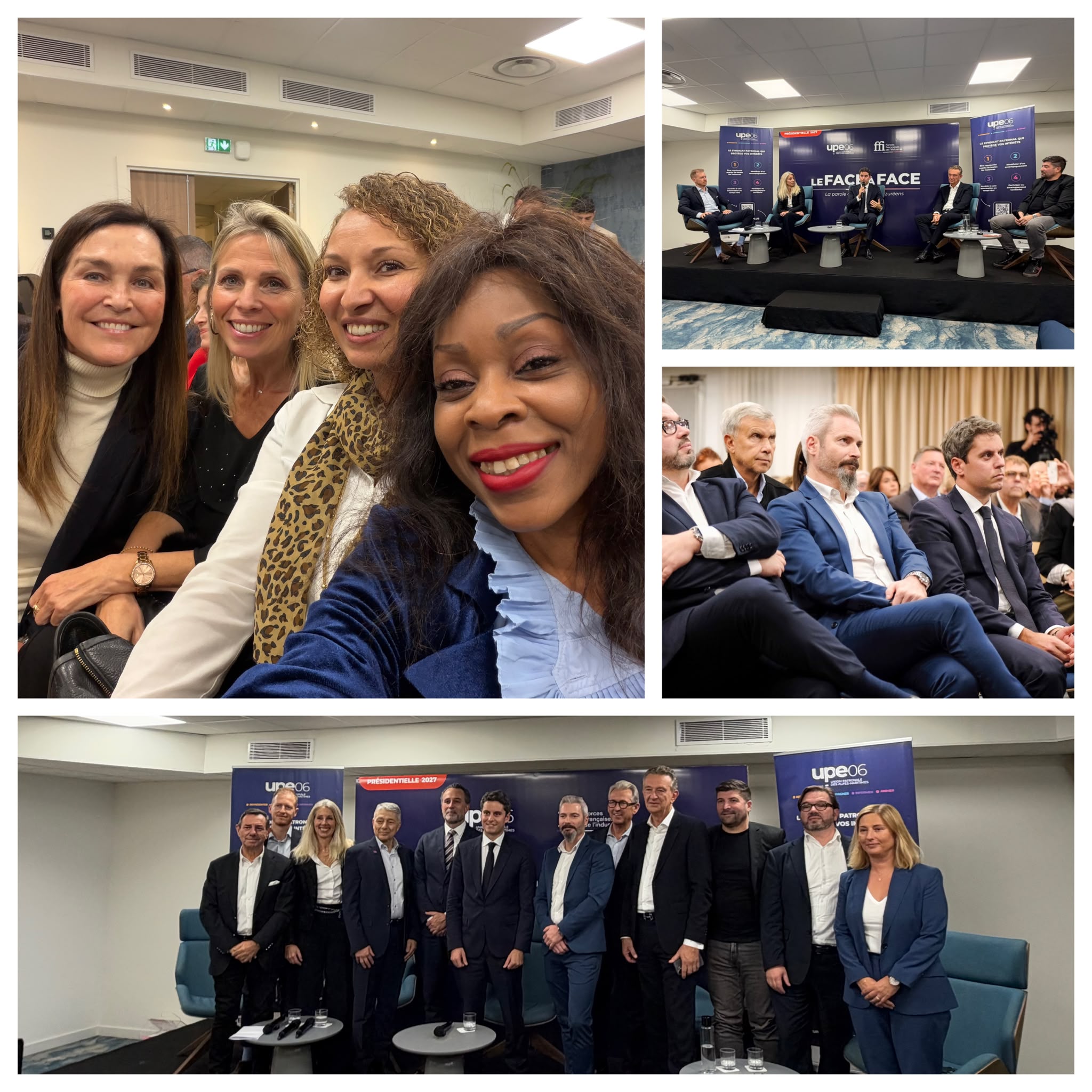
In Nice, on November 7, 2026, the Union pour l’Entreprise des Alpes-Maritimes (UPE06) and the Forces Françaises de l’Industrie inaugurated a series of meetings with candidates for the 2027 presidential election. First guest, Gabriel Attal, former Prime Minister and Secretary General of Renaissance, answered questions from entrepreneurs in the French Riviera. A non-partisan initiative aimed at confronting political projects with field experience.
When entrepreneurs question those who want to govern
Manufacturing in France, preserving know-how and continuing to export. For industrial companies, these ambitions face increasingly strong economic constraints. In Grasse, Stéphane Roux, director of Parfumerie Galimard, testifies to this: his family business markets its perfumes internationally, but must cope with rising production costs and solicitations from foreign partners proposing to relocate certain manufacturing stages.
“We want at all costs to remain a French brand, to continue manufacturing our perfumes in Grasse. But it’s becoming increasingly difficult,”
he explains. This question, asked on Saturday, November 7 at the Radisson Hotel Nice Airport, sums up the interest of the first “Face to Face” organized by UPE06 and the Forces Françaises de l’Industrie (FFI).
I attended this inaugural meeting with Gabriel Attal. Throughout the exchanges, one thing became clear: behind national economic proposals are business leaders facing immediate decisions about investment, employment, financing or succession. It is this dialogue between political ambition and entrepreneurial experience that the organizers wanted to establish.
A non-partisan approach led by UPE06 and FFI
From the opening, Franck Cannata, president of UPE06, presented the philosophy of this consultation cycle. “Our approach is non-partisan,” he insisted. The main candidates must be received according to the same guiding principle: how to free up initiatives, create value and strengthen companies’ capacity to prepare for the future?
“We are not asking to be heard out of courtesy, but because we are part of the solution,”
Franck Cannata reminded. The discussions are based on UPE06’s contribution, “The 10 challenges to make France the best country for entrepreneurship,” derived from concerns expressed by economic actors in the region.
Laurent Moisson, representative of the Forces Françaises de l’Industrie, emphasized that economic debates readily give voice to political leaders and economists, but more rarely to those who create companies and jobs. Moderated by Laurent Moisson and Jean-François Puissegur, the exchanges chose a direct approach, without long introductory speeches. Claire Peradotto, involved in UPE06 in promoting entrepreneurship and host of Go Boost, opened the questions on the desire to do business in France.
Taxation and simplification: a need for stability
The first interventions revealed constant concerns: instability of levies, accumulation of standards, slow procedures and difficulty in anticipating public decisions. Gabriel Attal acknowledges the limitations of successive simplification policies. He proposes going further than adjusting existing mechanisms, by rewriting certain regulatory frameworks.
For labor law, he envisions a “constitution of labor” of about fifty pages, establishing the main principles, while a larger share of the rules would be negotiated at the branch and company level. He also advocates a principle of administrative speed, with tacit acceptance of certain requests in the absence of a response within two months, as well as a limitation of cumulative appeals on economic projects to eighteen months. Their implementation would require clarifying legal guarantees and exceptions, particularly regarding environment and safety.
On the fiscal front, the former Prime Minister wants to pass a ten-year economic and fiscal programming law as early as summer 2027. He proposes reversing several tax increases that occurred since 2024 and reducing the corporate value-added contribution (CVAE). The question of financing and the real scope of such a commitment, beyond political alternations, remains open.
Economic patriotism: Cédric Messina questions sovereignty
Cédric Messina, Nice-based entrepreneur and founder of MyCoach, recounted difficulties faced against an American competitor in a market linked to the Olympic Games. His account questions the gap between declarations of support for French innovation and concrete decisions.
“Do you still believe in economic patriotism?” he asks.
Gabriel Attal responds with a project for strengthened European integration. He advocates for a “United States of Europe” on the economic, technological and ecological levels, with a capital markets union, European preference in public procurement, and requirements for partnerships and technology transfers for certain foreign establishments. He believes France cannot respond alone to American and Chinese competition. These orientations would, however, require complex arbitrations between member states and compatibility with international trade rules.
In Grasse, manufacturing and transmission of know-how
The intervention of Stéphane Roux, for Parfumerie Galimard, gave this debate a territorial dimension. His company wants to preserve production rooted in Grasse, while remaining competitive against countries where costs and tax incentives differ. He also mentioned difficulties in transmitting family businesses and the risk of seeing know-how fall under the control of large foreign groups.
Gabriel Attal cites several levers: production taxes, labor costs, standards and energy. He notably proposes an electricity price of 50 euros per megawatt-hour for manufacturers exposed to international competition. He also announces future measures on succession, without detailing all the modalities during this meeting. The discussion recalls that the issue goes beyond mere capital ownership: it also affects jobs, skills and local decision-making centers.
Energy transition: Élodie Bondi raises industrial questions
Élodie Bondi, co-president of French Tech Côte d’Azur and CEO of Qualisteo, a company specializing in measuring and optimizing energy consumption, questioned Gabriel Attal about energy availability, its cost and financing decarbonization. For industrialists, these three questions directly condition investment.
The former Prime Minister advocates a strategy combining nuclear revival and renewable energy development. He presents the gradual phase-out of fossil fuels as a sovereignty requirement as much as an environmental objective. It remains to define the financing and implementation conditions for increased electrification of the economy, as well as those of the industrial tariff he proposes.
Housing, apprenticeship, public procurement: territorial constraints
The exchanges also recalled the specificities of the Alpes-Maritimes. Housing costs limit recruitment possibilities and weigh on job attractiveness, even when wages exceed the minimum wage. Gabriel Attal acknowledges the difficulties of the real estate sector and announces a private rental investment revival program.
On apprenticeship, he advocates more targeted aid according to company size and qualification levels, while criticizing certain cross-cutting funding reductions. Pierre Mario, representative of the construction sector, questioned him about access of very small and small businesses to public procurement. Gabriel Attal mentioned a 30% cash advance for SMEs involved in orders from major public buyers. Restaurant owners, for their part, raised tourism competitiveness, recruitment and the place of innovation in this sector.
Pensions and innovation financing: the savings question
Adina Grigoriu, founder and CEO of Active Asset Allocation, questioned Gabriel Attal about developing funded pensions and mobilizing savings to finance companies. The candidate wants to expand existing mechanisms and notably proposes an initial endowment of 1,000 euros at each birth in a long-term savings mechanism, as well as a mandatory allocation of 50% of profit-sharing and employee participation toward retirement savings.
He sees this as a way to develop capital available for innovation. But this orientation calls for an analysis of transition costs, financial risks and intergenerational equity. The return comparisons he presented during the meeting should be considered as political arguments, not as results guaranteed for all savers.
Artificial intelligence: an apprentice’s question about the future of employment
One of the last questions came from Candice, a young apprentice, who mentioned the difficulties of entering a job market that simultaneously demands diplomas, experience and rapid adaptation. Gabriel Attal emphasized the transformation of professions under the effect of artificial intelligence and announced a proposal: train 30 million French employees in AI over five years, particularly through existing professional training mechanisms.
This intervention particularly caught my attention. While acquiring digital skills has become essential, it is not enough, on its own, to transform an organization. Productivity gains also depend on redefining processes, governance, management and the ability to integrate tools with business needs. The challenge is therefore not only to train more, but to translate this training into value creation, professional development and strategic autonomy.
A new dialogue method to test over time
By giving voice to leaders from very different sectors, this first meeting went beyond the format of a program presentation. The speakers confronted Gabriel Attal with situations observed in the field: risk of relocation, international competition, energy transition, cash flow, training and employment. The candidate’s responses reveal several economic choices, whose financing and implementation conditions will need to be the subject of additional debates.
The merit of the initiative by Franck Cannata, UPE06, Laurent Moisson and the Forces Françaises de l’Industrie lies in its method: listening to entrepreneurs, asking common questions to candidates and enabling a reasoned comparison of responses. Its impact will depend on the diversity of invited personalities and the continuity of dialogue.
Leaving this first meeting, I retain less a succession of announcements than a requirement: an economic policy must be measured not only by its intentions, but also by its feasibility and its effects for the companies responsible for implementing it. By opening this “Face to Face” in Nice, UPE06 gives a concrete place to entrepreneurial experience in the 2027 presidential debate.
Pascale Caron | AI Strategy Advisor | International Keynote Speaker | Co-author of EntrepreneurIA