Entrenched conflicts, mounting state debt, and accelerating technological investments: in Monaco, Jean-Pierre Petit describes a resilient global economy nonetheless subject to growing financial constraints. Behind his market analysis lies a question directly relevant to business leaders: how can transformation efforts be sustained when resources become harder to mobilize?
By Pascale Caron
“The global economic situation is not too badly oriented.”
After a lengthy analysis of conflicts and a harsh diagnosis of France, Jean-Pierre Petit’s statement may come as a surprise. Yet it expresses the thread running through his conference: the accumulation of risks alone does not explain the economy’s trajectory. Companies adapt, technology supports investment, and profits enable some players to continue their development. This resilience, however, offers no protection against imbalances or financial corrections.
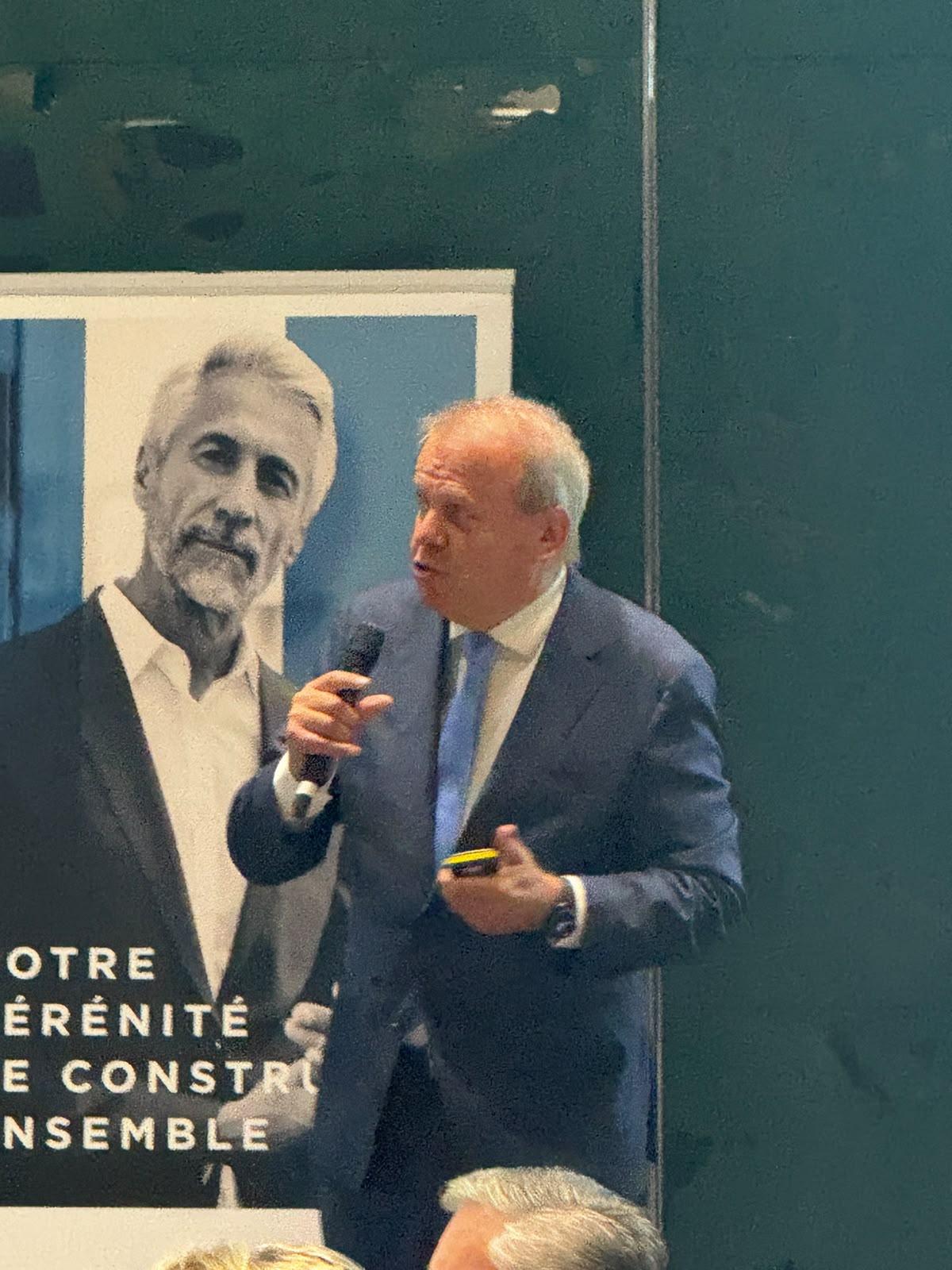
Invited to Monaco by the Monaco Economic Board and Jutheau Husson, the president of Les Cahiers Verts de l’économie examines the relationships between geopolitics, public finances, growth, and markets. His remarks blend economic analysis, forecasts, and forthright political judgments. It’s important to distinguish these registers: his scenarios describe developments he considers probable, while his institutional critiques reflect an interpretation. Beyond the occasionally polemical tone, his presentation questions the economic conditions under which states and companies must prepare their future.
Conflicts that reshape investment conditions
Jean-Pierre Petit places the beginning of a lasting deterioration in global conflict around September 11, 2001, following the peace dividends of the 1990s. He emphasizes the persistence of historical motivations: territorial ambitions, imperial aspirations, ideological rivalries, and control of resources. Commercial interdependence has therefore not eliminated power relations. In his analysis, it also provides new means of pressure through supply chains, infrastructure, and restrictions on access to certain technologies.
Critical minerals occupy an important place in this reasoning. He recalls that needs concern rare earths but also other materials, including copper. Energy, digital, and military transformations depend on concrete industrial capacities. For a company, this reading invites examination of supply chain robustness as much as market potential. A strategy may be commercially sound yet undermined by a dependency difficult to circumvent. Geopolitical risk thus enters into the very construction of investment choices.
The duration of wars constitutes a second point of attention. Drawing on Clausewitz, Jean-Pierre Petit emphasizes survival stakes, adversary resistance, and the political difficulty of accepting non-victory.
“Duration feeds duration,” he summarizes.
Elapsed time can increase the political cost of withdrawal and prolong hostilities. The proliferation of drones reinforces, in his view, this difficulty: it makes certain means of combat more accessible without guaranteeing a rapid outcome. Waiting for tensions to disappear thus becomes an uncertain hypothesis for decision-making.
Understanding the mechanisms behind shocks
The speaker devotes increasing attention to hybrid warfare. He describes its manifestations: cyberattacks, sabotage, disinformation, economic pressures, and trade restrictions. These forms of action maintain ambiguity and complicate the victim’s response. He poses three questions:
“Who is acting? Is it really an attack, and should we retaliate?”
For companies, this uncertainty means that an activity can be affected by a confrontation without being located in a territory directly at war.
His examination of tensions around Iran and the Strait of Hormuz illustrates an approach centered on economic mechanisms. He distinguishes theoretically exposed oil volumes from actually blocked quantities. Rerouting, strategic reserves, and consumption adjustments can mitigate a shock without eliminating it. His conclusion therefore does not minimize the conflict but refuses an automatic translation of each military escalation into an extreme energy price scenario. The scale of disruptions and their duration remain decisive.
He also seeks constraints likely to favor a resumption of negotiations. On the American side, he notably considers the economy and markets. On the Iranian side, he highlights internal difficulties and the plurality of power centers. He envisions discussions without deducing a lasting peace:
“That won’t prevent the continuation of the war.”
This distinction deserves leaders’ attention. A temporary improvement may facilitate activity without justifying abandonment of the disruption scenarios on which company preparation rests.
This approach also leads to distinguishing forecasting from preparation. A central scenario helps organize a decision, but it doesn’t cover all possible developments. For a leader, the challenge is to identify the most sensitive dependencies and the conditions under which they would become critical. A variation in energy prices, an additional delay, or a trade restriction can modify a project’s profitability without undermining its fundamental merit.
Institutions facing their capacity for action
The conference extensively addresses the weakening of democracies. “Democracies can die,” warns Jean-Pierre Petit, who criticizes slow decision-making, corporatism, and the transfer of certain powers to unelected authorities. His assessments of French and European institutions are particularly severe. They constitute a political reading of economic difficulties, whose causal links are not demonstrated by the presentation alone. The question raised nonetheless remains important: how can lasting capacity for action be maintained in societies traversed by contradictory interests?
For companies, the issue concerns rule predictability as much as administrative speed. An unstable decision can complicate an investment even when made quickly. Regarding the United States, Jean-Pierre Petit actually relativizes the idea that opposition between the president and Congress would mechanically produce economic paralysis. He recalls that this configuration belongs to American history. His electoral scenario nonetheless leads him to monitor budget tensions, debt negotiations, and sectors exposed to political confrontations.
French debt at the center of concerns
The diagnosis of France is the most pessimistic of the presentation. Jean-Pierre Petit describes a combination of weak growth, high debt, and reduced fiscal room for maneuver. To explain debt dynamics, he emphasizes the relationship between nominal growth, average financing cost, and primary balance—that is, the budget balance excluding interest. The initial debt level also matters:
“It’s certainly harder when you’re at 120 than when you’re at 50.”
He distinguishes the rate on new borrowings from the average rate actually borne on total debt. Past issuances continue to produce their effects until refinancing. Rate increases therefore gradually transmit to public accounts. This inertia can delay deterioration without preventing it. In his analysis, a persistent primary deficit and insufficient growth maintain rising debt. Fragility thus sets in before a spectacular market tension makes it visible to the wider public.
Jean-Pierre Petit nonetheless distances himself from direct comparison with the Greek crisis. “We have a lot of savings,” he notes, mentioning a French resilience factor. He adds France’s weight in the eurozone and a different external situation. These elements don’t automatically correct budget imbalances, but they modify the nature of risk. His hypothesis of a crisis followed by European intervention should therefore be read as a scenario, not as an inevitable trajectory.
His concern extends beyond public finances. It touches investment, skills, productivity, and governance quality. “Everything is a question of governance,” he asserts. His critiques of collective behaviors are sometimes general, but they return to a precise economic question: what productive capacity will finance future needs? For a leader, this question invites consideration of available qualifications, infrastructure, and policy continuity, beyond immediately visible fiscal parameters alone.
Technology supports economic resilience
The contrast with his reading of the global economic situation is striking. Jean-Pierre Petit considers that several mechanisms have absorbed tensions: wealth effects, use of fiscal room for maneuver, and declining household savings in certain countries. This resilience is not uniform. Industrial structures and energy exposure produce different trajectories. A relatively favorable global indicator can thus coexist with significant difficulties in certain sectors, regions, or company categories.
Technology plays a central role in his explanation. “It’s tech,” he answers when he asks his audience about activities that have resisted. He highlights the economies involved in manufacturing equipment necessary for digital development. In the United States, he emphasizes corporate margins: “When you have high profits, you don’t lay off.” In his reasoning, these profits help preserve investment and employment. This is a macroeconomic mechanism he privileges, not a rule applicable without exception to every company.
He also links productivity growth to the capacity to absorb part of wage increases. This analysis doesn’t isolate AI’s specific contribution to observed gains. Rather, it underscores the importance of productive efficiency in the balance between growth and inflation. China, for its part, is presented through the contrast between export and technological dynamism, weak domestic demand, and real estate difficulties. For the eurozone, he distinguishes improvement in certain indicators from the French trajectory, which he considers worrying.
The cost of financing as the counterpart of acceleration
One of the most illuminating passages concerns real interest rates—that is, rates adjusted for inflation. Jean-Pierre Petit examines them notably through growth prospects and the balance between savings and investment needs. “If you have a shortage of savings relative to your investment needs, the real rate rises,” he explains. In this reading, capital demand matters as much as monetary decisions for understanding the tensions affecting economic financing.
Technological, energy, and geopolitical transformations simultaneously mobilize significant resources. Large technology companies’ investments participate, in his view, in this pressure: “It’s investment needs that drive up the real interest rate.” The formulation summarizes his interpretation of a dynamic also involving public deficits and international capital movements. It reveals a paradox: technology supports growth while contributing to increased financing needs that condition its own expansion.
This gap between immediate expenditures and future benefits is essential. Infrastructure must be financed before its economic effects fully materialize. Jean-Pierre Petit advocates a return to asset purchases by central banks to contain certain tensions: “We need to return to quantitative easing.” This position represents a monetary policy choice. His warning mainly concerns rate transmission throughout the economy, from public finances to real estate, companies, and equity markets.
The issue therefore doesn’t stop at the borrowed amount. Financing duration, expenditure timing, and expected revenue timing also determine an engagement’s solidity. A company may have an economically coherent project yet encounter a cash flow difficulty before its results materialize. This passage between decision and realization deserves specific attention, particularly when several transformations must be conducted simultaneously.
Financial discipline behind stock market enthusiasm
Regarding technology stocks, Jean-Pierre Petit refuses too simple an opposition between bubble and no bubble.
“A bubble can last for years,” he reminds.
The existence of high valuations alone doesn’t provide the timing of a correction. He examines IPO dynamics, earnings expectations, investor positioning, and price acceleration. He identifies signs of excess while highlighting differences from historical episodes to which current markets are frequently compared.
Among these differences, he notes investors’ ability to distinguish companies according to their results and cash flows. “They look at cash flows,” he insists. An investment expenditure can be depreciated in accounting over several years, while its financing immediately mobilizes liquidity. Behind technological promises thus remains a question of means: “Do you have the means to pay?” This question primarily targets listed companies whose investments he analyzes.
His market preferences reflect this combination of interest and vigilance. He maintains a “relatively constructive position on equities” while being “very cautious in the short term.” He mentions geographical and sectoral choices, an interest in gold, copper, and mining companies, as well as the place of cash. On bonds, he notably emphasizes rate sensitivity. These orientations depend on context and presented assumptions; they don’t constitute universal prescriptions for readers.
Financing the transformation period
For leaders, this conference’s interest extends beyond financial allocation. It invites looking together at dependencies, financing capacities, and decision horizons. Waiting for perfect visibility can delay a necessary evolution. Committing too many resources without room for adjustment can compromise its execution. Strategy must therefore specify the assumptions supporting investment and events likely to lead to its revision. This discipline allows maintaining ambition without transforming a forecast into certainty.
In the AI domain, I draw a particular question: how to finance the transformation period? This question extends Jean-Pierre Petit’s reasoning; it’s not a recommendation he himself would have formulated for SMEs. A project may be relevant yet mobilize too many resources before its first results. Conversely, a requirement for immediate profitability can prevent an important evolution. Value expected, operational stages, and actually available means must be examined simultaneously.
Expenditures concern tools but also data, integration, training, and practice evolution. The initial budget doesn’t summarize the complete commitment. Defining stages allows confronting promises with observed effects, then continuing, adjusting, or stopping. In this perspective, financial constraint becomes an element of project design, just like its utility. It compels specifying the transformation pace the organization can actually sustain.
This requirement also concerns governance. Who assesses intermediate results? Who decides to modify scope or slow expenditures? These responsibilities must be explicit for financial evaluation to truly accompany teams’ work. They allow treating gaps as information useful for decision-making.
The conference thus leaves an open question. In an environment Jean-Pierre Petit describes as resilient but under tension, what transformations can a company finance long enough to allow them to produce their value? The answer will depend on its resources and choices, but also on its capacity to distinguish a lasting ambition from an expenditure it cannot support until its results.