
AI creates capability. Why organizations create value
From AI capability to organizational transformation and value creation Pascale Caron AI Strategy Advisor | Founder & CEO, Yunova Consulting | Co-author of EntrepreneurIA It has never been easier to use artificial intelligence in business. In just a few months, tools have multiplied, uses have become commonplace, and experiments have spread across almost all functions....

In the age of AI, our scarcest resource may no longer be technology
Invited to the NeuroMynds Visionary Roundtable in Monaco, I participated in a discussion bringing together profiles from finance, healthcare, technology, law, entrepreneurship, engineering and sustainable development. Behind very different issues, the same question gradually emerged: in organizations increasingly augmented by artificial intelligence, what happens to attention, trust and our ability to cooperate ? On September...
AI in business: the missing link between productivity and value creation
A report by the United Nations Independent International Scientific Panel on Artificial Intelligence raises a question that should directly interest business leaders: who actually captures the value created by AI? Behind this question lies a much broader problem. Companies have invested heavily in accessing technologies, adopting them, and multiplying use cases. But they still have...
What does AI know about your company after 1,000 conversations?
An AI becomes more useful when it knows your business. But what happens when the combination of mundane information reveals context that no one has explicitly provided? A business leader uses artificial intelligence daily. One Monday, he asks it to prepare a negotiation with a supplier. A few days later, he analyzes with it the...
AI 2027: is the real risk superintelligence or the power we give to AI agents?
What if the real risk were not just superintelligence, but the power of action we grant to AI agents? AI 2027 imagines a loss of control of systems that have become superior to humans. Yoshua Bengio shifts the debate toward agency. For companies, the question is already concrete: an AI can be capable of acting...
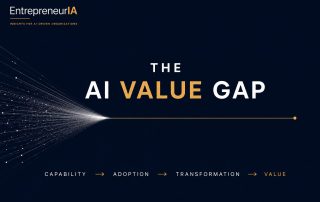
The AI value gap: why AI works but doesn’t always create value
Artificial intelligence works. It analyzes documents, generates content, synthesizes information, detects anomalies, automates certain tasks and is now beginning to act through agentic systems capable of chaining multiple operations. Yet as these capabilities advance, another question becomes central: Why do companies with high-performing AI technologies not always manage to transform this technological power into measurable...