
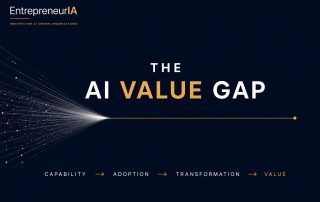
The AI value gap: why AI works but doesn’t always create value
Artificial intelligence works. It analyzes documents, generates content, synthesizes information, detects anomalies, automates certain tasks and is now beginning to act through agentic systems capable of chaining multiple operations. Yet as these capabilities advance, another question becomes central: Why do companies with high-performing AI technologies not always manage to transform this technological power into measurable...
When companies adopt AI faster than they can transform
What if the next AI risk for businesses was no longer just moving too slowly, but moving faster than the organization itself? In the sample studied by the Boston Consulting Group, 61% of CEOs surveyed believe their board of directors is pushing artificial intelligence transformation too quickly. This finding comes from the global study CEOs...

Does Europe still need new accelerators?
Why does Europe produce so many startups, incubators, and innovation programs, yet so few tech champions capable of scaling? The question goes far beyond funding young companies. It concerns how territories choose their priorities, organize their capabilities, and transform technological experiments into sustainable industrial capacities. For François Hoehlinger, the question is no longer about creating...

Why AI Could Weaken Corporate Judgment
Artificial intelligence was meant to save us time. It sometimes seems to produce the opposite effect. Generative tools enable us to summarize faster, write more, multiply analyses, and accelerate exchanges. Yet the time saved is not always transformed into space for reflection. It is often absorbed by new tasks, higher targets, and an intensification of...

AI ROI: Why Technology Alone Isn’t Enough to Create Value
After several years of experimentation, the return on investment of artificial intelligence has become a central concern for executive management. Companies can no longer simply accumulate proofs of concept, generative assistants, and demonstrators. They must now answer a more demanding question: what economic value does artificial intelligence actually produce? A study published on July 15,...

AI is no longer an IT issue. It is becoming a board responsibility.
The five principles published by KPMG International and INSEAD in April 2026 show that artificial intelligence governance is now part of boards' ordinary mandate. By Pascale Caron For several years, artificial intelligence was presented to boards of directors as primarily a technological subject. IT departments, innovation teams, and business units conducted experiments. The board monitored...