 Why does Europe produce so many startups, incubators, and innovation programs, yet so few tech champions capable of scaling? The question goes far beyond funding young companies. It concerns how territories choose their priorities, organize their capabilities, and transform technological experiments into sustainable industrial capacities.
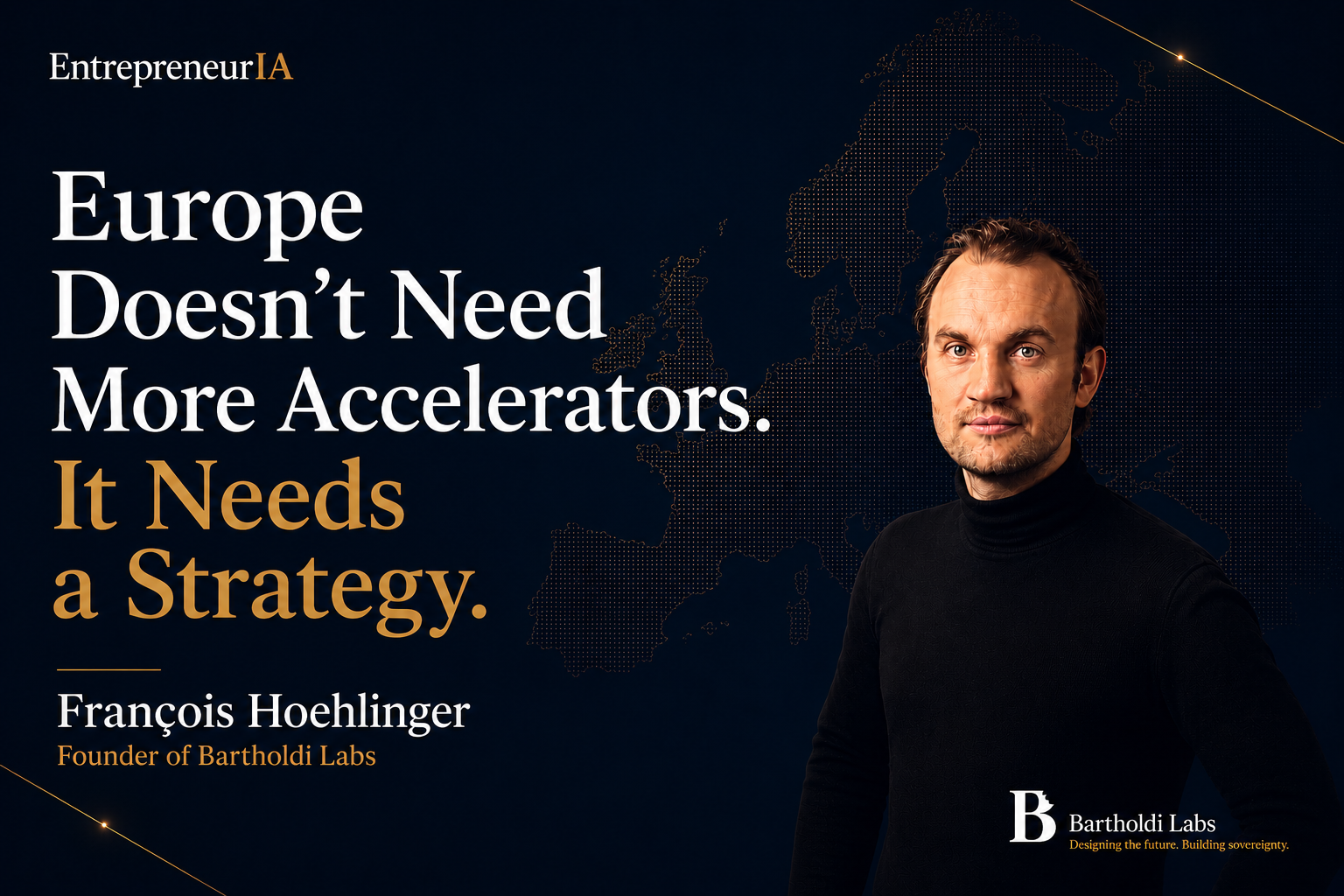
For François Hoehlinger, the question is no longer about creating another accelerator. It’s about knowing which project to develop, with which companies, and in which territory.
“Territories or companies whose sole objective is to develop an accelerator are fighting the wrong battle. Creating innovation and excellence centers, dedicated particularly to breakthrough technologies (AI, Quantum, Cyber, Dual-use), these are the real challenges and they are both industrial and territorial.”
His entire reasoning is captured in this principle: an accelerator is not a strategy. It only becomes useful when it fits within a clearly defined economic, industrial, and territorial direction.
Created in March 2026, Bartholdi Labs aims to intervene precisely at this juncture. The structure combines strategic consulting, technological implementation, and ecosystem facilitation. It works primarily with SMEs, mid-sized companies, and certain large groups, but also with territories seeking to better structure their innovation policy.
The discussions initiated in Sophia Antipolis and the projects developed in Albania illustrate this vision. In both cases, François Hoehlinger advocates the same method: start from existing resources, identify a credible specialization, and organize the concrete conditions for its development.
American models don’t automatically transfer
After experiences in consulting, mobility, and international development, notably at Simon-Kucher, FlixBus, and Troopy, François Hoehlinger joined Plug and Play Tech Center as Senior Director France & Smart Cities. This experience plays a decisive role in the creation of Bartholdi Labs.
He observes the limitations of directly transposing American models to the European market. The divergences particularly concern sovereignty, the commercialization of American solutions in Europe, and understanding local networks.
“Europe develops and functions through the richness and specificities of its territories. To better understand their complexities, you must be known, recognized, and find the right angle of collaboration with these territories”
A performing technology is not enough. It must find customers, partners, funding, and skills. It must sometimes also rely on public actors. Above all, it must adapt to a regulatory and industrial environment that varies significantly from one European country to another.
Europe does not constitute a uniform market. It combines economic cultures, administrations, financing systems, and different professional networks. A method that works in California cannot therefore be reproduced identically in France, Albania, Greece, or Poland.
It is from this observation that he builds his project.
From diagnosis to implementation
Bartholdi Labs structures its activity around three components: strategic consulting, operational implementation of solutions, and ecosystem facilitation.
“We enter with our clients through support and then tool delivery, in order to make our action concrete. We facilitate ecosystems in parallel, to remain always relevant on existing technologies, but also help territories to better specialize in order to better compete on a global scale”
Consulting allows understanding the company’s needs, analyzing its processes, and identifying projects capable of producing measurable value.
Bartholdi Labs generally starts with a 90-day audit. The objective is to distinguish projects capable of creating real value from those that mobilize time and budgets without producing concrete results. The expected decision is deliberately clear: deploy or stop.
This addresses a frequent difficulty. Under market pressure, some organizations launch proofs of concept before having precisely defined the problem to solve. Tools are chosen before objectives. Projects accumulate, but rarely remain integrated into operations. Bartholdi Labs wants to reverse this logic. The structure starts from the need, then examines existing solutions. When an adapted technology is available, it can be purchased and integrated. When it doesn’t exist, it can be developed.
François Hoehlinger then speaks of a choice between “make” and “buy.”
Implementation constitutes the second step. It’s no longer just about recommending, but building, integrating, and maintaining solutions.
A technology strategy is only valuable if it genuinely transforms the company: its processes, decision-making, or execution capacity. The consulting report is therefore only a starting point.
A technology team is already based in Albania. It works on artificial intelligence, data architecture, technical infrastructures, product creation, and their maintenance.
To intervene in sectors as varied as defense, cybersecurity, energy, mobility, or health, Bartholdi Labs relies on a network of consultants and experienced executives, accustomed to managing complex projects.
SMEs facing the risk of misdirected innovation
Unlike many accelerators, Bartholdi Labs does not make startups its priority. François Hoehlinger assumes this without ambiguity:
“Our priority target remains SMEs and large mid-sized companies because they represent the backbone of the European economic fabric, and must not be the forgotten ones of this technological disruption”
Startups can be supported within ecosystems or occasionally receive advice. However, they do not represent the core of the business model.
This choice addresses a significant difficulty for European companies. SMEs and mid-sized companies don’t just risk staying on the sidelines of innovation. They can also adopt it too quickly, without having evaluated the strategic consequences.
A company can invest in an attractive tool, but poorly adapted to its processes. It can multiply experiments without managing to industrialize them. It can also depend on a supplier whose architecture, data, or future operating conditions it doesn’t control. Artificial intelligence makes these risks more visible.
Adopting a generative assistant does not constitute an AI strategy. The leader must also examine data quality, security, integration with existing systems, maintenance conditions, and supplier dependency.
For François Hoehlinger, sovereignty must therefore become an operational question.
“Sovereignty is above all an approach that must combine a sovereign cloud, data stored on-site, and finally a powerful cybersecurity lock”
Sovereignty is not limited to the nationality of a provider. It is measured in contracts, infrastructures, data location, technological components, and the ability to maintain the solution over time. For leaders, the question is therefore no longer just: “Which tool to adopt?” It becomes: “What capability do we really want to build?”
The accelerator is the tool of a broader industrial policy
It is on territorial strategies that François Hoehlinger’s thinking takes on its full scope.
When a government or local authority announces wanting to create an accelerator, his first reaction is not to immediately propose a program. He first seeks to understand the economic project. Which companies does the territory want to attract? What industrial needs does it want to solve? What skills does it already possess? What domain can it develop with genuine credibility? Which customers will be likely to buy the technologies produced?
Without answers to these questions, an accelerator risks becoming another host structure, without differentiation or sufficient outlets.
François Hoehlinger cites Station F as an example that is both successful and incomplete. He recognizes its ability to concentrate startups, investors, and large companies.
“While Station F is a formidable flagship of French tech, it lacks clear positioning and a revenue model that encourages other territories to launch.”
The problem lies in the next step. What happens after hosting startups? Where will the technologies be developed? Where will the industrial teams be installed? Which territories will actually benefit from the jobs, infrastructures, and value created?
Europe cannot be satisfied with grouping innovative companies in a few emblematic places. It must also organize a coherent distribution of capabilities. Estonia, Poland, Greece, Albania, or France do not have the same advantages. Therefore, each country should not seek to reproduce exactly the same programs. A coherent innovation policy could thus identify the domains in which each territory possesses a scientific, industrial, energy, or geographic base strong enough to build a specialization.
Albania, laboratory for another territorial strategy
Albania probably constitutes the most enlightening example of this vision. Bartholdi Labs is working there on creating a reception and establishment facility, or “landing pad,” intended to receive foreign SMEs, particularly Austrian and Serbian.
The project’s interest lies mainly in the method. Albania should not seek to become a reduced copy of France, Germany, or the United States. It must identify what it can offer distinctively. According to François Hoehlinger, the place of hydroelectricity in the Albanian energy system could become an attractiveness factor for certain digital or industrial activities that are highly electricity-consuming. Building a building or opening an accelerator is not enough. The challenge is to build a genuine territorial proposition combining energy, infrastructures, companies, services, and skills. One country could specialize in cybersecurity. Another in energy technologies. A third in certain medical or dual applications.
Behind this idea, European sovereignty does not assume that each country alone masters all technologies. It can rest on complementary specializations, provided that Europe collectively maintains control of its critical functions. For François Hoehlinger, Europe will not win by reproducing everywhere the same incubators, the same accelerators, and the same programs. It will progress if it manages to better organize its differences.
Choosing rather than dispersing
François Hoehlinger carries a severe diagnosis on Europe’s ability to compete with the United States in all technological domains. He estimates that the continent could play a “minor role” in certain markets, particularly due to gaps in funding and deployment capacity. Behind this observation lies a broader question: should Europe seek to be present everywhere or concentrate its resources on sectors in which it still possesses solid advantages? He particularly cites dual defense, cybersecurity, certain medical technologies, energy, and sovereign technologies.
For him, Europe will have to accept making choices. It will have to concentrate its efforts on sectors where it still has industrial advantages, support territories capable of developing them, and accept that certain technologies be purchased rather than developed locally. Not all artificial intelligence projects deserve to be deployed. Not all tools will create a competitive advantage. Not all experiments should be prolonged. The ability to stop a project becomes as important as the ability to launch it.
This is precisely the logic of the 90-day audit advocated by Bartholdi Labs: decide quickly, based on economic and operational criteria, whether to deploy or interrupt.
A vision now confronted with execution
Bartholdi Labs remains a recent structure. Created in March 2026, it carries a European ambition that must still be confirmed by its results. The company is considering development in Spain, Italy, and German-speaking countries. The model’s relevance will need to be evaluated on several points.
Will the audits enable SMEs to make better decisions? It is on these achievements that the model’s credibility will be judged. Finally, the promise of sovereignty will need to be examined in practice. Will data be better controlled? Will technological dependencies be reduced? Will solutions be maintainable in Europe?
François Hoehlinger summarizes his positioning with a clear statement:
“I’ve spent the last fifteen years operating, it’s time now to be able to put this ambition within a common European cause.“
This ambition must now be measured against results. Bartholdi Labs will be judged on its ability to transform this vision into concrete achievements. Because Europe no longer lacks accelerators.
Perhaps what it lacks most is direction.