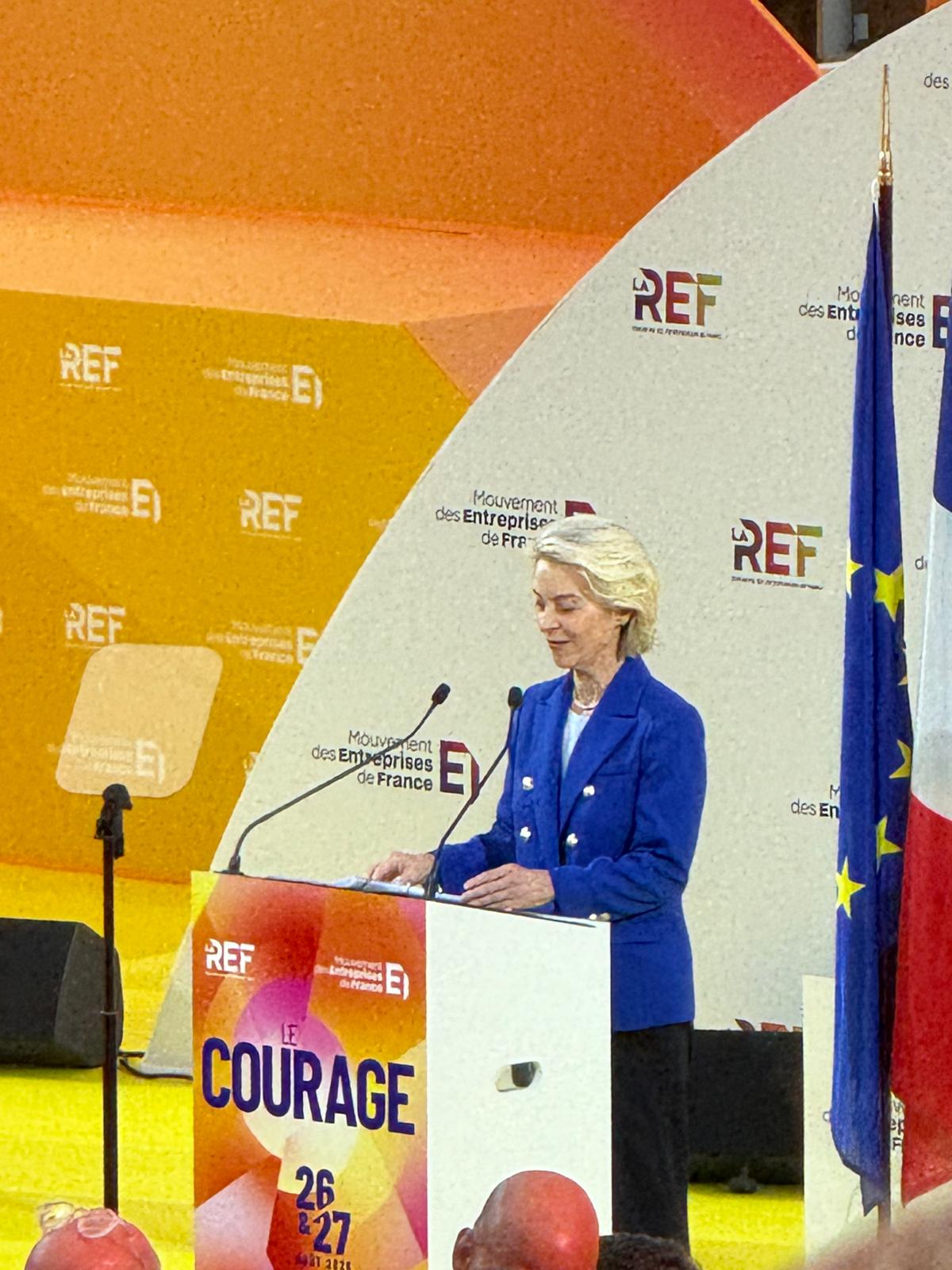
At La REF 2026, on August 27 at Roland-Garros, Ursula von der Leyen delivered a speech to French entrepreneurs that goes far beyond the question of competitiveness. The President of the European Commission starts from an observation: the conditions that have supported the European economic model for several decades are being profoundly challenged. Energy, China, financing, single market, skills, industry and artificial intelligence: Europe is now seeking to combine its market- and rules-based model with a new requirement for industrial and strategic capacity. One question remains: will it be able to transform its resources into value creation quickly enough?
At Roland-Garros, Ursula von der Leyen did not simply come to explain to French entrepreneurs that Europe needed to become more competitive. She came to tell them something more profound: the conditions on which the continent built part of its prosperity can no longer be taken for granted.
“These certainties have disappeared.”
The sentence comes in the first minutes of her speech.
The President of the European Commission has just listed five pillars that have long supported the continent’s economic model: “imported and cheap energy, open global trade, growing access to the Chinese market, American strategic protection and Western technological leadership.”
This observation gives coherence to the twenty-seven minutes that follow.
Ursula von der Leyen is not proposing to abandon the foundations of the European model. The single market, competition, trade openness, climate transition and the rule of law remain at the heart of her speech. But she adds another dimension to them: economic security, industrial policy, resilience, technological capabilities and reduction of dependencies.
The ambition is summarized in three verbs: making Europe “a continent that produces, invests and protects.”
This triptych marks an important evolution. Behind the announced measures appears a much more fundamental question: how to transform European capabilities into real economic power?
From potential power to capacity for action
Europe does not lack assets.
Ursula von der Leyen recalls at the end of her speech the existence of a market of 450 million consumers, world-class companies, a skilled workforce, research that still represents, according to her, 20% of global research and development spending and abundant savings.
The European problem lies elsewhere. It lies in the capacity to transform these resources into investment, production, growth and companies capable of scaling up.
This orientation explicitly follows in the wake of Mario Draghi’s report on European competitiveness, to which Ursula von der Leyen refers: “Mario Draghi has shown the way.”
The speech at La REF translates this diagnosis into economic policy: simplify rules, mobilize savings, complete the single market, enable companies to scale up, reduce energy costs, develop technological infrastructure, spread artificial intelligence, strengthen skills and secure supplies.
The diagnosis is largely established. The difficulty begins with its execution.
Simplify without abandoning the rules of the game
On rules and competition conditions, Ursula von der Leyen puts the problem simply: “European companies cannot pay twice.”
Once by bearing rules that are too complex. A second time by facing competitors who do not necessarily bear the same costs.
The Commission is targeting a 25% reduction in administrative burdens for all companies and 35% for SMEs by 2029. The twelve simplification packages mentioned in the speech would represent approximately 17 billion euros in savings per year. Six would have already been agreed upon, for approximately 6 billion.
But the President of the Commission also refers Member States to their responsibilities. Simplifying at European level will have little impact if governments add their own constraints when transposing texts.
The subject may seem administrative. It is in reality strategic. European regulation is no longer only evaluated with regard to the protections it provides. It must also be questioned on its capacity to enable companies to invest, innovate and grow.
Europe is therefore not abandoning its regulatory model. It is seeking to better articulate rules and competitiveness.
China: when dependence becomes an economic risk
This search for balance also appears in the relationship with China.
Ursula von der Leyen maintains the European doctrine of de-risking, not decoupling. China remains “a major economic partner.” But being a partner, she specifies, “does not mean accepting permanent imbalances.”
According to the figures cited in her speech, European imports from China have increased by 45% in five years while European exports are decreasing. The trade deficit would now reach nearly one billion euros per day.
The question becomes even more strategic when she addresses critical raw materials. European dependence would exceed 80% for several of them and 90% for certain rare earths.
Yet these dependencies, Ursula von der Leyen points out, can be used as means of pressure.
A supply chain is therefore no longer evaluated solely according to its cost and efficiency. It must also be assessed according to its resilience and the geopolitical risk it represents.
“Our market remains open, but openness requires security, fairness and reciprocity,” she states.
This is not the end of European trade openness. It is an openness now more conditional on economic security.
Europe has savings, but does it finance its growth sufficiently?
Financing is probably one of the most important passages of the speech for entrepreneurs.
Europe would lack “neither technology nor savings.” What it still lacks, according to Ursula von der Leyen, is the capacity to grow its companies.
Too many projects remain blocked because the initial investment is too risky, demand too uncertain or capital too expensive. European companies then go elsewhere to find the financing necessary for their development. Some shift their center of gravity. Others are bought out.
Ursula von der Leyen cites a considerable figure: 10,000 billion euros of European household savings would remain in bank deposits.
“This savings is lazy,” she says.
The formula designates a major paradox. Europe has capital, but it still struggles to channel it sufficiently towards financing innovation and especially scaling up.
The Savings and Investment Union must respond to this weakness. The various proposals presented could, according to the Commission, release up to 470 billion euros in additional investments.
Ursula von der Leyen adds another level: “The next budget will be the financial arm of our independence.”
More than 450 billion euros from the European Competitiveness Fund and Horizon Europe programs should, according to the presented project, support the entire chain: “from research to innovation, from laboratory to company, from first prototype to industrial production.”
This formula summarizes an essential part of the European problem.
Europe knows how to produce knowledge. It must demonstrate that it also knows how to industrialize it.
EU Inc.: solving the European scaling problem
The same difficulty is found in the single market.
Thirty years after its creation, it remains fragmented in services, energy, telecommunications, finance and digital.
Ursula von der Leyen cites a striking comparison: some internal obstacles would produce effects equivalent to customs duties that could reach 45% for goods and 110% for services.
“These are levels we would never accept from a trading partner. Yet we still tolerate them between Europeans.”
The most concrete answer presented to entrepreneurs has a name: EU Inc.
The project is part of the future “28th regime,” designed to offer a common European framework in addition to national systems. The announced ambition is strong: enabling the creation of a company in 48 hours, for less than 100 euros, entirely online and without minimum capital, in a framework common to the Union.
For entrepreneurs, the challenge goes beyond administrative simplification.
A European startup can theoretically access 450 million consumers. In practice, its scaling up remains confronted by a multitude of legal and administrative frameworks.
Europe therefore has a single market. It does not yet fully have a single entrepreneurial experience.
The Commission also wants to thoroughly review its rules on concentrations in order to better integrate investment, innovation, resilience and global competition. The objective is explicit: enabling European companies to grow in Europe and become global leaders.
The question then becomes sensitive: how to preserve effective competition within the Union while enabling the emergence of players capable of competing with American and Chinese giants?
Skills, the link between technology and productivity
Scaling up, however, does not depend solely on capital or regulation. It also depends on the women and men capable of driving transformation.
Ursula von der Leyen recalls that nearly two out of three SMEs report being unable to find the skills they need.
The Commission is due to present a package on fair labor mobility in the autumn, including notably the strengthening of the European Labour Authority, a European social security passport and measures designed to facilitate the recognition of skills and qualifications in the Union.
These issues are directly linked to technological transformation.
Europe can build computing capabilities, finance models and develop digital infrastructure. Without skills capable of integrating them into production processes and organizations, these investments will not automatically become productivity.
Human capital thus constitutes the link between technological capacity and value creation.
Energy and AI: two now inseparable infrastructures
On energy, the diagnosis is particularly severe.
Ursula von der Leyen describes it as “the first brake on our competitiveness and our independence.”
According to the figures cited in her speech, European prices remain two to three times higher than in the United States and China. More than half of the energy consumed in Europe still depends on imported fossil fuels.
The response is based on accelerating low-carbon production and electrification.
More than 70% of European electricity would already be produced from low-carbon sources, thanks to renewables and nuclear. But electricity still represents only about a quarter of final energy consumption.
The necessary infrastructure must still be available. The Union would have installed more than 80 gigawatts of renewable capacity last year, while a capacity six times greater would still be waiting to be connected. Ten terawatt-hours of renewable electricity would have been lost due to lack of grid or storage, equivalent to the annual consumption of approximately three million households.
The connection between this sequence and the one immediately devoted to artificial intelligence reveals another strategic dependence.
A strong European ambition in AI requires computing infrastructure. This requires semiconductors, data centers and networks, but also abundant, stable and competitive energy.
The European ambition for technological sovereignty cannot therefore be conceived independently of its capacity to have competitive energy that is less dependent on imports.
Artificial intelligence: “produce and spread”
On artificial intelligence, Ursula von der Leyen summarizes her strategy in two words:
“Produce and spread.”
Produce means mastering essential capabilities: computing power, semiconductors, cloud, data, energy and advanced models.
Europe no longer wants to depend entirely on other powers for the technologies that run its factories, infrastructure and services. Ursula von der Leyen notably mentions a mobilization of 20 billion euros for European artificial intelligence infrastructure.
But the most interesting part of the speech comes immediately after:
“Computing power is not enough. It must become productivity.”
This sentence shifts the debate.
The global competition around AI is no longer only played out in the race for models, semiconductors or computing capabilities. It is also played out in the capacity of economies to transform technology into productivity.
Von der Leyen therefore wants to spread artificial intelligence in factories, laboratories, hospitals, energy networks, transport and public services.
For leaders, this is probably where the real subject begins.
Produce, spread… then transform
Spreading a technology in an organization does not guarantee its value creation.
A company can multiply AI tools without transforming its processes, develop pilots without industrializing them or equip its employees without changing its decision-making methods.
The formula “produce and spread” could therefore be extended by a third verb: transform.
This is a reading of the speech, not a proposal made by Ursula von der Leyen. But it follows directly from her assertion that computing power must become productivity.
Value creation thus requires a complete chain: having infrastructure, accessing AI technologies, spreading them, transforming organizations, then converting this transformation into productivity gains.
This is probably where part of the next economic competition will be played out.
After the race for models begins the race for organizations capable of integrating them effectively.
Companies that know how to transform AI into new skills, new processes, new operating models and new decision-making capabilities will be able to create an advantage. Others risk accumulating experiments without obtaining the expected economic gains.
The speech, however, leaves an important question in the shadows: that of the articulation between regulation and technological acceleration. The Union must simultaneously manage the risks linked to AI, develop its capabilities and accelerate its adoption. These objectives are not necessarily contradictory, but their articulation will constitute a test: Europe will have to demonstrate that it can protect without slowing down excessively and accelerate without giving up its principles.
An independent Europe is not an isolated Europe
Trade completes this doctrine.
Trade agreements must, according to Ursula von der Leyen, open markets, diversify supplies, secure raw materials and offer alternatives when certain partners become less predictable.
The sentence that best sums up this conception of European independence is probably this one:
“An independent Europe is not an isolated Europe, it is a Europe that has a choice.”
The sovereignty described at La REF is therefore not autarky. It consists of having alternatives and avoiding a dependence becoming a vulnerability.
Does Europe now have an execution problem?
At the end of the speech, one thing is clear: Europe knows its main weaknesses.
The cost of energy. The fragmentation of the single market. The difficulty of financing scaling up. Strategic dependencies. The skills deficit. Administrative delays. The need to develop technological infrastructure and transform artificial intelligence into productivity.
It also knows the levers it wants to activate: simplify, mobilize savings, invest, electrify, build networks, develop computing capabilities, train, spread AI, secure supplies and enable companies to grow.
But announcing a doctrine does not demonstrate the capacity to execute it.
Europe must conduct several transformations simultaneously while their timelines are radically different.
Artificial intelligence models evolve in a few months. Energy infrastructure is built over several years. Skills require time. Industrial decisions commit capital over decades. Single market reforms require compromises between twenty-seven states.
Europe must therefore simplify without deregulating, protect without closing itself off, decarbonize without deindustrializing, finance innovation without wasting capital, develop champions without weakening competition and regulate artificial intelligence without losing the race for its adoption.
Each of these objectives can be defended separately.
The real test consists of executing them together, and quickly enough.
From capabilities to value
Ursula von der Leyen had opened her speech by repeating the phrase that overlooks the central court of Roland-Garros: “Victory belongs to the most tenacious.”
She also ends her speech on this idea of tenacity.
But in the global economic competition that is emerging, tenacity will probably not be enough.
Europe still has considerable resources. Its challenge now is to convert them.
Transform savings into investment.
Transform research and prototypes into industrial production.
Transform low-carbon energy and digital infrastructure into competitive advantages.
Finally transform artificial intelligence into productivity and value creation.
This is perhaps the main economic lesson to be learned from the Roland-Garros speech.
Europe may no longer lack diagnosis. It still lacks proof of execution.