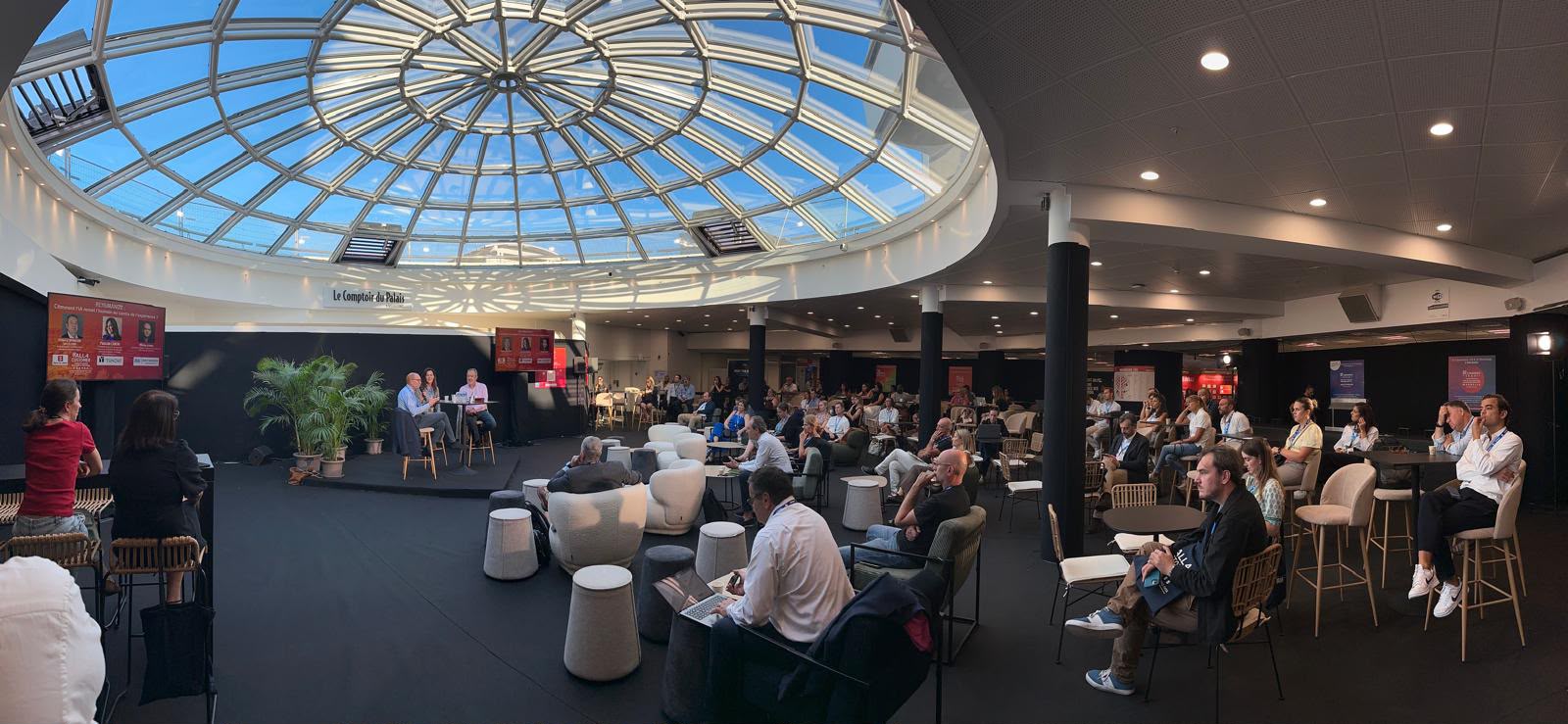
Invited to the NeuroMynds Visionary Roundtable in Monaco, I participated in a discussion bringing together profiles from finance, healthcare, technology, law, entrepreneurship, engineering and sustainable development. Behind very different issues, the same question gradually emerged: in organizations increasingly augmented by artificial intelligence, what happens to attention, trust and our ability to cooperate ?
On September 17, 2026, NeuroMynds organized its Monaco Visionary Roundtable at La Salière, Monaco. I was invited to participate in this meeting whose ambition was to confront several disciplines in order to identify some of the structural tensions currently affecting the economy and society. The composition of the roundtable was precisely what made the exercise interesting: private banking, health and prevention, entrepreneurship and venture capital, fintech, real estate, law, civil engineering, education, human transformation and sustainable fashion were represented.
I thought this diversity would naturally lead to very different diagnoses. Almost the opposite occurred. As the discussions progressed, common concerns emerged behind seemingly distant sectoral issues. How do we preserve our capacity for attention in information-saturated environments? How do we maintain or rebuild trust in complex systems? How do we enable individuals from different disciplines to truly cooperate? These questions particularly interested me because they connect to a central topic of my research on artificial intelligence and organizations: what happens to competitive advantage when technological capabilities gradually become accessible to everyone?
Three tensions behind apparently distinct transformations
The roundtable’s work identified three major areas of reflection. The first concerns health and prevention. The group notably questioned health systems still largely organized around treating pathologies rather than preventing them, as well as the difficulties in accessing certain preventive approaches. The report from the meeting also associates this issue with individuals’ ability to preserve their well-being and potential in rapidly transforming economic and social environments.
This question goes far beyond the healthcare system alone. In business, health also becomes an organizational issue. Fatigue, stress, cognitive overload, aging of the working population, absenteeism and sustainability of work rhythms directly influence an organization’s ability to function, learn and transform. The massive arrival of artificial intelligence does not make these issues disappear. It could instead make them more visible, because it rapidly modifies work processes, expected skills and the relationship between individuals and technology.
The second area identified specifically concerns cognition and technology. Participants discussed the fragmentation of attention in a digital environment characterized by the multiplication of solicitations, information flows, algorithmic social networks and, now, artificial intelligence tools. The Roundtable report mentions cognitive overload and attention fragmentation likely to affect critical thinking and the ability to perform work requiring prolonged concentration. However, it is important to clearly distinguish the observation made during the meeting from scientific demonstration: the document is a synthesis of collective reflection and not an experimental study establishing causality between AI, social networks and deterioration of cognitive abilities.
The question raised nevertheless remains essential for businesses: what happens when we considerably increase our capacity to produce information without proportionally increasing our capacity to process it? Generative AI now makes it possible to quickly produce summaries, analyses, documents, presentations, recommendations or hypotheses. This increase in intellectual production mechanically shifts part of the difficulty. When information becomes abundant, the problem is no longer just producing it. We must determine what deserves to be read, verified, explored in depth, discussed or ignored. From this perspective, attention becomes a strategic resource.
AI does not eliminate the human factor, it shifts its value
This shift seems essential to me for understanding the next phase of artificial intelligence adoption in businesses. During the early years of generative AI, much of the discussion focused on tools: which model to use? Which platform to choose? Which processes to automate? What productivity gains to expect? These questions remain legitimate, but they are no longer sufficient. The challenge is gradually shifting toward the architecture of work: which tasks do we really want to delegate to machines? Which ones should remain under human responsibility? How do we control results? Where do we place validation points? And above all, what do we do with the time and cognitive capacity potentially freed by automation?
This question directly connects to a conviction that structures my work: artificial intelligence creates capacity. Organizations create value. Automating a task is not yet creating value. Reducing the time needed to write a document or analyze a dataset is only worthwhile if the organization knows how to reinvest this capacity in activities that truly matter: decision-making, innovation, customer relations, creativity, solving complex problems or cooperation.
This is where the human factor returns to center stage, but in a different form. It is not about opposing human to machine, nor artificially defending human activities that technology could accomplish more efficiently. It is about understanding which human capabilities become more important as certain technical capabilities become commonplace. Discernment, the ability to formulate a problem, critical thinking, responsibility, trust and cooperation could thus gain value precisely because automated production becomes more efficient.
Trust, the invisible infrastructure of the organization
The third set of issues identified during the Roundtable concerned governance and relationship to risk. Participants notably mentioned institutional trust, bureaucracy, difficulty accepting failure and the consequences of excessive risk aversion on innovation and capital allocation. The report also relates these phenomena to concentration of decision-making and increased systemic costs. Again, some formulations in the document are general and would deserve to be supported by external data before being considered universal findings. But the issue raised during the discussions is particularly relevant.
Trust rarely appears in a company’s financial indicators. Yet it partly determines the speed at which an organization can decide, share information, delegate, experiment and accept uncertainty. An organization where every decision must be controlled by several hierarchical levels does not have the same capacity for action as an organization where trust enables structured delegation. With artificial intelligence and the emergence of agentic systems, this question becomes even more concrete. As tasks are entrusted to systems capable of executing sequences of actions, it will be necessary to determine who decides, who controls, who assumes responsibility and at what point human intervention becomes necessary. AI governance is therefore also an architecture of trust.
An unexpected convergence around community
This is probably the most interesting result of this meeting. The working groups addressed different issues and worked from distinct professional perspectives. Yet, according to the synthesis produced by NeuroMynds, they converged toward the same notion: community. The report presents it as a possible catalyst for systemic renewal and insists on the need to rebuild trust relationships, a shared human purpose and interdisciplinary networks capable of strengthening resilience.
The term is appealing, but it deserves to be questioned. A community is not simply a professional network, a LinkedIn group or a succession of events. For an organization, it can designate something much more structural: social capital enabling different people to share their knowledge, confront their expertise, take risks together and solve problems that no discipline could solve in isolation. Community is therefore perhaps not, in itself, the solution to the problems identified during the meeting. It could be the infrastructure that allows solutions to emerge.
This distinction seems important to me. Presenting community as a universal answer would be excessive. However, considering the quality of relationships as an economic and organizational infrastructure opens a much more fruitful reflection. Two companies can have the same technologies, recruit comparable profiles and access the same artificial intelligence models while obtaining radically different results. One may have developed a culture in which information circulates, expertise is confronted and experimentation is possible. The other may remain prisoner of its silos, procedures and protective logic. The difference then no longer comes from the technology itself, but from the organizational capacity to use it.
The paradox of the augmented company
We thus arrive at a paradox. The more technologically powerful our organizations become, the more their performance could depend on profoundly human resources: discernment, trust, the ability to ask the right questions, the quality of relationships, cooperation between disciplines and the capacity to learn collectively. Artificial intelligence therefore does not necessarily make these dimensions secondary. It could instead increase their relative value.
The Roundtable proposes four directions in this perspective: use AI and automation to reduce certain routine cognitive loads, redirect more capital toward building long-term ecosystems, develop a culture enabling learning from risk and failure, and create interdisciplinary collaborations going beyond silos between finance, law, engineering, technology and health. NeuroMynds plans to extend this reflection with interdisciplinary working groups, a collaborative platform and a series of European meetings in 2027.
It will naturally be necessary to observe what this approach concretely produces. Because all the difficulty lies precisely in the transition from collective reflection to action. Creating a community is not enough. Organizing meetings is not sufficient either. Knowledge must circulate, experiments must be documented, contradictions must be able to be expressed and learnings must progressively modify practices. It is under this condition that a community can become a true collective capacity.
What if competitive advantage changed in nature?
I ultimately take away from this meeting a hypothesis broader than the Roundtable’s initial conclusion. We are entering an economy where certain technological capabilities are rapidly becoming accessible. Companies can progressively use the same models, access the same infrastructures and deploy agents based on comparable technologies. Possessing high-performance technology will remain important, but it could become less differentiating when this technology is widely available.
Value would then shift toward what remains difficult to reproduce: a culture built over time, real trust between individuals, a capacity for discernment, relationships enabling contradiction, teams capable of cooperating beyond their disciplines and an organization capable of learning faster than its competitors. This may be one of the most interesting paradoxes of artificial intelligence: AI could make humans more strategic, not because technology fails, but precisely because it becomes extremely efficient.
For several decades, digital transformation has primarily sought to connect systems, data and processes. The transformation beginning today could force us to go further: effectively connect human and artificial intelligences, but also rebuild the conditions enabling individuals to think, decide and act together. The conclusion of the NeuroMynds Roundtable then takes on another dimension. Community is probably not a universal answer to contemporary economic and social difficulties. However, it could constitute one of the invisible infrastructures enabling organizations to transform technological capacity into real value.
One question then remains open for leaders: if tomorrow their competitors have the same artificial intelligence models, what will they have built in their organization that their competitors cannot simply buy?