In Monaco, SNCF Gares & Connexions and Akila are experimenting with a station capable of cross-referencing its data, monitoring its equipment, anticipating passenger flows and simulating its evolution. Behind the technological demonstration emerges a much more strategic question for businesses: how to make their physical operations intelligible to artificial intelligence?
The physical world, AI’s next frontier
What if the main obstacle to artificial intelligence in businesses was no longer AI itself, but the real world? Since the arrival of ChatGPT, attention has largely focused on models, conversational assistants and, more recently, agents. Yet a considerable part of economic activity still relies on factories, buildings, warehouses, stations, hospitals and numerous infrastructures. Their data remains scattered across software, sensors, documents and systems that struggle to communicate with each other.
Artificial intelligence cannot optimize what it cannot see, contextualize or connect.
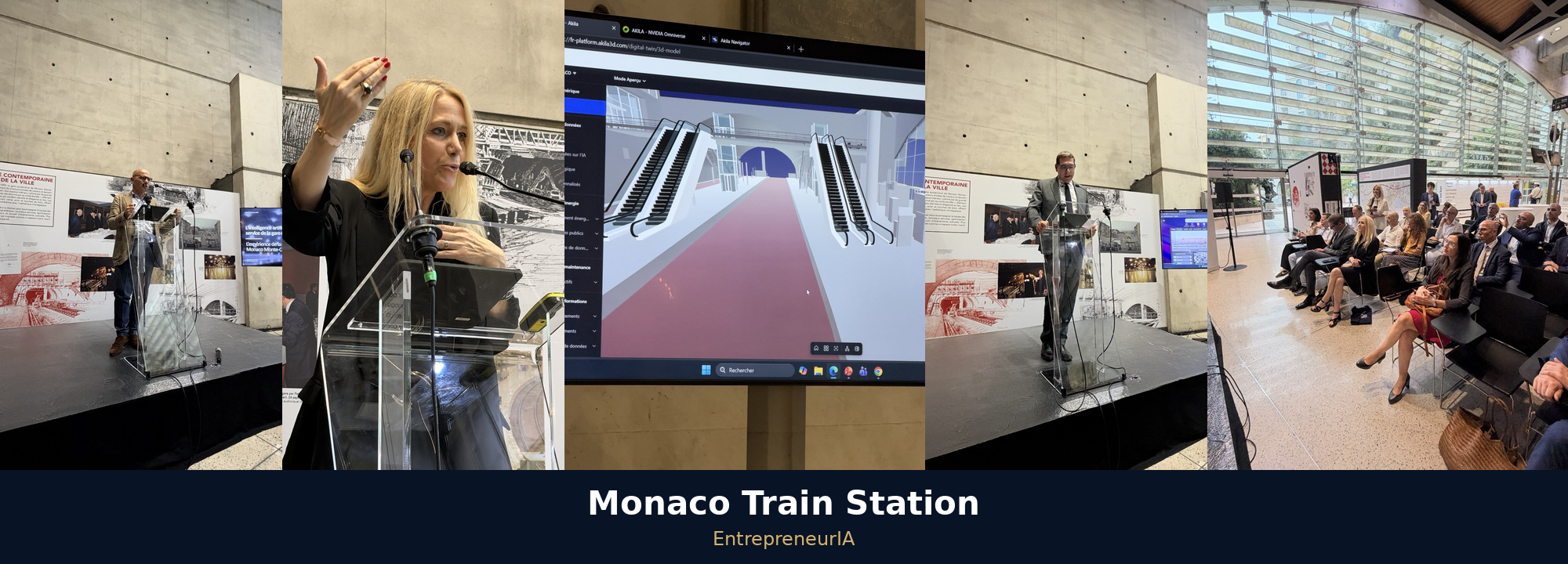
During a meeting organized in collaboration with the French Foreign Trade Advisors in Monaco, several actors from the economic and digital ecosystem gathered in the presence of the French Ambassador to Monaco. Fabrice Morenon, CEO of SNCF Gares & Connexions, and the Akila teams presented the digital twin deployed at Monaco–Monte-Carlo station.
Beyond the spectacular 3D representation of the station, it is above all a new way of operating an infrastructure that is taking shape.
“AI cannot act on what is not digitized.”
Take a station. It has plans, contracts, elevators, electrical systems, ventilation, cameras, sensors, maintenance software, energy data and information on passenger flows. The data therefore already exists to a large extent. But it is fragmented. A plan may be in an archive. Information about an elevator is held by its supervision system. Energy consumption comes from other equipment. Contractual information resides elsewhere. Cameras and sensors produce their own flows.
For a human being, these elements intuitively belong to the same environment. For a machine, they remain independent as long as their relationships have not been established. The digital twin makes it possible precisely to reconstruct this context and make the physical world intelligible to AI.
Monaco: making the station intelligible to machines
In the system presented, different sources are progressively integrated: documents, plans, software, technical equipment, IoT data and information from third-party systems. This data is structured using an ontology, that is, a model that represents objects and especially the relationships that unite them. An elevator is then no longer simply a line in a database. It belongs to a specific area of the station. It has technical characteristics. It produces operational information. It is subject to a maintenance program. Its unavailability can affect certain passenger routes. This contextualization represents a fundamental difference. The objective is no longer just to store more data, but to enable AI systems to understand how they are connected.
The demonstration carried out in Monaco made this very concrete. From a three-dimensional representation of the station, operators can browse spaces, select certain equipment and access associated information. On an elevator, for example, the platform can receive the status communicated by the manufacturer. An anomaly can trigger an alert. In certain technical areas, sensors monitor temperature and humidity. Electrical consumption can also be analyzed. The technology thus connects the digital model to operational reality.
Know, observe, anticipate
The presentation mainly highlighted three generations of twins.
- The first is the knowledge twin. It brings together what the organization already knows: plans, contracts, registers, documents and technical characteristics.
- The second is the operational twin. To historical data is added information coming from operating systems. It then becomes possible to observe what is actually happening in the infrastructure.
- The third level is more ambitious: the cognitive twin. It is no longer just about answering the question “What is happening?”, but progressively another one: “What could happen?”
The transition is essential: know, observe, simulate, decide. It is probably at this stage that the digital twin becomes particularly interesting for executives.
Simulate before investing
Monaco–Monte-Carlo station is a particularly telling case. What will happen if passenger traffic increases in the next ten or fifteen years? Will certain areas become insufficient? Will accesses need to be modified, equipment moved or new investments made?
The twin makes it possible to use current data to build different scenarios. Passenger flows can be simulated. Air movements can be modeled. Scenarios concerning temperature, ventilation or safety can be tested. The objective is notably to think about the station’s future needs for 2035 or 2040. Simulation then becomes an investment decision support tool. Instead of carrying out a transformation and then measuring its consequences, the organization can virtually test different hypotheses before committing its CAPEX.
The platform developed by Akila relies on NVIDIA Omniverse and Metropolis technologies. NVIDIA indicates that SNCF Gares & Connexions uses these technologies to simulate notably passenger flows, air movements, temperature or certain evacuation scenarios.
Value does not lie in 3D
Yet it is elsewhere that the most interesting lesson from this experiment lies. A digital twin is visually impressive. But its economic value does not come from its graphical representation. It comes from the decisions it helps improve.
An example presented during the demonstration concerns the station’s surface areas. Certain values used in different contracts would have been renewed over time without being systematically updated. Consolidating data in the digital twin would have made it possible to identify a potential savings of around 10% on certain contracts, particularly cleaning. Another example: energy. Analyzing consumption makes it possible to identify the equipment actually responsible for the main electrical uses. NVIDIA publishes higher results in its case study devoted to SNCF Gares & Connexions and Akila. The group reports a 20% reduction in energy consumption, 50% in downtime and response times, and 100% preventive maintenance completed on time. These indicators are published for the deployment presented by NVIDIA and should therefore not be automatically interpreted as the only specific results for Monaco station.
This distinction is important. Technology does not mechanically produce a savings of 10, 15 or 20%. It creates a new capacity for observation and analysis. The value then depends on the decisions made by the organization.
Anticipate flows rather than endure them
Passenger management is another illustration. According to Fabrice Morenon, the system developed now makes it possible to count trains with an announced reliability between 99 and 100%. Computer vision is also used to analyze people flows in certain areas.
The interest goes far beyond counting. When this information is historicized and then cross-referenced with the station’s spatial model, it becomes raw material for anticipating the evolution of uses. The system also opens up prospects for security. The detection of track crossing has, for example, been mentioned as a potential use case. Simulations can also study air circulation or the behavior of an environment during a fire.
We are therefore no longer simply in traditional smart building. The combination of real-time data, computer vision, simulation and AI progressively brings the infrastructure closer to a system capable of perceiving certain changes in its environment and helping operators respond to them.
Own your buildings but not their data?
A question asked during the exchanges moved the discussion to much more strategic ground. How to manage the heterogeneity of communication protocols and equipment? Behind the technical problem quickly appears a governance question: who owns the data produced by a building?
A company can own an infrastructure while depending on multiple suppliers to access information generated by its own equipment. As long as this data mainly served the maintenance of an isolated system, this dependency could seem secondary. With AI, it changes dimension.
Data becomes the raw material for understanding, optimizing and possibly automating operations. Companies will therefore probably increasingly need to explicitly integrate into their calls for tender requirements concerning system openness, interoperability, data ownership, portability and access conditions.
To this is added sovereignty: where is the data hosted? Who can process it? Which AI systems can access it? How are actions tracked? For critical infrastructures, these questions become as important as the technical performance of the model.
The human factor behind the digital twin
Another exchange from the evening deserves attention. Asked about the main difficulty encountered during the Monaco project, the speakers did not point to the algorithm, sensors or 3D modeling. On the contrary, they emphasized the role of management commitment and team buy-in.
The project would have benefited from a strategic choice carried at the highest level and properly introduced to employees, thus limiting change management difficulties. The observation goes far beyond the Monaco case.
Organizations can have excellent technologies and abundant data without succeeding in their transformation. The ability to create a common direction, involve operational teams and redefine processes remains decisive. Technology is a condition for transformation. It does not by itself constitute its engine.
After generative AI, Physical AI?
NVIDIA now widely uses the concept of Physical AI to designate systems capable of perceiving, understanding and acting in the physical world. The Monaco project fits into this evolution and combines digital twin, simulation, computer vision and AI agents.
This evolution deserves the attention of businesses. We have devoted a lot of energy to making the organization’s knowledge accessible to generative models. Documents, knowledge bases and business data progressively feed copilots and agents.
A new step could now consist of making operations themselves readable by AI. Factories, warehouses, buildings, energy infrastructures, hospitals, shopping centers or transport networks could be concerned.
After the race for models perhaps begins another competition: that of digital contextualization of reality.
What executives can learn from the Monaco case
For a company, the first question is therefore probably not: “Should we build a digital twin?” It is more fundamental: what important decisions could we make differently if we had a reliable, contextualized and real-time representation of our operations?
This question immediately leads to others: what data do we actually own? Where is it? Which suppliers control access to it? Are our systems interoperable? What data quality can we guarantee? Which processes could be simulated before making a costly decision? The Monaco case also shows that a project of this type should not be evaluated solely in terms of its technological sophistication. Its value is measured through operational indicators: energy consumption, equipment availability, maintenance costs, intervention times, service quality, safety or investment optimization.
This is perhaps where the most important transformation lies. The digital twin is no longer just the virtual double of a building. It can become a decision infrastructure, located at the intersection of data, AI and operations. The question for executives therefore evolves. It is no longer just about knowing which artificial intelligence to adopt, but about determining whether their organization produces and governs the data that will tomorrow allow this artificial intelligence to truly understand its operation.
In Monaco, the station provides a particularly concrete laboratory for this evolution. But energy savings, improved maintenance or flow anticipation do not come from the digital twin alone.
They appear when the organization transforms a new capacity for observation and simulation into decisions.