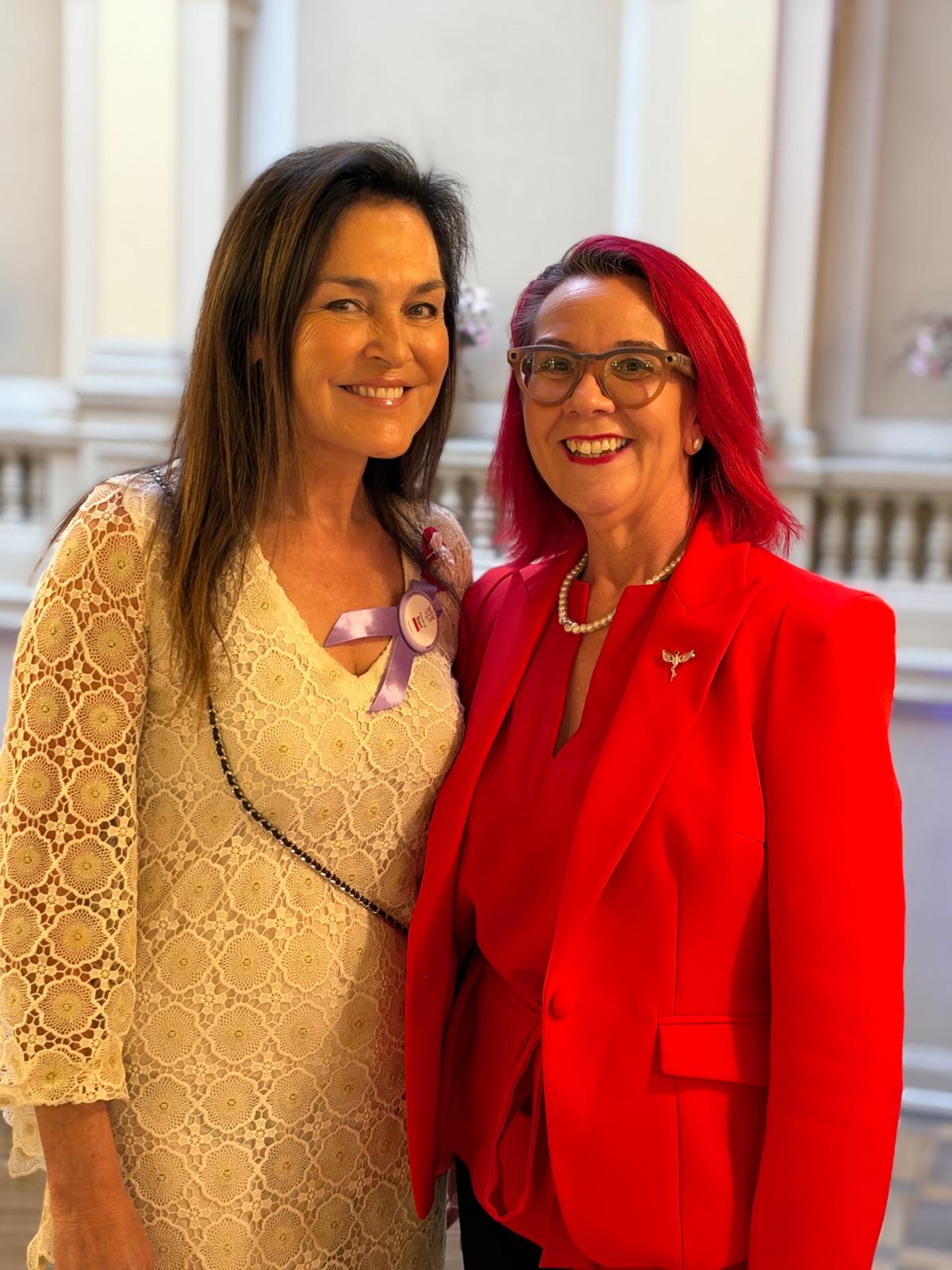

 On March 5th, in the elegant setting of the Anantara Plaza in Nice, the FEM’IMMO association hosted author and speaker Florence Servan-Schreiber. She delivered a captivating conference dedicated to audacity, marking the release of her book Chiche! Tentons l’audace (Dare! Let’s Try Audacity). For nearly two hours, Florence Servan-Schreiber presented audacity not as a command, but as an exploration, blending positive psychology, philosophy, personal stories, and experiences shared with the audience.
From the very first minutes, she sets out a definition that serves as the guiding thread throughout the evening: “Audacity is an action, it’s not a state of mind, but truly an accumulation of actions.” The formula is simple, yet decisive. It immediately moves away from a romantic vision of audacity. In the collective imagination, audacity is often associated with exceptional personalities, visionary entrepreneurs, or heroic figures. Florence Servan-Schreiber reverses this perspective. Audacity is not a quality reserved for a select few. It is built through the repetition of ordinary decisions, in those moments when we choose to act despite uncertainty.
To understand this approach, we must return to her work on positive psychology. This scientific research field, born in the late 20th century, focuses on the conditions of well-being and human flourishing. Florence Servan-Schreiber is careful to recall its fundamental distinction: “This is not about positive thinking, but a research universe where we study behaviors, personalities, and organizations that work.” In other words, it’s not about denying difficulties or proposing artificial optimism. The issue is to observe what enables individuals to develop, progress, and give meaning to their trajectories.
But this conference on audacity wasn’t born from academic curiosity. It takes root in a difficult personal period. The author recounts that the book idea emerged after the pandemic, in a moment marked by her father’s death and a profound sense of disorientation. “Honestly, I wasn’t in good shape,” she confides to the audience. Yet a conference was offered to her. She accepted without yet knowing what she would say. That’s when a small inner voice whispered simply: “You say yes, you’ll see.”
This scene inaugurates a central theme of the conference: audacity doesn’t always arise from strength or confidence. It can appear in doubt, in emptiness, in that space where we accept to move forward without guarantees. Florence Servan-Schreiber will later name this inner voice “Chiche” (Dare), an imaginary muse representing this impulse toward action.
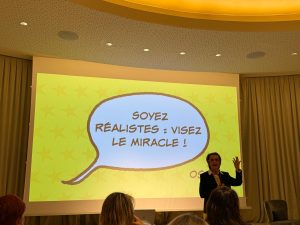 To structure her reflection, she decides to conduct her own investigation. For lack of abundant scientific research on the subject, she questions her community, discusses with people she meets, and gathers nearly 400 responses. This material allows her to formulate a synthesis that immediately resonates with the audience’s experience: “Audacity consists of disrupting one’s habits, taking risks, acting without restraint, and cutting one’s elastic bands.”
This definition reveals several important dimensions. There’s risk, of course, but also the idea of liberation. Cutting one’s elastic bands means loosening what holds us back: habits, social expectations, silent fears that often limit our choices.
One of the most striking moments of the conference is the distinction between courage and audacity. The two notions are often associated, but Florence Servan-Schreiber insists on their fundamental difference. Courage appears when life imposes a trial. “It’s something necessary, it’s imposed on us by life,” she explains. It’s about facing a difficult situation we haven’t chosen.
Audacity, on the contrary, is a choice. “Audacity has the particularity of being completely self-inflicted. No one and nothing obliges us to be audacious.” It is optional, voluntary, sometimes instinctive. Where courage protects, audacity opens. It doesn’t respond to a constraint: it creates a possibility.
This distinction also illuminates a cultural dimension. In the survey conducted by Florence Servan-Schreiber, more than half of those questioned say they are courageous, but only 21% declare themselves audacious. Why this gap? Her answer provokes both laughter and reflection: “Being audacious is like being beautiful, you don’t say it yourself.”
In many European cultures, asserting one’s own audacity can seem pretentious. We prefer to wait for others to attribute this quality to us. This observation opens a broader reflection on legitimacy, particularly among women. Audacity is often perceived as a transgression of modesty norms, even though it constitutes an essential engine of transformation.
To move beyond this restrictive vision, Florence Servan-Schreiber proposes a particularly meaningful metaphor: that of the dresser. “Audacity, in fact, is a dresser. There are drawers, and your life is a dresser.” In these drawers are all the audacious experiences already lived. “We have it under our nails, we have it in our hair, we have it under our soles.”
This image profoundly changes the way we perceive audacity. It’s not a quality we should acquire someday. It already exists in our journeys. We just need to look back to find those moments when we dared: leaving a job, changing cities, saying no, starting over elsewhere.
To make this idea tangible, the speaker proposes several interactive experiences to the audience. In one of them, participants must look at each other in silence for thirty seconds before answering a series of questions about their partner. The exercise reveals how quick and often wrong our judgments are. “When we meet someone, we have no idea what that person is going through,” she reminds us. Audacity also consists of suspending these certainties.
Throughout the evening, Florence Servan-Schreiber introduces several “drawers” of audacity, which she also calls “muses.” One of them is unconsciousness. She defines it as “total confidence in one’s ignorance.” Many audacious actions begin this way: we don’t know exactly what we’re doing, but we do it anyway.
Another form of audacity is the leap into the void. She then evokes the experience of a parachute jump that ended in a spectacular fall. The story is told with humor, but the conclusion is serious: “If we don’t try, we’ll never know.” Audacity is not a guarantee of success. It implies the possibility of error.
Florence Servan-Schreiber also evokes the audacity of “thinking big.” This means imagining something that exceeds immediate reality. She recounts how, after rediscovering a childhood dream—becoming an actress like Julie Andrews—she enrolled in a theater course and eventually created a show performed before 3,000 people at the Grand Rex. “I wish from the bottom of my heart that you realize that desire you dreamed of at eight years old,” she confides.
This invitation to revisit childhood dreams is accompanied by a phrase that will undoubtedly remain one of the most memorable of the evening: “Everything that isn’t dead is still alive.” In other words, certain aspirations never completely disappear. They can resurface at any moment.
The conference also explores the audacity of going against the current. Choosing a path different from that expected by family or society often requires more courage than following the traced path. Florence Servan-Schreiber recounts how, after a period of depression, she opened a sewing workshop dedicated to curtains—an unexpected activity in a family of intellectuals. This experience will last six years and allow her to discover “the power of I made this myself.”
Finally, she evokes insolence, which she defines as “a halt to conventions.” Insolence is not necessarily aggressive. It simply consists of suspending, for a moment, the implicit rules that govern our behaviors.
Throughout the stories and exchanges, one idea gradually emerges: audacity guarantees neither success nor recognition. It doesn’t eliminate fear. But it allows movement to return to existence.
Florence Servan-Schreiber also reminds us that audacity is deeply linked to the human condition. Unlike the gods of mythology, we know that time is limited. It’s this finitude that gives value to our choices. “What do we choose to do with the time we’re here?” she asks.
The evening organized by FEM’IMMO brought together a predominantly female audience, composed of entrepreneurs, executives, and professionals engaged in varied careers. In this context, the reflection on audacity takes on a particular dimension. It questions how women authorize themselves—or not—to take initiatives, to make themselves visible, to step out of assigned roles.
At the end of the conference, Florence Servan-Schreiber quotes Voltaire: “Success was always a child of audacity.” But she immediately adds an essential nuance: the reverse is not always true. Audacity doesn’t guarantee success. It simply opens the possibility of a larger life.
Leaving the Anantara Plaza on March 5th, what remained above all was an impression: that of having heard a profoundly human reflection. Audacity was no longer an abstract concept nor an inspiring slogan. It appeared as a daily practice, sometimes fragile, often imperfect, but always alive.