
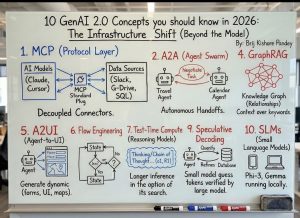
Following the work of Brij Kishore Pandey
In 2023 and 2024, the debate on generative artificial intelligence crystallized around a central object: the model. Parameter size, benchmark performance, ability to produce text, code, or images. This focus had a perverse effect: it masked a deeper, more structural, and undoubtedly more lasting transformation.
In 2026, the issue is no longer so much what a model can do as in what system it operates. We are entering a phase that can be qualified as GenAI 2.0, marked by a shift in the center of gravity: from models to infrastructure, from prompts to protocols, from isolated responses to distributed action chains.
This change is less spectacular than text generation demonstrations. Yet it is decisive for businesses.
From Model to System: A Conceptual Break
The first generation of generative AI relied on a simple interaction: a human formulates a query, a model responds. This logic, inherited from search engines, remains fundamentally reactive. It limits AI to the role of conversational assistant, however performant.
GenAI 2.0 breaks with this approach. AI becomes a component of a distributed system, capable of orchestrating data, cooperating with other agents, acting on digital environments, and maintaining state over time. Intelligence is no longer contained in a single model, but emerges from the global architecture.
This shift requires rethinking governance, responsibility, and the value created.
- MCP: The Protocol Layer as the New Foundation
The Model Context Protocol (MCP) embodies this shift. It is not an additional model, but a standardized interoperability layer between models and data sources.
Concretely, MCP enables connecting a model to heterogeneous environments—SQL databases, documents, collaborative tools, business applications—without strong dependency on a specific implementation. The model ceases to be a single entry point. It becomes an interchangeable actor in an ecosystem.
For businesses, the strategic stakes are high: reduced vendor lock-in, better traceability of data access, clear separation between reasoning and execution.
Value no longer resides in model sophistication, but in mastering the flows it traverses.
- A2A: When Agents Negotiate Among Themselves
The Agent-to-Agent (A2A) paradigm introduces an even more radical break. Agents no longer merely execute human orders. They negotiate, coordinate, and transfer tasks autonomously.
A travel-specialized agent can dialogue with a calendar agent, arbitrate constraints, propose compromises. Humans no longer intervene at every step. They define an objective and rules. This logic raises a central question: At what point does functional autonomy become a governance problem?
In organizations, the temptation will be strong to automate entire decision chains. Yet, the more distributed the delegation, the more diffuse the responsibility.
- GraphRAG: From Keyword to Structured Meaning
GraphRAG marks a silent but decisive evolution of classic RAG. Where RAG indexes documents, GraphRAG structures relationships: entities, dependencies, hierarchies, causalities.
AI no longer merely searches for relevant passages. It reasons on a knowledge graph. Context is no longer reduced to a token window; it becomes a representation of reality.
For businesses, this changes the very nature of decisional AI. It can: connect distant events, make implicit links explicit, reduce certain structural hallucinations. But this promise rests on one condition: the ontological quality of the graph. Poorly designed, it rigidifies thinking instead of illuminating it.
- A2UI: The Interface as Agent Product
With Agent-to-UI (A2UI), AI no longer merely produces text. It generates dynamic interfaces: forms, maps, tables, visualizations.
The interface ceases to be a fixed artifact designed upstream. It becomes contextual, adaptive, temporary. The agent creates the tool it needs to accomplish the task.
This evolution challenges classic boundaries between product, UX, and business logic. It also raises a control problem: who validates an interface generated on the fly? According to what standards?
- Flow Engineering: Orchestrating States, Not Prompts
Flow Engineering progressively replaces prompt engineering. The challenge is no longer formulating the right instruction, but managing successive states, branches, conditions. AI becomes a process. It maintains operational memory, tests hypotheses, backtracks, adjusts its decisions.
For leaders, this implies a change in posture: piloting AI is less about “questioning” it than designing a decision system.
- Test-Time Compute: Computation Time as Strategic Variable
With Test-Time Compute, reasoning is no longer fixed at training. The model can allocate more computation at inference time to explore multiple paths. This capability improves response quality on complex problems. But it introduces a new trade-off: precision versus cost, depth versus latency. Intelligence becomes a modular resource, not a constant attribute.
- Speculative Decoding: Asymmetric Cooperation
Speculative Decoding rests on a simple idea: a small model proposes, a large model verifies. This cooperation reduces costs and accelerates inference. It illustrates a broader trend: intelligence is no longer monolithic. It is hierarchized, distributed, specialized. This opens the way to hybrid architectures, combining local, cloud, and edge computing models.
- SLMs: The Return of Local and Frugal
Small Language Models (SLMs) signal the return of local computing. Less powerful but more controllable, they respond to sovereignty, latency, and confidentiality constraints. Their interest is not to rival large models, but to intelligently fit into a multi-level system.
What GenAI 2.0 Really Changes for Businesses
The key message is clear: competitive advantage will not come from the most performant model, but from the best-designed architecture. The businesses that will succeed are those that know how to: structure their data before exposing it, define explicit delegation rules, integrate AI into their real processes, maintain clear human governance.
The question is no longer “What can AI do?”, but “What will we delegate to it the right to act upon?”