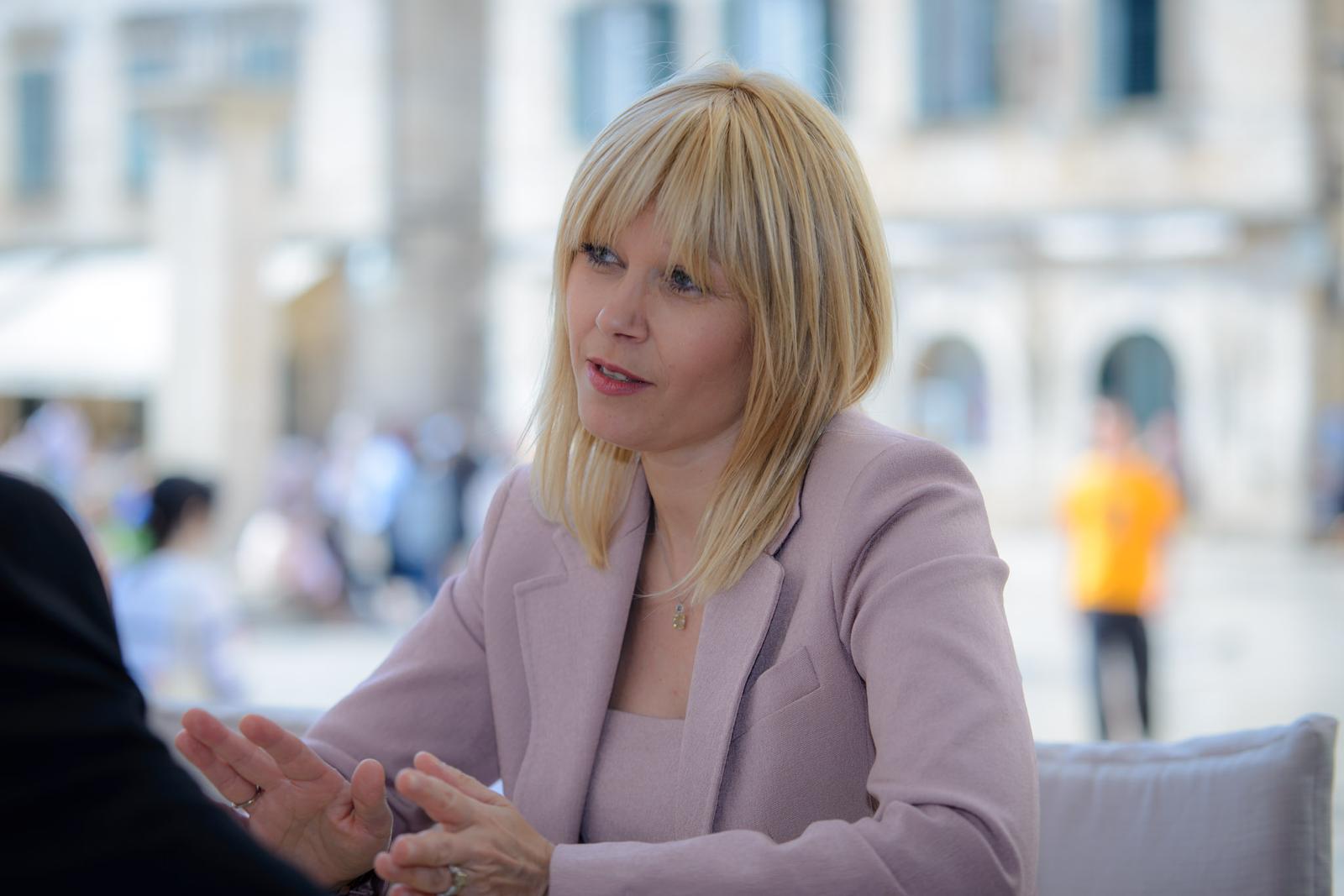
Maja Frenkel, founder of Oriel: rethinking wealth transfer through clarity, family governance, and “Emotional Finance”
Interview by Pascale Caron
Understanding Oriel’s intellectual proposition requires returning to the environment in which Maja Frenkel was formed. Her relationship with finance was not born in a stable market, but in a transition economy, at the time when Croatia emerged from war where a socialist system was transforming into capitalism. She studied economics in Vienna, completed her studies in Croatia, and entered the world of international finance very early. She worked with the World Bank, the International Finance Corporation, the EBRD, the IMF, in a context where, as she emphasizes, “the tools of financing were very limited and it needed a lot of creativity”. This phrase, far from being anecdotal, summarizes an intellectual matrix: finance is never purely technical, it is a contextual construction, dependent on culture, institutions, and power relations.
Before turning thirty, she became deputy minister of Economy and led the privatization of strategic assets such as the national telecommunications operator and the transformation of the energy sector. She participated in drafting new laws, worked with regulators, and observed the internal workings of a state in transition. This early immersion in the mechanics of public decision-making forged a capacity for systemic analysis that would remain at the heart of her approach. She did not learn finance in markets, she learned it in the construction of markets.
The Move to Monaco and the Birth of an Observation
Settling in Monaco represented a change of scenery, but not of intellectual dynamic. She became a mother of five children, temporarily stepped away from institutional structures, but continued intense training work. She studied psychology, engaged in a psychoanalysis journey, and developed a reading of economic behavior centered on the relationship between emotions, identity, and decision-making. This dual training—finance and psyche—is Oriel’s cornerstone.
In contact with great fortunes, she observed a recurring paradox: women have all possible advisors, yet remain overwhelmed by complexity. “Confidence is not a judgment, it’s a feeling. And financial confidence comes from clarity,” she explains. The issue is not information, but the ability to connect the different levels of a life: capital, relationships, role in the couple, identity, transmission. The confusion is not cognitive, it is structural.
“Emotional Finance” and Collective Paralysis
Her reflection draws on the work of David Tuckett and the notion of “Emotional Finance”. The 2008 crisis, she recalls, was not caused by a lack of information, but by a collective narrative that no one dared oppose. “Everybody knew it was coming, everybody was frozen”. Doubt had become socially unacceptable because it threatened group cohesion. This mechanism, she finds again in families and couples. Money becomes a narrative object that structures power relations, loyalty, guilt, and freedom. Excluding a partner from this space of thinking produces legally solid but psychologically fragile wealth architectures.
The Couple as the First Financial Institution
One of Maja Frenkel’s major conceptual shifts is to consider the couple as the first financial institution. “A couple has a shared state of mind”. Two individuals share not only emotions, but a representation of time, risk, continuity, and transmission. Money then becomes a language charged with meaning. Before transmitting wealth, one transmits a relationship to money. This idea transforms the wealth question into a question of relational governance. The success of a transmission does not depend solely on legal or tax structures, but on the quality of the shared thinking space. When only one partner holds information and decision-making capacity, the other becomes a “reactor” and not an actor. This asymmetry is transmitted to future generations and weakens continuity.
“Women are not a niche in private banking”
In this context, the rise of women in global wealth ownership constitutes a structural change. “Women are not a niche in private banking. They are a structural point in wealth management”. She does not develop a militant discourse, but a systemic analysis: transmission rests on four capitals—human, intellectual, social, and financial—the latter being the consequence of the first three. Without family narrative, without dialogue space, inheritance becomes a fragmentation factor. She cites examples of great entrepreneurial dynasties where family councils structure the common vision and where philanthropy serves as a first learning space for heirs. Philanthropy allows entry into the relationship with money through mission rather than consumption and builds collective responsibility.
Oriel: A Practice Situated Upstream of Decision-Making
Oriel deliberately positions itself before traditional financial advice. “I am upstream, very high before any advisors and way before execution”. She sells no product, prescribes no investment. She designs with her clients the thinking structure that will then allow decisions to be coherent. “I don’t give direction. I design the structure of thinking”. This upstream posture is the singularity of the model. She intervenes where confusion prevents decision, where roles are not clarified, where family narrative is not constructed.
Inheritance as Psychological Shock
The case of an heiress she accompanies illustrates this approach. Upon receiving a fortune from the sale of the family business, the client fell into depression. Money represented control, loss of freedom, imposed loyalty to her. She was “frozen”. The work did not focus on asset allocation, but on the symbolic relationship to capital, on family history, and on creating a dialogue space with her spouse and children. The transformation occurred when guilt and shame were replaced by conscious narrative. Inheritance ceased being a burden to become a project of continuity.
The Portfolio as Autobiography
Her pedagogy often relies on analogies. She compares an investment portfolio to a wardrobe: the fundamental pieces are structural assets, equity markets the ready-to-wear, passionate investments the accessories. “Your portfolio is your identity. How visible you want to be, how safe you want to be”. The real estate overconcentration she frequently observes among women then becomes readable as a need for control in the face of uncertainty. An asset cannot fulfill multiple functions at once. Diversification is first an identity question.
Separation, Fusion, and Personal Governance
The notion of separation, from psychoanalysis, occupies a central place in her reading of women’s trajectories. The difficulty in distinguishing what belongs to oneself and what belongs to external expectations leads to fusion with the company, family, or wealth. “It’s very hard to say: my money, my mind”. This inability to set a boundary is one of the major springs of decisional confusion. The formula guiding her action—”Moah shalit halev”—means the brain must govern the heart. It becomes a rule of personal governance as much as a financial principle.
Clarity as the New Luxury
In a world saturated with information and marked by uncertainty, clarity becomes the rarest asset. “Real luxury is clarity”. It precedes decision, which precedes direction. This sequence summarizes the Oriel method: “After clarity comes decision. After decision comes direction”. Financial performance is no longer the entry point. The ability to think together becomes the condition for continuity.
To extend this work, Maja Frenkel created the Monaco Women Lab, a space where participants explore themes such as life transitions, the mother-daughter relationship, liquidity, philanthropy, or wealth identity. The goal is not to produce immediate answers, but to restore the capacity to ask questions. This space allows women to enter the couple’s “shared thinking space” and become decision-making partners.
Barbarians at the Gate and the Lesson of Humility
When she discusses her inspirations, she cites a book, Barbarians at the Gate. This account of the battle for control of RJR Nabisco in the 1980s shaped her vision of finance. Meeting one of the protagonists of this story in Monaco was a foundational moment for her. She learned there that true economic power is accompanied by great humility.
Her definition of wealth lies elsewhere: in the silent support of her husband, in the authenticity of her children, in fidelity to her values. Economic capital is only one form among others. Continuity, transmission, and the ability to think together constitute true wealth.
At a time when the greatest wealth transfer in history is approaching, Oriel proposes a radical shift: before performance, narrative; before strategy, a shared thinking space; before execution, clarity. Restoring the capacity to think together about the future becomes the rarest asset.