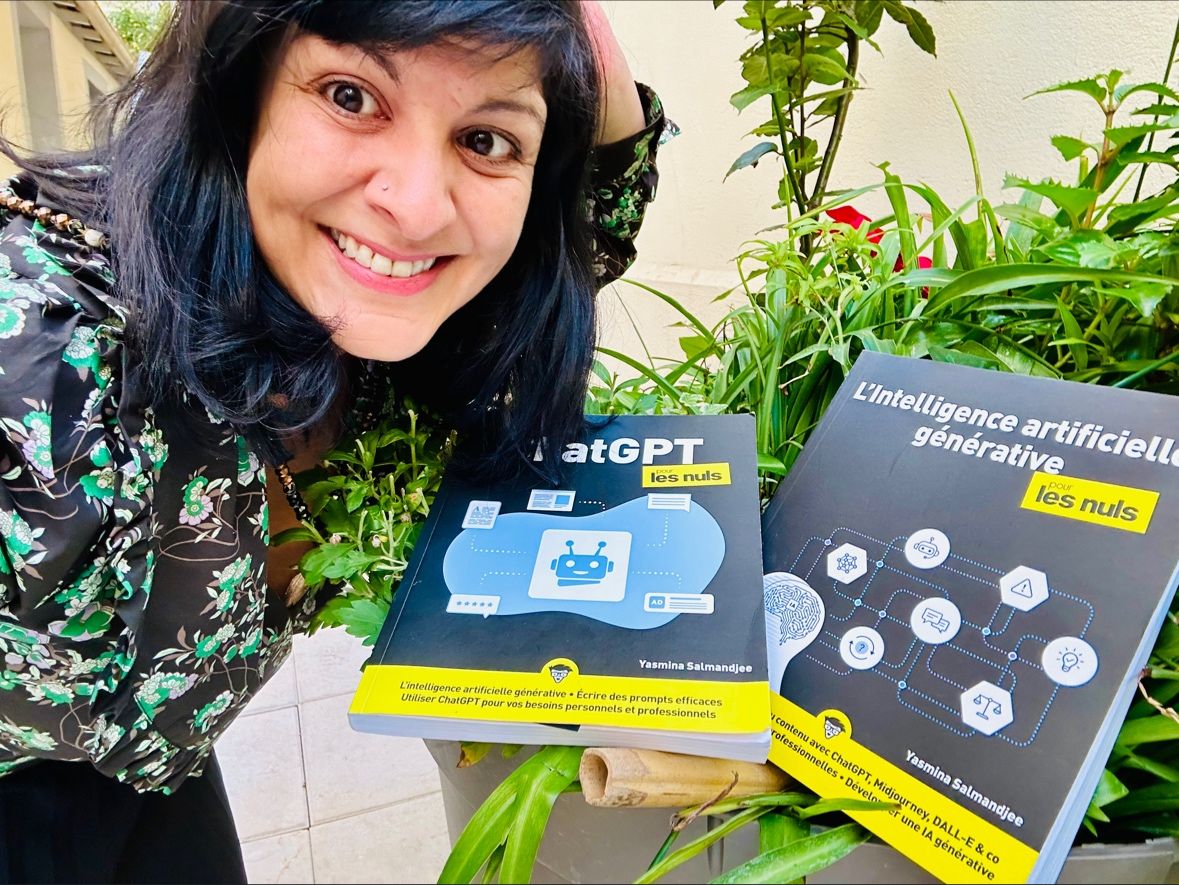
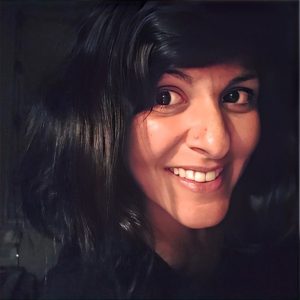
 Yasmina Salmandjee: engineer, bestselling author, bridge builder of generative AI
Interview by Pascale Caron
“The tears of the heart drown in the sweat of the brow.” This phrase, Yasmina Salmandjee wrote for herself, as a mantra. It closes our conversation. But it speaks volumes about the invisible thread of a journey that crosses technological waves, social fractures, brutal career changes, and repeated comebacks. From Polytech Paris-Saclay to technical publishing, from luxury tourism to digital entrepreneurship, from yoga to AI missions, her story composes a rare form of active resilience: creating, translating, transmitting, no matter the cost.
Born in 1977, a good student in high school, she was steered toward science by an educational system that values performance over preference. “I was more drawn to languages and literature, but you know the French system… when you do well, they push you toward scientific tracks.” Her love of storytelling never left her, even when in 1995 she won the Women’s Technical and Scientific Vocation Prize with an artistic project. She then discovered the very young engineering school of Paris-Saclay: “They had an unbeatable argument: 24/7 internet access.”
She entered computer science by default, driven by the need for independence: “My dream was to make films, but my parents refused to help me. I had to manage on my own.” The training was demanding. She persisted, without deep commitment: “I quickly became disillusioned… but I’m stubborn. I wanted to finish, get my degree, and leave.” Very early on, she experienced a double violence: that of gender and that of origin. “There were five girls in the class of thirty. Two didn’t find internships. Another and me.” This first failure shaped what followed. “I understood that it was going to be more complicated for me.”
She compensated through initiative. Alongside her studies, and to pay her rent, she sent eight letters to publishing houses offering her services translating computer books. Five positive responses. She began translating book after book, from English to French, during weekends and vacations. It was the first model: independence through competence. After her degree, she joined Abalone Games to develop an online version of the famous Abalone game. Ranked very well in her class, winner of the final thesis award (on computing in service of disability), she found herself paid 30% less than her male peers. One day, her boss asked her to type a text: “I’m a project manager,” she protested. Response: “You type faster.” She slammed the door. And pivoted to writing.
Without a network, without a career plan, she became an author for First Editions. She embraced this counterintuitive choice. No salaried status, no vacation, no security, but freedom. This allowed her to explore other paths: creating a speed-dating company in 2000, before Meetic. “We held events all over France, except Paris.” She even appeared in an episode of the series Un gars, une fille dedicated to speed-dating. Then, a new departure: world tour, dream of Argentina, and return.
She retrained in tourism, completed a luxury master’s degree at Marne-la-Vallée, became a product manager for world tours. In parallel, she inspected prestigious hotels incognito: “Mystery auditor. The dream.” But when she became pregnant in 2008, she was immediately sidelined. Once again, she picked up the thread of writing. She never stopped. She sold applications on the App Store: “Recipes, wellness, sports, games… and also children’s book-CDs, transformed into apps.”
In 2015, a series of fractures—personal, social, political—converged. She left her partner. She experienced a shocking event: the Charlie Hebdo attacks. “I don’t want to continue like this. Maybe die tomorrow doing something I don’t love.” She published a book with Jérôme Colombain (France Info), became a summer radio columnist. She knew political and media ecosystems well. She retrained as a yoga teacher. Also trained in screenwriting. Through a series of circumstances, she got closer to the “En Marche” team, then in gestation. “They offered me to join them. I was told my personality wouldn’t work in the Tech cell. I said: no problem. I became a volunteer, initially as a yoga teacher.” She gave her classes to the team, participated in events, and cooked, too, sometimes. She was nicknamed the “mood setter” of the movement.
This visibility still clings to her. “Today, it sometimes hurts me. People google ‘En Marche’ and close the door.” She left politics, in silence. Then hit rock bottom. Assault, depression, family complications. “I studied the question closely, I didn’t go through with it, but I hit bottom.”
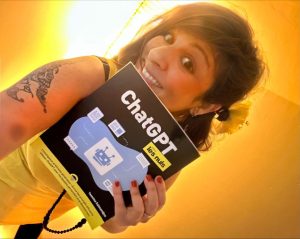 Her reconstruction passed through exile: the Canary Islands, then Ghent (Belgium), then back to Paris. “I came back with two suitcases. At 44, at my parents’ house, in my teenage bedroom.” And it was there, in winter 2022, that a new subject grabbed her: ChatGPT. “I immediately understood that something was happening.” She trained herself independently, every day. Sent a note to her editor. Proposed writing ChatGPT for Dummies. He hesitated then accepted. She wrote it in three weeks. The book came out and became number 1 on Amazon. “It’s my third real bestseller in almost 30 years.”
In parallel, she was recruited as a “prompt engineer” in a large company in Sophia-Antipolis. “An astrology and psychic company. I didn’t know they had brought me in to fire people. They looked at me as the arrogant Parisian.” The experience ended badly. She left after a few months, but stayed on the Côte d’Azur. And chained short-term missions: at Palazzo, Venus Williams’ AI startup; Aivancity, as a teacher. She continued to write. Six to seven books a year. The Art of the Prompt for Dummies, First Steps with AI… Educational formats, but aimed at real autonomy: “I designed the last one for seniors, with mobile use, really concrete.”
She also gives conferences for associations, institutions, and for Nathan, produces content for Gloria (diversity, inclusion, LGBT), teaches at TIHS Business School. A scattered economic model, but autonomous. She doesn’t complain: “I’m not a spender.” But she’s looking for permanent housing. “My landlord is selling, I have to leave.” She’s considering Cannes, maybe a return to local politics.
When asked about her favorite recent book, she mentions the latest to be published, First Steps with AI (First Editions): “The first that really speaks to beginners, seniors, those who don’t even have a computer.” When asked about her role models, to the question “who are the people who inspired you in your career?” She mentions notably her friendship with Cédric Villani, whom she describes as a faithful support in her personal projects, particularly that of a feature film. “One day when I was demotivated, he told me: ‘You’ll make it. If Emmanuel Macron managed to get elected, anything is possible.'”
She claims the status of independent. Of survivor too. Her only novel, self-published, PRISMA, translated into four languages, exists only in paper format. “I don’t want AI to ingest it without my consent.” She cites an academic tool that allowed her to discover that ChatGPT for Dummies was ingested by models, without notification or compensation.
“I write. I teach. I transmit. But I’m lucid. I’m a bridge builder. Nothing else.” It’s this lucidity, raw and disenchanted, that creates the coherence of her journey. One could see a “discontinuous” path. One must read in it a rare ability to capture the right moment and speak correctly when technology overflows all landmarks.