 She doesn’t talk about artificial intelligence as a mere tool, but as a revealer.
Interview by Pascale Caron
Marie Dollé has been working in digital ecosystems for over fifteen years. She navigates between marketing strategy, digital platforms, innovation, and supporting entrepreneurs. Currently Head of Marketing & Communications for EuroQuity at Bpifrance, she observes the transformations of the economic world through the lens of innovation on a daily basis. But her perspective goes far beyond performance. What interests her are the silent shifts, identity slippages, and intimate ruptures in our relationship with work, society, and ourselves. With SELFPRESSIONNISME – What if AI Made Us More Human? published on January 22, she offers a singular, profound, and sensitive essay. In it, she defends a radical hypothesis: the AI revolution is not primarily technical—it’s existential.
Self-taught, Marie Dollé graduated from high school at 16, spent her childhood abroad—her father was a diplomat—and entered the workforce early. At the beginning of her career in the sports world, in rugby sponsorship, then in media research at Kantar Media. There she learned about data, marketing automation, consumer panels, and advertising investments. She climbed the ladder without a degree, but with a vision. She then joined Bpifrance, where she has been working for eight years on the EuroQuity platform, connecting investors with high-tech startups. She has coached nearly 900 young companies. “I’ve always been fascinated by what makes a company succeed. But behind that, it’s human psychology that attracts me.”
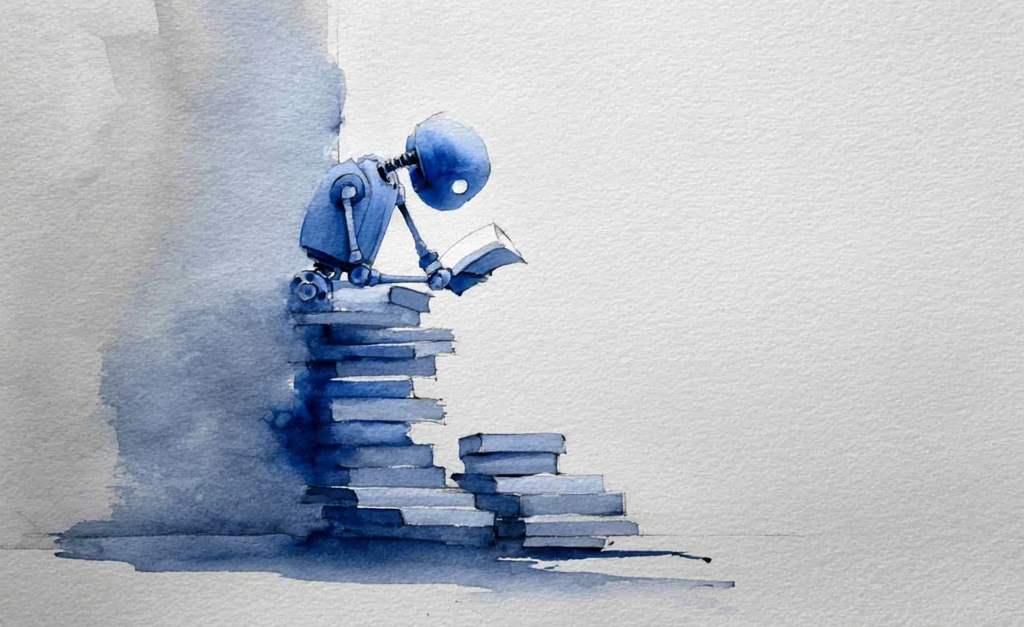
During lockdown, she resumed writing and created the newsletter In Bed With Tech (and its English version In Bed With Social) to structure her thinking. She mixes texts and visuals, some from her own watercolors, others generated from them via AI. “I painted a lot, but I lacked time. I started feeding image generators with my works. The grain of the paper, the pigments—everything is there. Sometimes you don’t know what’s handmade and what’s generated.” Already, she was exploring this hybridization between human creation and algorithmic power.
What fascinates her about generative AI isn’t automation—it’s the shift from determinism to probabilism. “With transformers, we’ve left the logic of closed systems. We’re touching something that resembles how the human brain works.” She reverses dominant narratives. “The real risk isn’t that machines become human. It’s that humans become machine-like.” Notifications, Slack, LinkedIn, excessive productivity: “We’ve become primates hunched over our screens. We’re developing physical pain, we no longer look at the horizon.” She quotes Jane Jacobs: “Cities were secured by crossed gazes. Today, no one looks anymore.” And reminds us that in cities, the horizon is cut off. “Yet the horizon is the condition of existence.”
In this anthropology of posture, she reads an erasure of our relationship with the world. But also an opportunity to seize: “Generative AIs are trained on an immense part of humanity’s archives, including the most sensitive: poetry, narratives, art. Before, we only analyzed numbers. Today, we can access collective sensitivity.” For her, everything depends on usage. “If we delegate our thinking, we become dull. But if we use it to question ourselves, we can become more human again.”
She rejects the erroneous reading of the MIT study on ‘cognitive debt.’ “It doesn’t say people become dumber, but that when you delegate a task, you think less. Which is obvious.” She emphasizes the risks related to children’s cognitive development. “It’s appropriate friction, not ease, that makes the brain progress.”
She recounts a striking scene: her 13-year-old daughter, stuck on irregular Spanish verbs. She suggests using ChatGPT, but without asking for answers—only explanations. “I saw her dialogue, understand, then ask the machine to create a quiz from her lesson. She got a 17.” For her, AI shouldn’t make us go faster, but help us slow down. To understand. To go deeper. To start over.
She insists: “With the machine, you can ask the same question fifty times. Ask: explain it to me like I’m five years old. And start over as many times as necessary. Facing a teacher, you don’t dare. Facing the machine, you persevere.” This cognitive plasticity is for her one of AI’s most beautiful promises. Provided we don’t submit to it.
She evokes a powerful idea: language models are engines of taste. “Everyone can generate. But not everyone knows how to choose.” She describes three levels: copy-paste; choosing an option; analyzing, transforming, appropriating. “Why do we learn rules? To better break free from them.”
She rejects the vocabulary of “augmented human”—too technocentric. She prefers the term “expanded”: “Augmenting implies a lack. Expanding means starting from within. Toward the outside. Toward the Other.” It’s in this logic that she develops the concept of selfpressionism, in reference to major artistic movements. “When photography appeared, it disrupted painting. The Impressionists responded not by imitating reality, but by capturing emotion, light, the moment. This was possible because new tools emerged: paint tubes and the portable easel. The artist could go out and paint on location, capturing fleeting impressions.” Then came Expressionism, in a context of war and the rise of psychoanalysis. “There, it’s interiority that explodes on the canvas.”
 Today, she proposes a new movement: selfpressionism. “Self in the sense of the self, but not the selfie, which is a narcissistic staging. I’m talking about the self turned toward the other. A subjectivity in relationship.” She adds: “We’ve long focused on personal development. We’ll now have to work on relational development. With humans, but also with other forms of intelligence: artificial, plant, animal. The living.”
She returns to skills. She rejects the idea that hard skills would be obsolete. “How can you choose between fifty proposals if you don’t have the basics? Without expertise, you can’t question or challenge the machine.” She frontally opposes the thesis that soft skills alone would be enough to prepare for the future. “We’re told that only relational skills matter now, but how can you exercise critical thinking without cognitive structure? Soft skills can only take root on a solid framework of knowledge.” For her, thinking requires technical foundations, intellectual rigor, grounding. It’s the combination of expertise and capacity for connection that will make the difference.
She cites two figures who deeply inspire her. First, Professor Marc Cavazza, AI researcher, rigorous, methodical, scientific. “My brain doesn’t work like his. But every time I read him, an idea is born. He triggers incredible creativity in me.” Then, Leonardo da Vinci. “The model of the polymath. An artist who mastered painting, sculpture, mathematics, music. It’s this ability to bridge disciplines that fascinates me. And which will be, I think, the skill of the 21st century.”
Fundamentally, what she defends is a posture. A way of inhabiting one’s era without suffering it. Of dialoguing with machines without submitting to them. Of preserving what makes us human. She quotes Roland Barthes and his concept of punctum: that detail in an image that triggers an intimate resonance. And concludes: “A good book is no longer a book that teaches me something. It’s a book that moves me.”
Her mantra, finally, could be a compass: “Look at what isn’t immediately visible. Go into the interstices.”