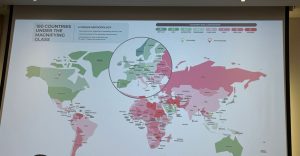

 On Tuesday, February 10, at the Novotel Monte-Carlo, the Monaco Economic Board (MEB) hosted a conference on country risks and opportunities for businesses, led by Jean-Christophe Caffet, Chief Economist at Coface.
An eagerly awaited session. And this year, a particularly enlightening one.
From the opening, the tone was set: the global growth forecasts made a year earlier proved accurate. Global growth reached 2.8% in 2025, compared to the 2.7% anticipated. A detail in appearance, but a strong signal in a world swept by successive political, geopolitical and economic shocks.
However, this statistical stability should not mask the underlying reality. The global economy is advancing through the storms, without yet knowing whether it is in the eye of the cyclone or on the verge of new turbulence.
A more uncertain world, durably
One of the guiding threads of the presentation rests on a structural observation: the level of global uncertainty never returns to its previous level. Crisis after crisis, the world crosses successive thresholds of economic illegibility.
Uncertainty indicators, although down from the peaks observed during last spring’s US tariff announcements, remain abnormally high.
This phenomenon is not cyclical. It is structural. Each shock—financial crisis, pandemic, war, trade tensions—adds an additional layer to an already complex environment. Result: a world more difficult to read, anticipate, and therefore insure.
In this context, Jean-Christophe Caffet invites us to maintain some strong convictions, in the absence of absolute certainties.
No, globalization is not dead
First conviction: globalization has not disappeared. It has transformed. The discourse announcing a “deglobalization” is, according to him, largely excessive. Global trade flows remain high. The share of trade in goods and services in global GDP remains historically high.
What has changed, however, is the geography and logic of trade. The world no longer trades in the same way. It has become fragmented.
Inter-bloc trade—between countries aligned with the United States and countries close to China—has considerably declined since 2022. Conversely, intra-bloc trade is holding up, while trade with “connector” countries—Vietnam, Mexico, Southeast Asian countries—is progressing strongly. These countries serve as relays, as bypass zones, in a now politicized globalized trade.
Globalization is therefore not stopped. It is reconfigured, and above all instrumentalized.
From efficiency to security
Another profound mutation: the logic of value chains.
For decades, they were built according to one main objective: lowest cost. Today, the priority becomes securing supply chains.
The shift from just-in-time to just-in-case is not a slogan. It is redrawing the global economy. This new globalization is less disinflationary, less favorable to growth, but deemed more resilient to shocks.
Direct consequence: a change in macroeconomic regime, particularly for monetary policies. Structural inflation could durably remain above 2%, even excluding exceptional shocks.
Energy transition: an irreversible dynamic
On the energy front, Jean-Christophe Caffet is categorical: the energy transition is not a fad.
It continues, not out of ideology, but because it is economically profitable.
The total production cost of renewable electricity—solar, wind, offshore—is now lower than that of fossil fuels, even in countries where gas remains cheap. This competitiveness explains the scale of ongoing investments, including among major historic energy players.
Europe, like China, remains structurally dependent on hydrocarbon imports. This dependence reinforces the strategic importance of decarbonized energy, beyond short-term political debates.
US trade policy: behind the noise, the facts
The American sequence occupies a central place in the analysis.
Contrary to a widely held belief, US customs duties are not applied at the level of initial announcements. The average effective rate is now estimated around 17 to 18%, far from the 36% reached after “Liberation Day”.
Above all, the economist dismantles a persistent myth: foreign exporters do not bear the majority of the tariff costs.
Data show that, in many sectors, it is US consumers who absorb the price increase, particularly when imported goods are not substitutable by domestic production.
The cases analyzed—beverages, electronic equipment—illustrate a heterogeneous reality, but a clear trend: tariffs fuel domestic US inflation.
Inflation: two trajectories, two worlds
The gap between the United States and Europe is widening.
In the United States, inflation remains sustained by customs duties, domestic demand and now energy pressure linked to data centers. In Europe, on the contrary, energy prices are falling and manufactured goods remain subject to strong deflationary pressure, largely imported from China.
This divergence complicates the task of central banks. The monetary easing cycle begun 18 months ago is probably reaching its end, without the structural imbalances having disappeared.
China: the great concern
It is undoubtedly on China that the diagnosis is most worrying.
Far from rebalancing its model towards consumption, the Chinese economy is accentuating its industrial overcapacities, particularly in strategic sectors: electric vehicles, batteries, energy equipment.
Result: a massive trade surplus, deflationary pressure exported to Europe, and an accelerated loss of competitiveness for European industrialists, already weakened by the energy crisis.
The production cost differential between Europe and China has widened by 30 to 40 points in a few years. A situation that Coface observes directly through the deterioration of margins and revenues of its industrial clients.
Companies: a lasting default risk
Unsurprisingly, business failures are rising again, particularly in the United States, where they reach levels unprecedented in fifteen years. In Europe and Asia, the trend is also upward, in a context of compressed margins and stricter financial conditions.
Some areas are more resistant: Eastern Europe, Nordic countries, certain African economies. But the overall picture remains mixed.
And artificial intelligence?
Questioned at the end of the conference, Jean-Christophe Caffet delivers a nuanced analysis.
Yes, massive investments, high valuations and the sector’s insularity raise fears of a partial bubble. Consolidation is inevitable. But no, a potential burst would not call into question the underlying trajectory of AI, any more than the bursting of the internet bubble called into question digital technology.
Innovation always advances through excess, then through selection.
A necessary clarity
At the end of this dense conference, one message dominates: the world is not in permanent crisis, but in permanent instability.
For companies, the key is no longer perfect forecasting, but adaptability, fine-grained reading of country risks and understanding of new globalization logics.
In a fragmented, politicized and volatile environment, economic clarity becomes a competitive advantage in its own right.