A Structural Warning, Not a Technical One
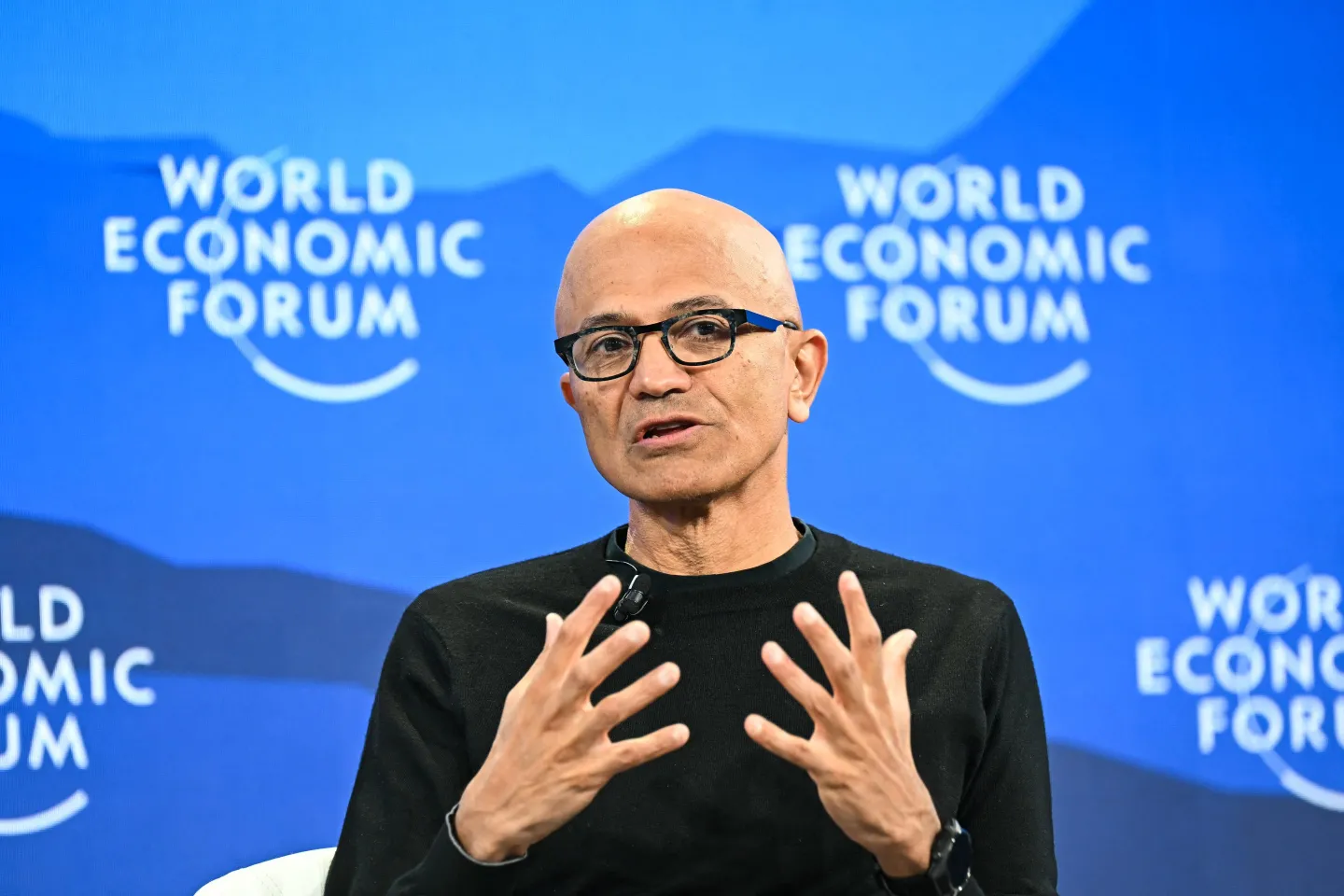
At Davos in January 2026, Satya Nadella issued a warning that contrasts sharply with the prevailing enthusiasm surrounding AI. According to him, the real risk of a bubble lies not in the models themselves, but in the concentration of benefits within a few dominant players. What’s at stake is not the performance of the technologies, but their ability to produce real, widespread, and inclusive economic impact. The warning deserves serious consideration: if the value generated by artificial intelligence remains confined to a few large companies or certain advanced economies, then the current excitement could prove speculative. The core message is clear: a technology that doesn’t translate into mass adoption or visible transformation of the economic fabric ultimately fuels a disconnect between promises and reality.
An AI Economy Without Massive Return on Investment
Nadella isn’t questioning the power of generative models or the relevance of infrastructure investments. He’s warning about an unbalanced economic dynamic: too much capital, too few tangible returns in the real economy. The potential bubble doesn’t result from an excess of technology, but from a failure to distribute value. In other words, the meteoric growth of cloud providers, GPU manufacturers, and AI startups doesn’t in itself guarantee a healthy technological cycle. What matters now is the ability to prove that artificial intelligence creates observable productivity, beyond showcase effects. The signal is shared by other players at Davos: Demis Hassabis, CEO of DeepMind, also mentions investments with bubble-like characteristics, particularly in startups without a finished product. The assessment is becoming cross-cutting: the AI ecosystem risks being structured around an excess of technological supply, without sufficient demand to sustainably support valuations.
Moving Beyond Big Tech to Avoid Speculation
For Nadella, the reality test is simple: if AI use cases don’t quickly move beyond Big Tech’s perimeter, the bubble forms. We need to observe where value is created: in large industrial companies, in government administrations, in SMEs, in developing countries. Even today, many economic players remain sidelined. The majority of SMEs have neither the technical means nor the internal skills to integrate AI into their processes. Emerging countries face major obstacles: lack of infrastructure, energy access, reliable data, and local skills. This gap is documented by international institutions, particularly UNCTAD, which warns of growing concentration of technological benefits in the hands of a few economic powers. This isn’t ideological criticism, but a structural reading of power relations on a global scale.
AI, an Energy-Intensive Industry
The formula used by Nadella in another speech—”tokens per dollar per watt”—clearly illustrates this reality. AI is becoming an energy-intensive industry, dominated by unit cost logic. The more widespread the usage, the more access to computational resources becomes a factor of economic power. The marginal cost of computation becomes as strategic as model quality. In this context, talking about AI democratization is no longer enough. We must question the concrete conditions of access: infrastructure, data governance, training, change management support. The promise of AI “accessible to all” remains theoretical as long as the total cost of use remains out of reach for small organizations. The diffusion of AI into the economic fabric is therefore an industrial policy issue, not just a matter of technological regulation.
The Productivity Test
The ability to generate real productivity constitutes an essential tipping point. If the promised gains don’t manifest in macroeconomic indicators—growth, competitiveness, employment, innovation—then doubt sets in. Recent economic history illustrates this: robust technological cycles are accompanied by visible transformation of the production model. Conversely, bubbles form when the narrative exceeds organizations’ capacity to absorb change. Recent analyses by the IMF and UNDP confirm this reading. AI can widen gaps if it primarily benefits organizations that are already best equipped. It can also generate asymmetric effects: massive gains for a few, painful adjustments for others.
An Open Architecture for a Resilient Ecosystem
From this perspective, Nadella’s position in favor of an open architecture takes on strategic significance. He advocates for a multi-model ecosystem, less dependent on a single provider, capable of fostering innovation and reducing rent-seeking effects. Behind this statement also lies Microsoft’s strategy: positioning itself not as a simple player, but as a platform hosting a diversity of actors (OpenAI, Mistral, xAI, etc.). This positioning allows absorbing market developments, capturing varied use cases, and making Azure cloud central to the AI value chain. That said, the scope of this model will depend on the real capacity to reach local ecosystems, beyond major digital capitals.
A Strategic Message for Europe
For European leaders, Nadella’s message contains an implicit warning. If Europe wishes to avoid increased dependence on foreign infrastructure, it must invest massively in local capabilities: computing centers, sovereign ecosystems, internal skills, data governance. Regulation alone won’t suffice to create a virtuous dynamic. The industrialization of AI at the SME level becomes a strategic priority. Without this, the continent risks remaining in a position of passive adopter, without sustainable value capture. In this equation, digital sovereignty isn’t just about server location, but about the capacity to produce, govern, and exploit AI models adapted to local needs.
Three Tests to Monitor AI Cycle Strength
In summary, the notion of an AI bubble doesn’t refer to an imminent collapse of technologies, but to a serious question about the distribution of benefits and the strength of demand. To distinguish between speculative bubble and sustainable innovation cycle, three indicators deserve monitoring: the integration of AI into real and measurable economic processes; SMEs’ ability to adopt these tools without excessive dependence; observable value creation among users, not only among infrastructure sellers. The next step won’t be technological, but organizational. And that’s where AI’s future as a transformation vector or as a capital-intensive mirage will be determined.
Primary source: ZDNet, “Microsoft CEO warns of AI bubble risk,” January 22, 2026 — zdnet.fr