
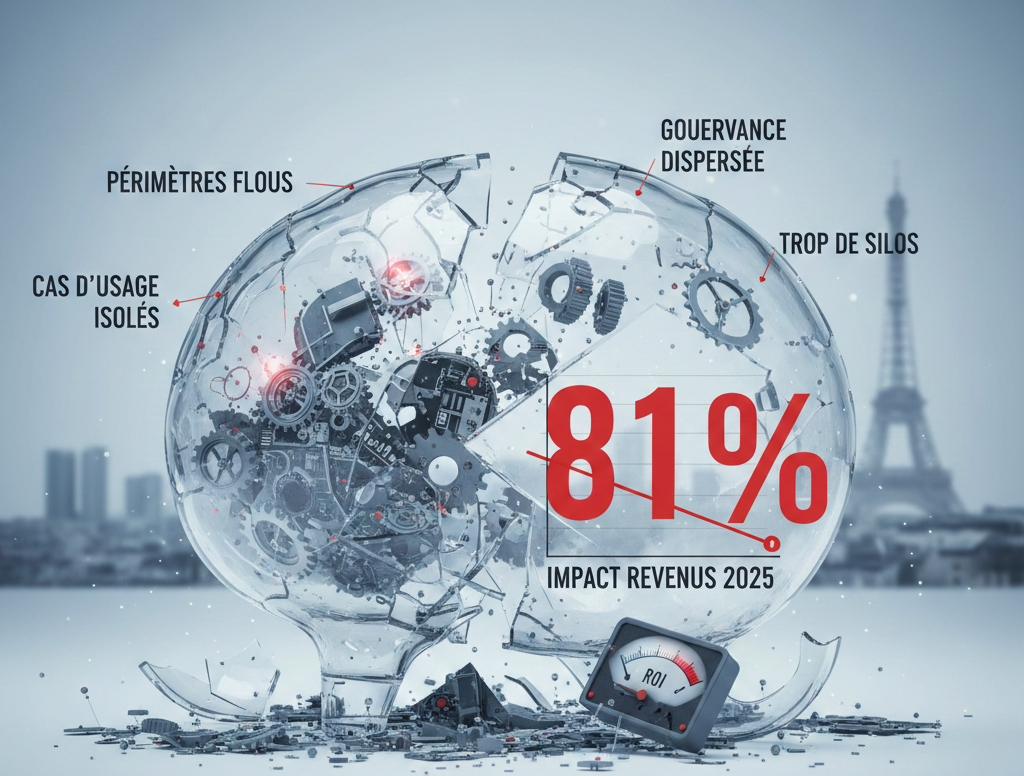
81% of French leaders declare that artificial intelligence has had no effect on their company’s revenue in 2025. This figure, drawn from PwC’s latest global survey (Global CEO Survey 2026), sounds like a wake-up call. Not about the technology itself, but about the ability of French companies to extract measurable value from it. Beyond the announcements and showcase projects, a reality emerges: the return on investment from AI remains difficult to demonstrate.
France is no exception when it comes to adoption. AI projects are multiplying: assistants, automation, customer service, predictive analysis. But the financial effects are slow to materialize. In 56% of cases globally, the executives surveyed by PwC have seen neither revenue increases nor significant cost reductions. In France, this finding is even more pronounced: only 19% of leaders identify a positive impact on their revenue. The question is no longer one of experimentation. It becomes one of transformation. Why, despite growing investments, does AI fail to convert its promises into tangible economic results?
The first identified obstacle is structural. AI is still too often deployed in the form of isolated use cases, driven by technical or business teams. These projects, while locally relevant, do not always fit into a logic of global optimization. Without process redesign, AI optimizes at the margins. It does not transform the core of the business model. In other words, it sometimes reduces the costs of a task, but not those of a complete process. It improves a service without modifying the end-to-end customer experience. To what extent are your AI projects integrated into your value chain? Are they technological add-ons or genuine performance levers?
Second factor: the absence of clear and centralized governance. Who drives the AI strategy? Who makes the trade-offs? What is the scope for measuring ROI? In many companies, AI still falls into a gray area of responsibilities. The IT department experiments, business units request, but few organizations have appointed a sponsor capable of arbitrating, prioritizing, and above all linking technological deployment to value creation. Globally, 70% of Chief Data & Analytics Officers (CDAO) are now responsible for AI strategy, according to Gartner. But in France, this role often remains confined to technical matters. Does your company have strong leadership in AI management? Is executive management involved in decisions related to the value produced?
Another pitfall: the difficulty in evaluating real impact. The ROI of AI cannot be read solely in cost reduction or immediate revenue increases. It can translate into better service quality, reduced churn, faster execution, or risk anticipation. These effects are real, but often poorly measured. Moreover, they can be neutralized by induced costs: infrastructure scaling, human supervision efforts, enhanced security, regulatory compliance. The net balance then becomes difficult to establish. And skepticism grows. Does your company measure AI benefits in financial or only operational terms? Do you have indicators shared between business, finance, and IT?
The European regulatory framework adds a layer of complexity. Between transparency obligations, ethical principles, data protection, and regulation of high-risk uses, companies must integrate a compliance dimension into their AI projects. This framework, while protective, can also slow industrialization. It requires legal resources, audit processes, and technical traceability. All necessary conditions for operating at scale, but barely visible in the immediate ROI calculation. Is AI designed in your organization as a strategic asset or as a regulatory risk project? Is compliance integrated from the design phase or endured at the end of the chain?
Beyond governance, the problem is also economic. In many companies, AI projects remain perceived as cost centers. Few are yet structured as profit centers. However, to generate clear ROI, AI must fit into a logic of offering or revenue. This involves improving a billed product or service, finer customer segmentation, creating new data-based offerings, or enhancing customer relationships through personalization. Without a direct link to financial flows, AI projects struggle to demonstrate their profitability. And become vulnerable during budget restrictions. Does AI in your company have an internal or commercial purpose? Does it generate savings or revenue opportunities?
The contrast with Asia is striking. According to PwC, Asian leaders are twice as likely to see revenue increases thanks to AI. They adopt faster, at greater scale, with a more pronounced customer orientation. This differential does not solely reflect digital culture. It reflects a more integrated approach: AI is not perceived as a technology, but as an execution infrastructure. Projects are not experimental, but directly linked to revenue streams. Governance is driven at the highest level. Can France catch up in AI value creation? Or are we settling into a model where innovation remains peripheral, not transformative?
Technological advances are accelerating the pace even further. AI agents, autonomous workflows, multi-agent systems represent a new stage. They require a complete redesign of execution chains: fewer repetitive human tasks, more supervision, more management by exception. But again, these innovations require integration capacity. They only produce value if the organization agrees to redefine its flows, roles, and indicators. Is your company ready to move from AI assistance to intelligent automation? Do you have the infrastructure and skills to industrialize this transition?
PwC’s latest survey shows growing concern among leaders. Nearly one in two estimates that their business model will no longer be viable in ten years without structural transformation. And yet, in practice, AI remains confined to one-off initiatives. Scaling up remains the exception. For many observers, the “elusive ROI” is less a flaw in AI than a revealer of governance, alignment, and management failures.
What if the real question was not: “Where is the ROI of AI?” But rather: “Are we ready to do what it takes for it to happen?”