
From Task Automation to the Emergence of a Structured Agentic Economy
A Disruption Deeper Than a Simple Technological Evolution
In less than twenty-four months, artificial intelligence agents have moved beyond the experimental stage to establish themselves as a new organizational foundation. This shift is neither a passing trend nor a simple scaling up of language models. It marks a structural transformation in how companies make decisions, operate, and create value.
The report AI Agent Bible – The ultimate guide to agent disruption, published in 2025 by CB Insights, stands as a major reference in this regard. It rigorously documents the emergence of a global agentic ecosystem, already supported by over 500 startups founded since 2023 and by all major tech players.
The question is no longer whether AI agents will prevail, but how organizations will structure their adoption without losing control of their critical processes.
From Assistive AI to Agentic AI
An AI agent is not simply an advanced chatbot. According to the operational definition adopted by CB Insights, it is a system based on language models capable of reasoning, planning, remembering, and acting autonomously, interacting with tools, data, and other agents.
This distinction is essential. While copilots merely assist humans, agents execute complete action chains, sometimes without direct human intervention. In 2025, most of these agents still operate with strict guardrails. But the trajectory is clear: autonomy is progressing as companies learn to manage risks.
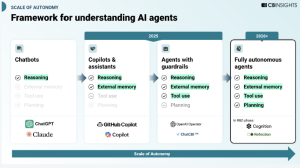
The report proposes an explicit maturity framework, ranging from chatbots to fully autonomous agents. This analytical grid moves beyond marketing discourse and enables objective assessment of a project’s actual level of AI autonomy.
Market Dynamics of Unprecedented Intensity
 The numbers speak for themselves. Mentions of AI agents in financial communications have increased tenfold since 2023. A quarter of agent startups created since that date are already in commercial deployment phase. Among the 1,500 technology markets tracked by CB Insights, five of the ten most active in 2025 are directly related to AI agents.
This acceleration is unprecedented. Historically, infrastructure technologies took several years to reach significant commercial maturity. AI agents cross this threshold in less than two years. This speed imposes rapid decision-making on executive leadership, often without sufficient historical perspective.
The Real Battleground: Architecture, Not the Model
One of the report’s major contributions lies in shifting the focus. Value no longer resides primarily in the language model. It is built into the overall architecture: data, context, orchestration, security, governance.
CB Insights maps an agentic tech stack structured in distinct layers: models and infrastructure, agent frameworks, tool integration, context and memory management, multi-agent orchestration, supervision and governance. This approach highlights a key point: an agent without reliable access to the right data, at the right time, becomes a risk factor rather than a performance lever.
This strategic shift explains the rapid emergence of new markets, particularly in observability, governance, and agent security.
Protocols and Standards: The Battle for Interoperability
The agentic economy cannot function without standards. Three protocols have established themselves in less than a year as structural building blocks: Anthropic’s Model Context Protocol, Google’s Agent-to-Agent Protocol, and IBM’s communication protocol.
These initiatives aim to solve a fundamental problem: enabling heterogeneous agents to communicate, coordinate, and act in complex, distributed environments. The parallel drawn by CB Insights with the pre-TCP/IP Internet is illuminating. Without shared standards, agents remain technological silos.
The rapid adoption of these protocols by major consulting firms, cloud providers, and software publishers indicates that interoperability is becoming a strategic prerequisite, not a technical luxury.
When Agents Enter the Real Economy
One of the most significant turning points concerns the emergence of agentic commerce. For the first time, infrastructures enable agents to execute financial transactions on behalf of users, within predefined authorization frameworks.
Players like Stripe, Visa, Mastercard, and Coinbase are investing in this field. Stripe announced the launch of an agentic commerce protocol designed to standardize exchanges between agents, businesses, and payment systems. This evolution opens the door to previously theoretical scenarios: agents negotiating purchases, arbitrating suppliers, or optimizing supply chains in real time.
This market remains immature. But it crystallizes a strategic convergence between AI, fintech, and commerce, with major regulatory implications.
The Economic Shock of Reasoning
The report devotes an in-depth analysis to a still-underestimated phenomenon: the cost of reasoning. Reasoning models, which have enabled “vibe coding” and the execution of complex tasks by agents, multiply the volume of tokens generated by twenty.
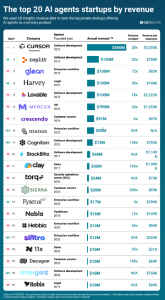
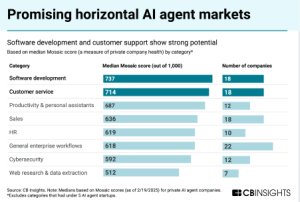
In the software development agent sector, this dynamic has caused brutal margin compression. Companies displaying spectacular revenue growth find themselves confronted with inference costs that exceed captured value. Result: price increases, questioning of subscription models, and multiplication of acqui-hires rather than traditional acquisitions. This lesson extends far beyond the code domain alone. It foreshadows what awaits other agent categories as intensive reasoning use cases become widespread.
Governing Agents Becomes a Strategic Issue
As agents gain autonomy, the question is no longer just what they can do, but how they are supervised, audited, and controlled. CB Insights identifies the rapid emergence of a market dedicated to agent observability and governance.
Voice testing, synthetic users, human-AI productivity measurement, decision traceability: these tools become indispensable to avoid costly failures. In certain sectors, particularly cybersecurity, the report anticipates a profound transformation of professions, with professionals evolving toward roles supervising armies of specialized agents.
An Organizational Transformation, Not Just Technological
The central message of the AI Agent Bible is unambiguous. AI agents are not simple tools. They redefine the very structure of organizations. They modify value chains, redistribute responsibilities, and impose a new form of governance.
The strategic question for businesses is no longer “should we adopt AI agents?”, but:
- which agents to deploy,
- on what data,
- with what guardrails,
- and under what human responsibility.
Organizations that master orchestration, governance, and the real economics of agents will build a lasting advantage. Others risk undergoing automation they no longer control.
Article published as part of EntrepreneurIA by Yunova