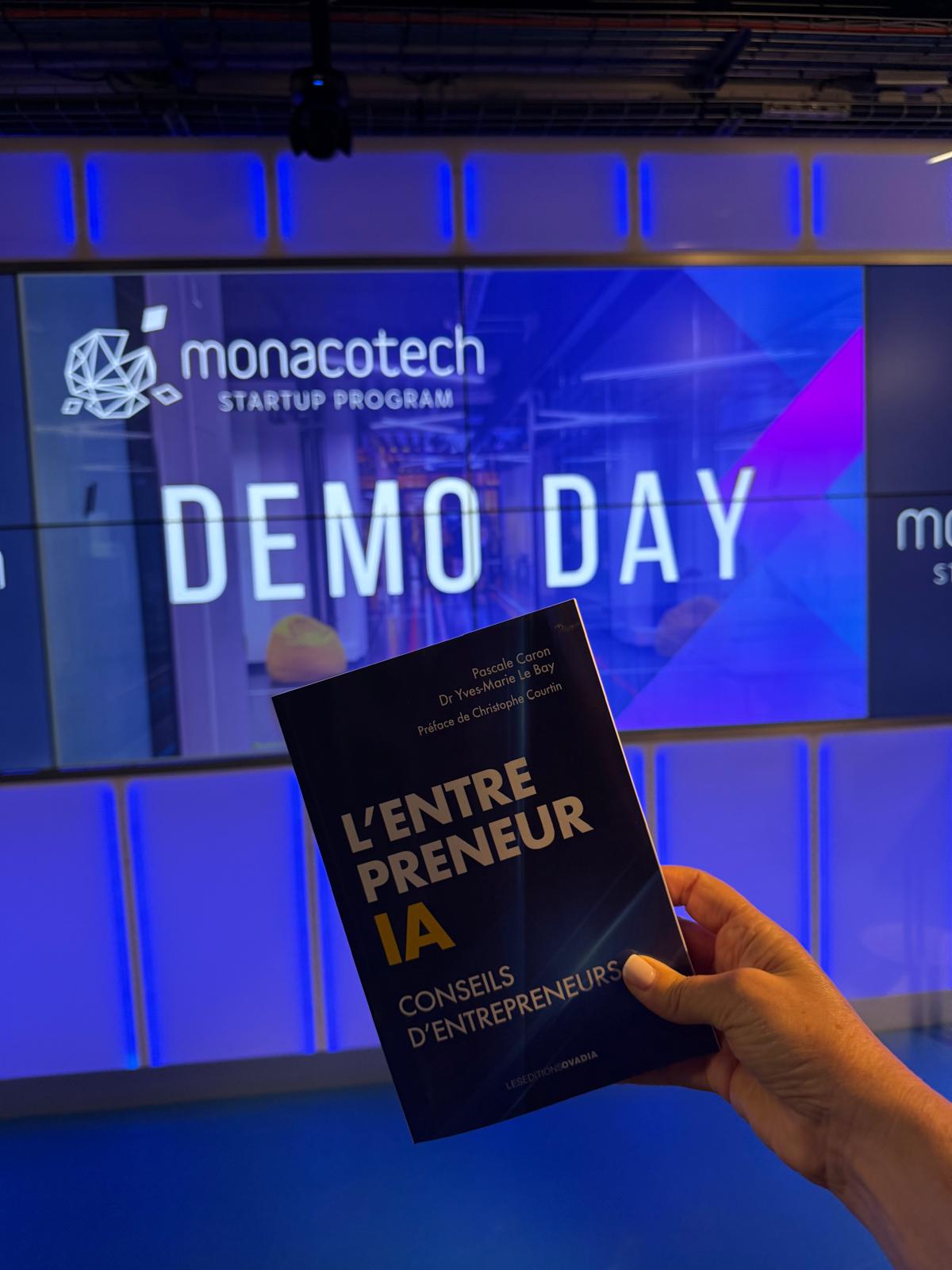
 The Demo Day evening was both a startup showcase and a pivotal moment for MonacoTech. It marked the culmination of Sandrine Sauval-Chanteloube’s four years of leadership. Her tenure shaped the incubator, strengthened its methods, expanded its network and structured an environment conducive to demanding innovation. Yesterday’s event sealed this work. It offered a final snapshot of the momentum she generated: a more mature ecosystem, better connected, resolutely focused on impact and technological credibility.
It was in this continuity that Sandrine Sauval-Chanteloube handed over to Chloé Boscagli, recently appointed director of MonacoTech. The transition took place in a climate of trust and ambition. Chloé arrives at a time when MonacoTech is scaling up. She follows in the footsteps of the work accomplished, while bringing a vision focused on acceleration, international openness and technological sovereignty.
 The evening revealed more developed projects, clearer ambitions and a clear alignment with major contemporary challenges.
Among the startups on display, two AI projects immediately stood out for their relevance and conceptual solidity. The first, KLA Digital, offers comprehensive governance of artificial intelligence in enterprises, at a time when the AI Act imposes strict obligations. The second, DataGreen, rethinks the very structure of digital infrastructures with ecological, sovereign and ultra-dense data centers, capable of meeting the growing needs of AI models.
KLA Digital’s pitch immediately tackled a central challenge: how to deploy AI in critical processes without exposing the company to regulatory, operational or reputational risks? The explosion of use cases, the rapid emergence of autonomous agents and the rise of tools capable of acting on sensitive systems create an area of uncertainty. European regulation reinforces this complexity. The AI Act introduces strict requirements for transparency, control, documentation and traceability. Penalties are high. Legal risks are concrete.
 The platform presented by KLA Digital responds precisely to these constraints. It offers a comprehensive governance layer on top of AI systems. It manages permissions, traces decisions, supervises behaviors, generates evidence necessary for audits and integrates human validations adapted to internal processes. It centralizes logs, guarantees their integrity, automates document production and ensures continuous supervision of agents. It provides a robust framework for transforming peripheral experiments into deployments on sensitive functions.
The approach is based on a simple idea: AI must become predictable, reliable and controllable. A “boringly safe” structure, designed to offer operational and regulatory confidence. This architecture becomes the condition for strategic use of AI in sectors where every decision counts. As long as companies do not have such tools, their AI projects will remain confined to the margins, far from the operational core. KLA Digital’s presentation showed that this phase of immaturity is coming to an end.
 The second pitch opened a complementary but equally strategic horizon. DataGreen addressed a topic that few players tackle with the same radicality: the physical transformation of data centers. The energy footprint of computing centers continues to increase. GPUs proliferate. AI models consume considerable amounts of energy. Traditional infrastructures are reaching their limits, whether in terms of cooling, density, costs or environmental impact.
DataGreen proposes a profound disruption. Its technology is based on direct-to-chip liquid cooling operating in a closed loop. It completely eliminates air conditioning. This single innovation reduces the overall energy consumption of the data center by half. Servers are isolated, protected from external attacks. A stabilized internal microclimate allows them to be installed anywhere: on a roof, in a parking lot, outdoors, in a container. This flexibility opens the way to modular urban architectures, adapted to dense territories like Monaco.
The computing density is spectacular: up to forty GPUs in a single server. The necessary space decreases by 90%. This compactness directly responds to the needs of modern AI. Heat recovery, reaching 98%, transforms the data center into a thermal resource. The energy produced can heat or cool buildings, offering a rare circularity for this type of infrastructure.
DataGreen’s business model revolves around the sale of servers, retrofitting of existing infrastructures and AI-assisted predictive maintenance software. The company positions itself as a key player in the decarbonization of digital infrastructures, capable of reconciling performance, sovereignty and sustainability.
Other startups completed the evening by illustrating MonacoTech’s diversity. Poseidon “From sea to surface” explored solutions from the marine environment. Omnivorus SmartFood proposed an innovative approach to sustainable food. Nova-doc presented a platform designed to simplify onboarding and supplier management, an issue that has become strategic for organizations in transformation.
The whole painted a coherent landscape. MonacoTech now attracts more ambitious projects, more aligned with major societal transitions. The incubator positions itself as a place where innovation confronts reality, is structured and deployed. Its strength lies in its ability to test quickly, to adjust, to support and to connect startups to a dense institutional ecosystem.
The handover between Sandrine Sauval-Chanteloube and Chloé Boscagli crystallized this evolution. It signified the end of a remarkable cycle and the opening of another, equally decisive one. The incubator is entering a phase of new intensity, demanding, focused on issues of sovereignty, ecology, infrastructure and profound transformation.
An ecosystem ready to support fundamental transformations and contribute to a sustainable technological future.