
Data: An Asset That Has Become a Matter of Trust
Paris – Les Échos.
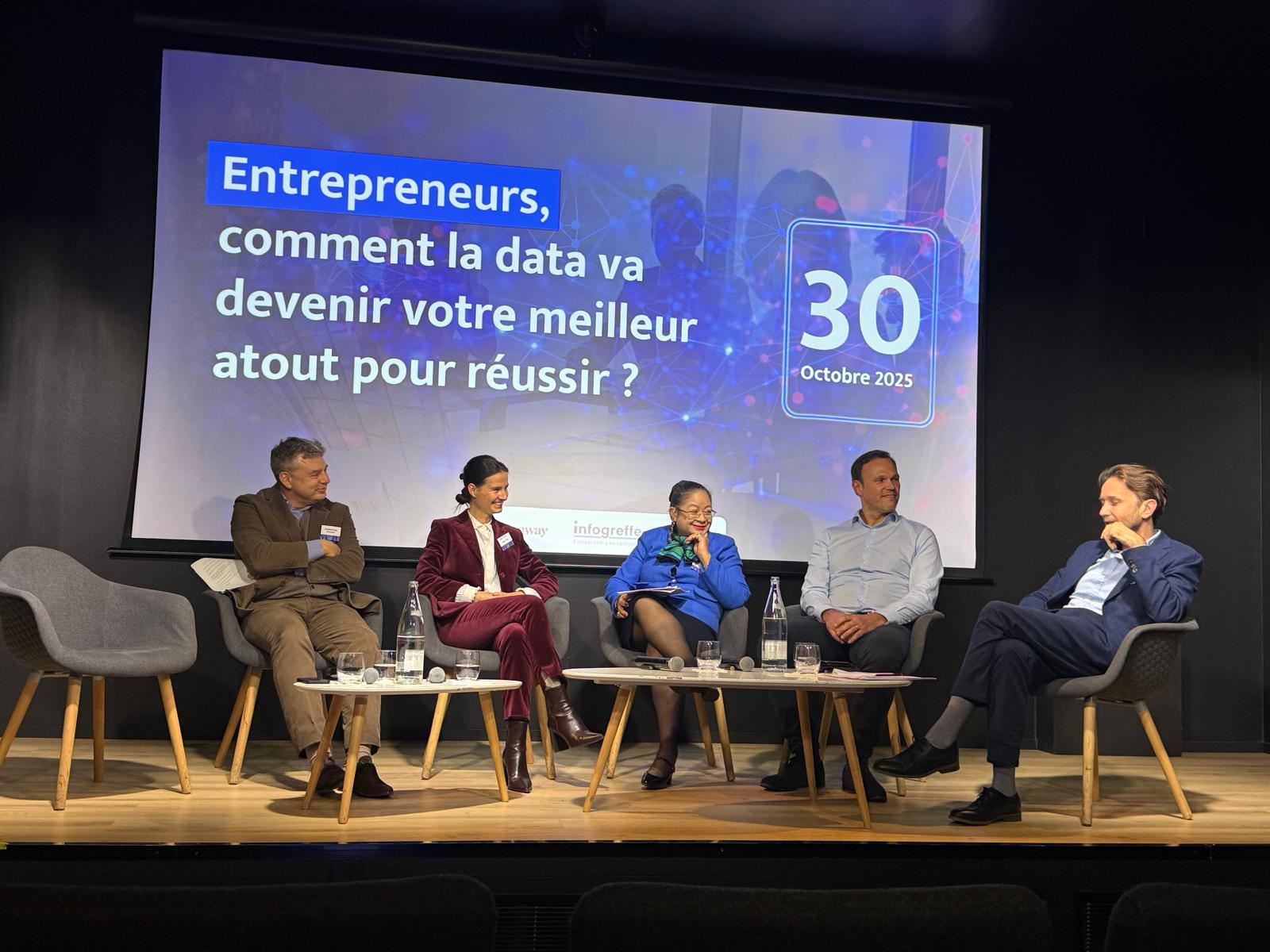
The conference organized by Les Échos, OpinionWay, and Infogreffe, moderated by Charlie Perreau, Head of the Tech-Media-Startups section at Les Échos, brought together executives and experts around a unanimous observation: data is no longer a technical flow, but a strategic asset that involves trust.
“Data is not a neutral asset, but a contract of trust,”
emphasizes Bruno Jeanbart, Vice President of OpinionWay, at the opening of the presentation of the OpinionWay x Infogreffe barometer.
The figures confirm this awareness: only 47% of executives believe they have sufficient data culture, while 82% consider data reliability a determining factor in competitiveness.
For Infogreffe, corporate data becomes a public trust infrastructure. By centralizing, certifying, and making it traceable, the institution provides an essential framework of reliability in an environment dominated by digital flows and predictive AI.
Reliability is no longer a regulatory option: it has become a condition for economic survival.
Three Entrepreneurial Voices: Between Vigilance and Innovation
On stage, three executives embody the diversity of uses and sensibilities around data.
Mehdi Ouchallal, co-founder of LegalPlace, opened the dialogue between legaltechs and institutions. “Simply accessing data doesn’t make it valuable. It must be qualified, cleaned, contextualized.”
His experience as a lawyer turned entrepreneur illustrates a central issue: in the legal field, the fragmentation of databases generates inconsistencies with real economic consequences.
Nadine Rakotonanahary, founder of Forwarding Logistic & Shipping, provides concrete insight from the maritime transport world. “Corrupted logistics data doesn’t just cost money: it destroys the credibility of an entire chain.”
She emphasizes the challenge of real-time traceability and cybersecurity, now vital for a sector where each link in the chain depends on the reliability of the previous one.
Finally, Inès Hamy, lawyer and CEO of Octolo.tech, questions human responsibility in the age of generative models. “ChatGPT or Gemini may seem reliable, but if the input data is false, they amplify the error. Reliability then becomes a shared responsibility between humans and machines.”
Author’s Perspective
Beyond the conference discussions, this issue questions the very posture of the executive in the digital age.
Sovereignty is no longer limited to server location or legal compliance. It becomes an act of governance.
The modern entrepreneur must learn to master their data flows, understand their strategic value, and distinguish reliable information from noise. Transparency, often perceived as a constraint, now emerges as a differentiating factor.
In an environment saturated with AI, where decisions are automated, chosen transparency becomes a tool for trust and competitiveness. This cultural shift marks the end of passive data management and the emergence of mastered data.
Artificial Intelligence: Catalyst for Efficiency, but Revealer of Vulnerability
While artificial intelligence amplifies the decision-making power of organizations, it also reveals their structural weaknesses. Poorly fed AI—that is, fed by biased or outdated data—produces massive errors. The danger lies not in the machine, but in the illusion of algorithmic truth.
This reflection aligns with an observation I often make in business: an AI’s performance depends less on its technical sophistication than on the quality of the data it ingests. This logic places human responsibility at the center of the technological system. The challenge is no longer raw performance, but interpreted reliability: understanding what the data says, and especially what it doesn’t say.
Executives must therefore implement data audit mechanisms before deploying any predictive model. Traceability, required by the AI Act, represents a major step toward shared digital responsibility.
From Imposed Transparency to Chosen Transparency
Far from being a mere regulatory requirement, transparency becomes a strategic value. Companies that choose clarity build lasting trust capital. They demonstrate that data is not a resource to exploit, but a commitment to keep.
“True sovereignty is not in the possession of data, but in the ability to guarantee its truth”
Data, yesterday a compliance tool, today becomes a symbol of coherence. In a world saturated with automation, reliability becomes a human act again—a conscious, responsible, and meaningful choice.
Key Takeaways
- Reliability trumps quantity: accurate data is worth more than unreadable volume.
- AI reveals hidden biases: it demands enlightened governance.
- Executives must become guardians of meaning again: their sovereignty depends on mastering information.