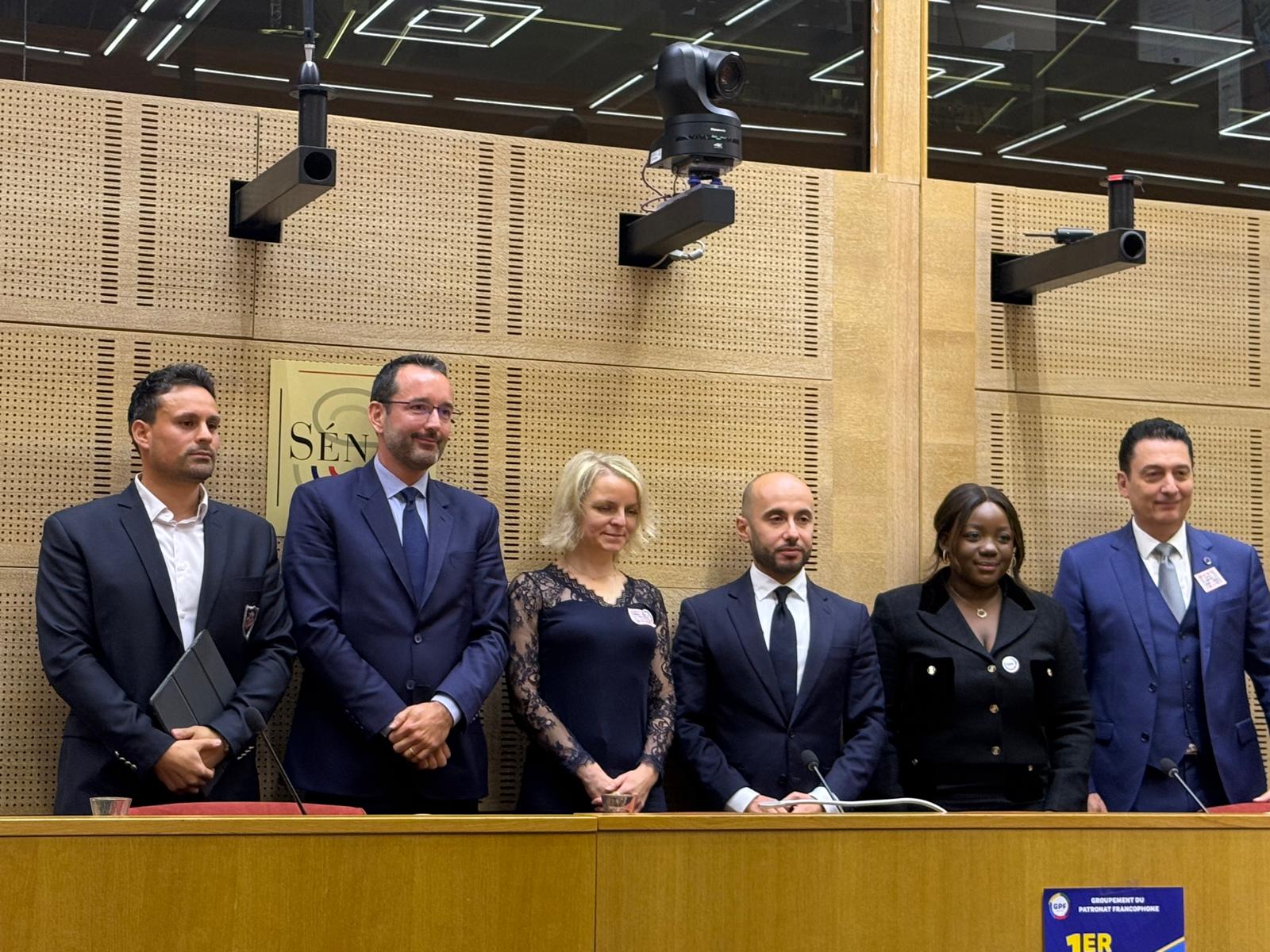
Senate, Paris — The Forum of the Francophone Business Group (GPF) continued with a third roundtable devoted to a central issue: green and digital finance in the Francophone space. After debates on artificial intelligence and the circular economy, this panel shifted focus to financial instruments, emerging technologies, and how the Francophonie can structure a collective approach.
Moderated by Houssam Nasrawin, Middle East Head of Investor Relations, the discussion brought together four speakers from complementary backgrounds:
- Ornella Bonioma, CEO of Odaa Consulting and founder of an NGO supporting women and the environment.
- Svetlana Cranga, CEO of Natixar, a specialist in blockchain and sustainable finance.
- Eddy Rhimi, entrepreneur engaged through a climate credit initiative.
- Alexandre Lhéritier, co-founder and president of Koaloo.fi, a fintech dedicated to ESG.
A colossal gap between needs and means
In opening, Houssam Nasrawin painted a stark picture. Initiatives are multiplying—green bonds, impact credits, ESG funds—but the amounts committed remain largely insufficient. “The funds mobilized today are counted in tens of billions of euros, while the needs amount to thousands of billions. For Africa alone, €2,500 billion would be needed in the next five years to achieve the ecological transition,” he reminded, citing the UN.
The central question of this panel was posed: how can digital tools and financial instruments bridge this imbalance?
Changing the African narrative
First to speak, Ornella Bonioma presented her background and the work of her firm Odaa Consulting, specializing in CSR, and her NGO dedicated to women’s rights and the environment. Her plea focused on two axes: the need for massive investments in Africa and control of the narrative around the continent.
“Africa is the lungs of the world. Our peatlands absorb enormous amounts of carbon. We emit little, but we’re on the front lines. Yet we’re told: you can’t develop like others,” she denounced.
Her call was clear: give investors confidence. “Communication is key. Too often, Africa is perceived through the prism of war or corruption. We must change this image and show that we are the solution to the climate crisis.”
On the opportunities side, she emphasized the energy mix. “We can’t depend on a single resource. Oil won’t disappear tomorrow, but we must develop solar, hydro, wind. Investors can bring technologies and financing.”
Regulation, innovation and blockchain
The CEO of Natixar, Svetlana Cranga, brought a technological and pragmatic vision. For her, three levers are essential: regulation, innovation and digital.
On regulation, she called for international standardization. “Europe is multiplying standards, sometimes to the detriment of competitiveness. But this framework must be extended globally. Otherwise, efforts will remain imbalanced.”
On innovation, she highlighted current technical limitations: intermittency of renewable energies, battery maturity, CO₂ capture costs. “Innovation is a catalyst. It alone will enable the shift from discourse to industrial reality.”
Finally, she emphasized the cross-cutting role of digital, particularly blockchain. “Blockchain guarantees transparency and traceability. It’s estimated that €87 billion in supposedly green funds were invested in companies that weren’t. Blockchain makes data verifiable and auditable.”
She cited the example of ESG-certified critical minerals in the DRC, where blockchain enabled the creation of a market premium for responsible metals.
Climate credit as financial innovation
Entrepreneur Eddy Rhimi presented an original initiative: climate credit, complementary to carbon credits.
He recalled the limitations of carbon credits, focused on offsetting the past. “We imagined a climate credit that addresses the future. Each token is backed by an ecological project. Thanks to blockchain, every euro invested is traceable, irrefutable and dedicated to a real project.”
His model is based on a “token economy” with a fixed supply of 200 million tokens. “Unlike carbon credits, which appear in companies’ liabilities, climate credit is recorded as an asset, because it appreciates over time.”
This approach is already attracting investors: “In one week, our token went from $1 to $14.5 without official communication.”
Despite skepticism caused by cryptocurrency volatility, Eddy Rhimi emphasized rigor
ESG as a competitiveness factor
A former investment banker, Alexandre Lhéritier explained why he co-founded Koaloo.fi, an ESG fintech. His diagnosis is severe: “There’s a considerable gap between companies that access financing and those that need it.”
Koaloo.fi aims to finance value chains—the suppliers of large groups—at much more advantageous conditions. The objective is twofold: encourage SMEs to share their ESG performance transparently and help them finance their transformation.
To illustrate ESG’s impact, he cited the example of Porsche: “In July 2024, a flooded supplier halted production. Result: 10,000 cars not produced, a loss of €5.5 billion in market capitalization in one day. This proves that ESG is a matter of resilience and profitability.”
According to him, AI can strengthen this dynamic by improving the quality and verification of ESG data, particularly in supply chains which often represent 90% of a company’s carbon footprint.
Convergences and tensions: finance, digital and sovereignty
The exchanges highlighted several convergences:
- The importance of transparency (via blockchain or AI),
- The need for massive investments in energy, logistics and agriculture,
- The key role of communication and trust to attract investors to Africa.
But tensions persist:
- The balance between regulation and competitiveness,
- Skepticism about cryptocurrencies and the risk of greenwashing,
- The difficulty of aligning international standards.
A Francophonie at a crossroads
This third panel confirmed a crucial point: green and digital finance is an essential lever, but it remains hampered by a lack of harmonization and by the massive financing deficit that Africa needs.
The speakers nevertheless showed that the Francophonie has unique assets: natural resources, local talent, digital innovations and the will to build an alternative model.
Green finance will not only be a question of capital. It will also be a battle of narratives, standards and governance. And on this terrain, the Francophonie can play a decisive role.