
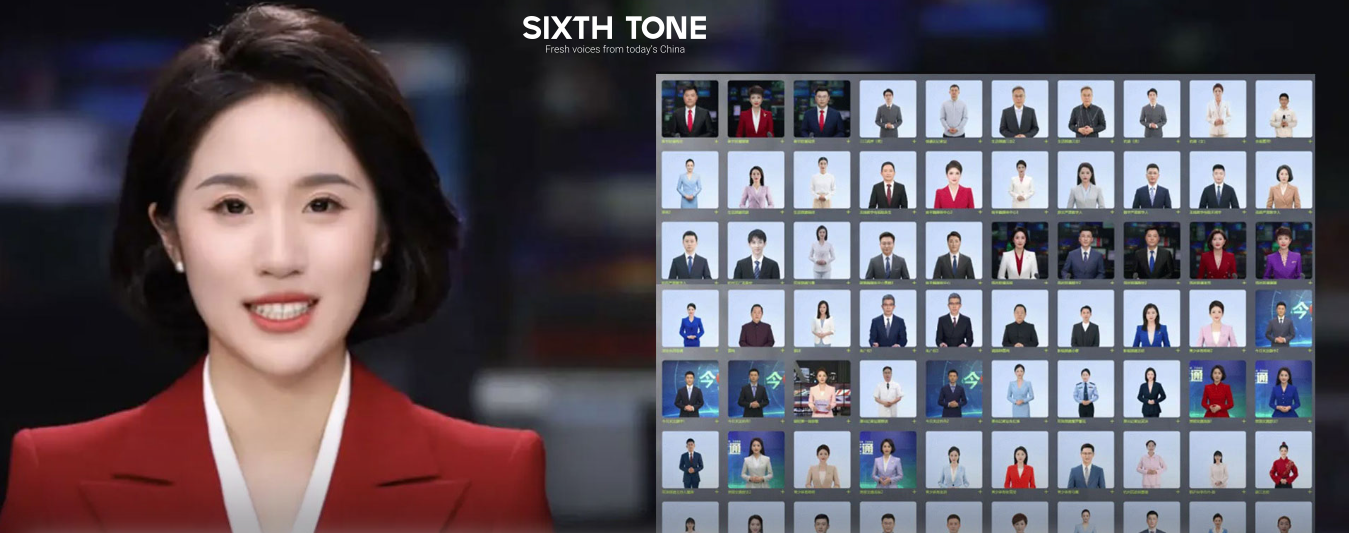
On July 3, 2025, Sixth Tone published a revealing article on the rapid integration of artificial intelligence in Chinese newsrooms. Digital avatars, faithful replicas of human journalists, were deployed to present television news during the Lunar New Year holidays. These AI clones have become the faces of news bulletins broadcast across the country, from Shanghai to Zhejiang province. Beyond the technical feat, this trend raises fundamental questions: what remains of the journalist’s profession when a digital clone can occupy the airwaves, without fatigue or apparent error?
An optimization lever for broadcasters
The economic argument is compelling for broadcasters. These AI agents require no salary, no rest, no studio set. They operate continuously, with perfect diction, and can read scripts generated by LLMs (large language models) at any time. Some channels even use replicas of well-known presenters to maintain apparent continuity. According to proponents of these innovations, automation improves productivity without harming quality.
A cold reception in newsrooms
On the ground, the perception is quite different. Han Rubing, a 26-year-old journalist interviewed by Sixth Tone, admits to being troubled by the resemblance to a colleague temporarily replaced by his AI double. “You could barely distinguish the original,” she recounts. But beyond the technical performance, she highlights a fundamental difference: the absence of warmth, improvisation, humanity. “It’s just a cold machine reading a text,” she says. A sentiment shared by many professionals, who see in this evolution a reduction of their role to a simple transmission function.
Soulless avatars
The most recurring criticism concerns the lack of emotion and authenticity. Che Youlu, an editor in Beijing, observes that avatars can imitate pauses, smiles, intonations. But according to her, “it’s only surface-level.” They grasp neither the gravity of a tragic announcement nor the subtleties of political news. In her eyes, the public connects with a personality, not with a soulless voice. It’s this emotional connection that makes all the difference between a human being and their generated double.
Reforming training, revaluing the human
In this context, university institutions are reacting. The Communications University of China and Renmin University, two institutions renowned for training journalists, are revising their programs. Objective: to reaffirm irreplaceable human skills. Courses now emphasize improvisation, live broadcast management, emotional storytelling, interpretation. Critical analysis, contextual understanding, and ethics are also reinforced.
For Gao Guiwu, professor at Renmin, AI plays an ambivalent role. It acts as a revealer, highlighting easily automatable tasks. But it also offers an opportunity: to reassess the true added value of the journalist. “AI is a mirror,” he states. “It forces us to rethink what makes us unique.” For her part, Li Hongyan, from the Communications University, reminds us that AI can read a script, but doesn’t know what really matters in news. It grasps neither the implicit, nor irony, nor social stakes.
A new generation under pressure
Faced with this transformation, pressure is increasing on students. Journalism remains a highly sought-after field: more than 10,000 candidates apply each year for 100 places at the Communications University. But the competition is no longer played out solely on traditional skills. Now, young journalists must also master digital tools, produce short video formats, know how to interact with online audiences, develop a presence on social networks.
Many of them, like Zhang or Ma Zhiyao cited in the Sixth Tone article, are already considering broadening their profile. They are moving toward multimedia content creation, digital communication, even AI tool development. Some are considering a career change into the technology sector. This shift testifies to an awareness: reading a teleprompter is no longer enough. Analysis, creativity, and the ability to reach an audience are becoming essential.
Cooperating rather than resisting
It’s not simply about resisting AI, but coexisting with it. Automation can certainly replace repetitive tasks. But it also opens a field of innovation: new interactive formats, live interviews enriched by data, narratives augmented by virtual reality. Channels that invest in human talent while integrating AI tools could gain an advantage.
A question of trust and transparency
The debate also extends to the ethical sphere. If AI presenters become indistinguishable from humans, how can transparency be guaranteed to the public? Should a visual label be imposed signaling that it’s an avatar? What safeguards will prevent manipulations, deepfakes, information falsifications? The risk of confusion is real, especially since avatars are capable of personalizing their discourse according to the target, without awareness of social or political implications.
Standardized content, an impoverished public space
This phenomenon is part of a broader logic, that of content industrialization. AI enables low-cost, large-scale production, but often without discernment. In countries where press freedom is limited, this automation can become a propaganda tool: controlled information, repeated identically, without possibility of contradiction or critical interpretation.
Preserving the soul of the profession
In this context, the journalist’s role becomes more precious than ever. It’s no longer just about reporting facts, but contextualizing them, asking questions, alerting to abuses. The ethical dimension, long relegated to the background in some schools, is becoming central again. Training must integrate deep reflection on AI’s social impact, content regulation, the editor’s responsibility regarding algorithms.
Toward a hybridization of profiles
There are numerous evolution paths. Hybrid programs are emerging, combining journalism, data science, social psychology, and immersive technologies. The objective is to train professionals capable of working in collaboration with AI, while keeping control over editorial decisions. Some institutes are even developing training in supervising generative models, detecting factual errors produced by LLMs, or AI-augmented writing.
Resisting the temptation of all-technical
Ultimately, the challenge lies not in the technical performance of avatars, but in our ability to preserve the essence of the profession: the demand for truth, the embodiment of a perspective, the defense of public debate. Artificial intelligence can automate, it cannot be indignant. It can read, but not understand. It can imitate, but not feel. It’s in this tension between speed and meaning, between standardization and subjectivity, that the future of journalism is being played out.
Photo Six Tone