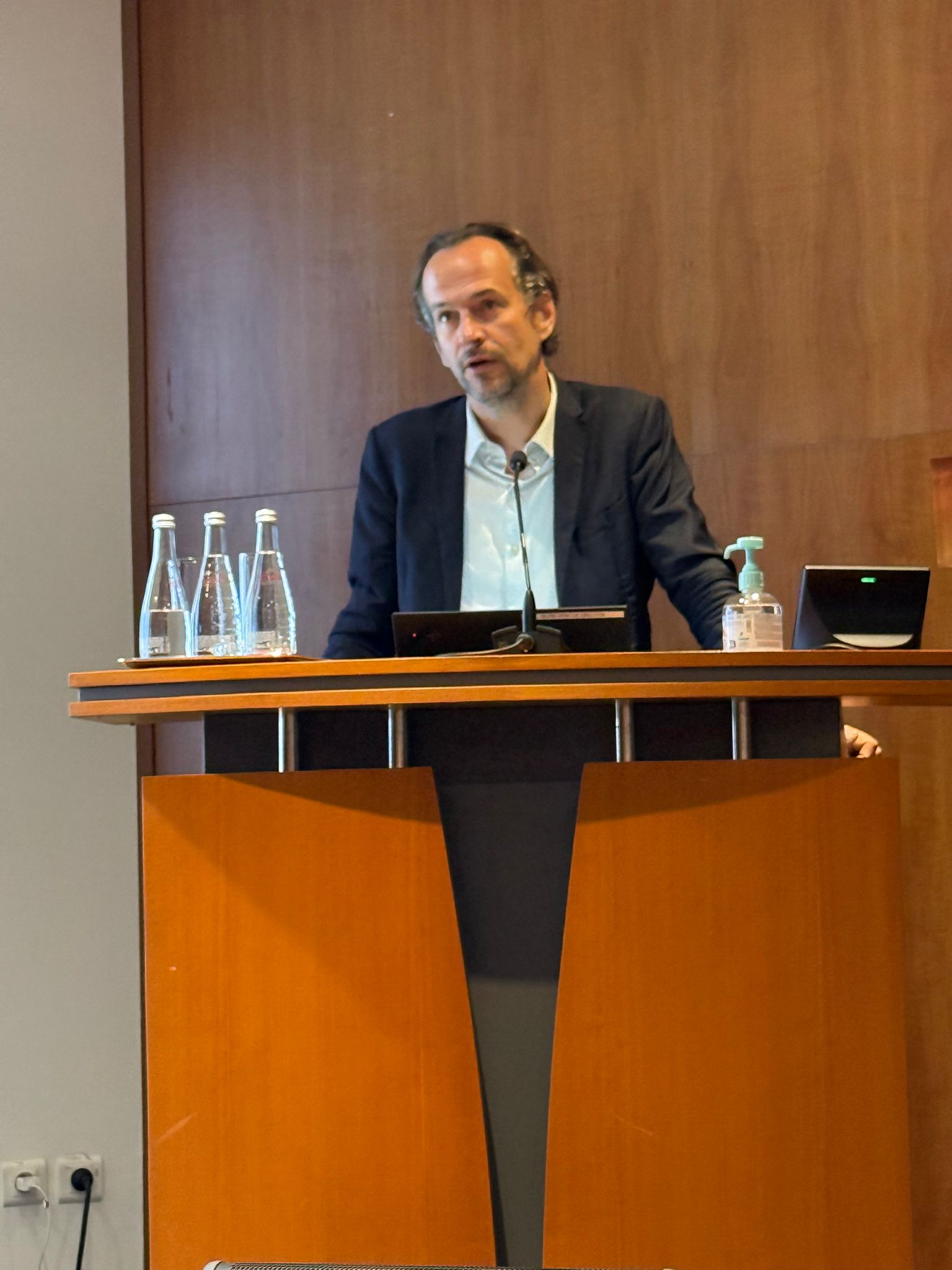
On June 17, 2025, the Lou Clapas Amphitheatre at the Princess Grace Hospital Centre hosted a remarkably substantial conference on the ongoing revolutions at the intersection of artificial intelligence and healthcare. Organized by Ms. Benoîte Rousseau de Sevelinges, Director of the CHPG, it was led by David Gruson—a renowned expert, director of the home healthcare program at La Poste Santé et Autonomie, and a committed author. This gathering aimed to examine the ongoing transformations with a seemingly simple question: AI and Healthcare: what revolution(s)?
Behind this plural question lies a fundamental debate: how can we integrate AI into care practices without losing control or ethics? Gruson proposes a path: that of positive regulation, rooted in human values, education, traceability, and anticipation.
The Urgency of a Framework: From Regulation by Refusal to Regulation by Usage
From the outset, David Gruson advocates for a posture of regulated openness, which he contrasts with two extremes: the timid blocking of innovation and technophilic frenzy. He champions an approach that the French National Ethics Committee calls a “revolution of minds”: refusing AI in healthcare would generate an ethical loss of opportunity for patients. He grounds this conviction in the work of the 2021 bioethics law and in opinion 141 of the National Consultative Ethics Committee from 2023.
“We are no longer dealing with science fiction, but with reality. We must regulate, not block.”
This conceptual shift fuels the strategy of the European Health AI Act, from which the Principality of Monaco can freely draw inspiration. This text is based on a logic of risk proportionality: the higher the impact of a system, the greater the regulatory requirement must be.
Generative AI, Agentic AI: Technological Disruptions to Regulate
Another strong message runs through his presentation: technology is now moving much faster than institutions’ ability to regulate it. Over the past 18 months, the breakthrough of generative AI and Agentic AI (or mission AI) has accelerated this asymmetry.
“What we now call Agentic AI are systems capable of handling a series of autonomous tasks, controlling other digital tools.”
David Gruson warns here of the ambiguity of the term—in computing, everything is potentially an “agent”—and prefers the designation mission AI, emphasizing their ability to embed other intelligences for defined purposes. This is precisely what he explores in his novel SARAH, where a fictional AI manages a health crisis with cold rationality. This fiction, he writes, is a tool to work on our mental representations of AI and simulate ethical dilemmas.
Between Fiction and Reality: The Blurred Boundary of Life
David Gruson develops an original reflection on the ontology of life. By examining the Larousse definition, “a being possessing complex structures, capable of resisting change, growing, and reproducing,” he suggests that certain self-learning algorithms could meet these criteria.
This tension between the living and the artificial constitutes, according to him, one of the fundamental challenges of AI in healthcare: where does the biological end, where does the computational begin? This is exemplified by the analogy he develops with the blob, a unicellular organism capable of collaborative learning—a perfect metaphor, according to him, for deep learning. “Everything existed in nature before being in machines.”
Concrete Use Cases in Healthcare: Promises and Limitations
The discussion becomes more pragmatic when Gruson describes current use cases:
- Medical image recognition: analysis of X-rays, MRIs, dermatology, melanoma detection at home by independent nurses with deferred human validation by specialists.
- Medical consultation synthesis: generative AI automatically transcribing exchanges between doctor and patient to enrich medical records.
- Risk prediction: AI analyzing correlations in genomic databases to refine diagnoses, particularly in gynecology.
- Access to care: AI used to address medical deserts, with experiments in Gaillac, Menton, or the valleys of the Alpes-Maritimes.
He emphasizes the importance of supporting these deployments with human guarantee protocols. At Saint-Joseph Hospital, for example, radiology assistance AI is used at night in emergency departments with deferred human review.
The Challenge of Medical Free Will
The central question underlying these uses is that of free will. By pushing algorithmic logic to its extreme, don’t we risk reducing the practitioner’s role to that of a mere executor?
“The risk is not AI alone. It’s breaking medical intuition, that unique dialogue between doctor and patient.”
He calls for preserving spaces of hesitation, doubt, and shared reflection, against the temptation of absolute objectification of care. This point connects with the notion of cognitive delegation, one of the major ethical risks of AI.
Sovereignty and Platform Control
David Gruson also warns against a loss of algorithmic sovereignty. If healthcare professionals share sensitive data (such as consultation summaries) through general tools like ChatGPT, they lose control of it.
“The real danger is not just legal. It’s no longer controlling the strategic data of the healthcare system.”
He cites here the Dalia project developed by La Poste: a sovereign AI for medical synthesis assistance, designed in a secure HDS environment. The example illustrates a European alternative to dominant American models.
HR Impact: Automation Without Elimination
Another strong theme of his presentation is that of human resources. Contrary to some fears relayed in the media, AI does not eliminate medical professions.
Gruson relies on a study conducted with the Montaigne Institute: AI does not eliminate caregivers, it relieves them of certain burdensome tasks (secretarial work, logistics, admissions). It also enables repositioning: radiologists toward interventional procedures, nurses toward advanced practices.
Regulating Innovation Without Stifling It: Human Guarantee
The central concept structuring his argument is that of human guarantee for AI. Deployed since 2018 with the ESSEC Chair on Algorithmic Regulation, it has become a central legal principle in the European AI Act.
Two pillars are identified:
- Patient information: they must know that an AI system is being used in their care, without requiring specific consent.
- Appropriate human supervision: any high-risk system must be supervised, from design to real-world use, with decision traceability.
This principle enables regulation through risk management, as opposed to a fixed legal framework. It applies to both establishments and AI developers.
Legal Challenges: Evolving Responsibility
Legally, current law is based on two principles:
- Professional responsibility: guardian of the act of care, they remain responsible, even if AI is used.
- Developer responsibility: in case of system failure.
But a risk exists: the development risk. An AI that learns autonomously can become unrecognizable to its creator, which undermines the attribution of responsibilities. Hence the importance of permanent monitoring.
The Eliza Effect: When AI Reassures (Too Much?)
He humorously recalls the foundational experience of Eliza, the first experimental medical chatbot developed… in 1962. He evokes the Eliza effect: the fact that an AI can reassure the patient, even if they know they are not speaking to a human.
This calls for educating patients: in the near future, everyone will arrive at the hospital with a preconceived idea of their diagnosis, derived from their own AI assistant.
The Challenge of Enhanced Consent
One of the virtues of the European AI Act is having avoided an error: requiring specific consent for AI. Gruson emphasizes the importance of not fragmenting consent, but adding a layer of intelligible information.
This allows for restoring a space for clinical dialogue without overloading the care process.
An Opportunity for Monaco: Human Scale, Strategic Agility
He sees Monaco as a laboratory territory, capable of rapidly implementing sovereign, structured, and agile strategies.
“Here you have the ability to make rapid choices, build your own institutional doctrine, experiment on a human scale.”
The CHPG can play a pilot role, particularly on generative AI applied to patient records or training.
AI, Driver of Economic Innovation
Ethics becomes a driver of innovation, even a reimbursement criterion. The French High Authority for Health now requires human guarantee as a criterion to accelerate device reimbursement.
This coupling between regulation and economic leverage is, according to Gruson, a major advance for European competitiveness.
Embodied Regulation
The conference concludes with a simple but fundamental message: AI must never become an object of fascination or absolute fear. It is a tool. A powerful tool, certainly, but one that must remain in service of a human, embodied, contextualized, regulated care project.
By promoting institutional strategy, training, human guarantee, and data sovereignty, David Gruson outlines the contours of modern governance of artificial intelligence applied to healthcare.
Food for thought: what if, regarding AI, the real revolution were not technological, but cultural?