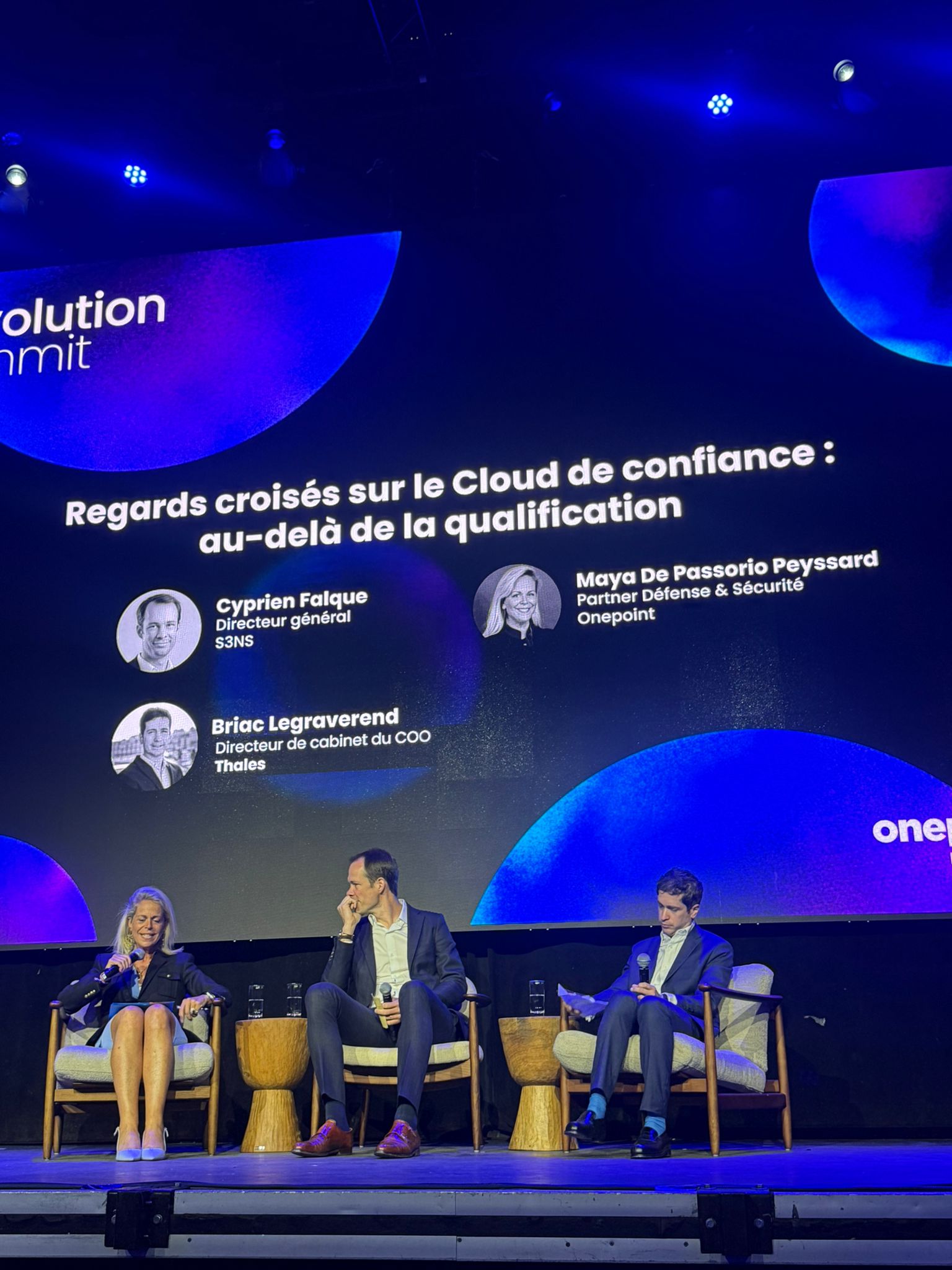
Palais de Tokyo, Paris — Revolution Summit Onepoint
The panel discussion “Cross-Perspectives on the Trusted Cloud: Beyond Qualification,” hosted at the Revolution Summit, provided strategic insights. Through the cross-testimonies of Cyprien Falque (CEO of S3NS), Briac Legraverend (Chief of Staff to the COO of Thales), and Maya de Passorio Peyssard (Defense & Security Partner at Onepoint), the challenges of sovereign cloud were dissected with lucidity and ambition.
Digital technology: a strategic battlefield
From the introduction, Maya de Passorio Peyssard sets the scene: “Digital technology has become a true battlefield, just like space, sea, cyber, or information warfare.” This statement, far from being metaphorical, reflects the intensity of the challenges facing critical infrastructure operators (OIVs), strategic industrial players, and public authorities. Mastery of information is now the key to decision-making, operational efficiency, and resilience.
In this context, the cloud is no longer merely an IT rationalization lever. It becomes a geopolitical issue. The need to access the power of global technologies while guaranteeing the sovereignty of critical data calls for a new approach that is robust, transparent, and sustainable.
S3NS: when Thales and Google combine performance and sovereignty
It is precisely in this tension zone that S3NS intervenes, the result of an unprecedented partnership between Thales, a French cybersecurity flagship, and Google Cloud, an American innovation giant. Through this industrial project, Cyprien Falque defends an ambitious proposition: “Offer the best of global cloud technology, without compromise, within a framework compliant with French security and sovereignty requirements.”
S3NS’s promise rests on three pillars: access to Google Cloud’s most advanced services (150+ managed services, including Vertex AI, BigQuery, etc.). A technical architecture audited and operated in France exclusively by Thales employees, and a contractual model governed by French law.
Going beyond simple SecNumCloud qualification
The trusted cloud cannot be limited to regulatory compliance. As the speakers highlighted, SecNumCloud 3.2 qualification, while decisive, is only a milestone. S3NS’s ambition goes further: demonstrating verifiability, operational resilience, and the ability to evolve in the face of constantly changing threats.
Cyprien Falque recalls that S3NS’s trusted cloud is based on dedicated infrastructure (three data centers in Île-de-France). A secure integration process (quarantine zone for software updates), and enforceable legal measures. “Google becomes a simple technology provider. Control, hosting, administration, and contracting are entirely in S3NS’s hands.”
The sovereign cloud promise: an innovation accelerator
One of the key messages of this session was to reposition sovereignty not as a constraint, but as a lever for competitiveness. “Sovereignty and economic performance are often seen as opposites. Yet it’s the reverse,” emphasizes Maya de Passorio Peyssard. By providing companies with a secure and compliant cloud environment, they can innovate on sensitive use cases — health, justice, defense, finance — previously constrained.
A video illustrating the journeys of Irène (health researcher), Chloé (aerospace engineer), Isabelle (insurance actuary), and David (magistrate) made this promise concrete. Access to AI services, massive data processing, operational agility — all within a controlled sovereign framework.
Thales: toward migration of restricted distribution data
Briac Legraverend’s testimony marked a strong symbolic milestone. A year ago, putting data classified as “restricted distribution” on the cloud would have been unthinkable at Thales. Today, this migration is confirmed. “Thanks to S3NS, we will be able to unlock our ‘Move to Cloud,’ including for C3 data,” he explains.
Historically very conservative — particularly due to its civil and criminal responsibilities — the group’s IT department is now paving the way for profound digital transformation. Short-term objectives: migrate MES (Manufacturing Execution Systems) and, in the medium term, SAP ERP to S3NS. “This is not a revolution, it’s a strategic revolt,” he summarizes.
A structural transformation, not simple rehosting
As the speakers emphasize, moving to the trusted cloud is not a simple technical “lift and shift.” It is a holistic transformation that impacts organization, governance, skills, and mindsets.
At Thales, this required work to raise awareness among the Executive Committee, historically attached to on-premise IT, a change in the technical teams’ posture, and a massive certification program. “We are targeting over 2,000 certified Google Cloud employees. The expertise needed for S3NS is 95% the same as for Google Cloud, which facilitates adoption,” explains Briac Legraverend.
Strategic anticipation and long-term governance
The deployment of sovereign cloud is part of a long-term trajectory. On average, it takes nine months to achieve the first benefits. Strategy definition, legal and financial framing, team training, technical environment construction… nothing can be improvised.
Cyprien Falque’s intervention highlighted the central role of the State in structuring the market. As early as 2021, the national “cloud at the center” strategy established a clear framework that enabled the emergence of a trusted offering. “France is more mature on this subject than Germany, due to the lack of an equivalent framework across the Rhine,” he notes.
A strong partnership and territorial approach
Finally, the three speakers emphasized the importance of a locally anchored ecosystem. Sovereign cloud is only credible if it relies on strong territorial anchoring: data centers in France, French personnel, applicable French laws, localized support. But beyond territory, it is the entire ecosystem — customers, technology partners, integrators — that must build expertise.
Onepoint, a partner of S3NS from the beginning, embodies this co-construction logic. The firm is already supporting financial sector players in this strategic migration and strengthening, along with others, the collective capacity to build a robust and scalable trusted cloud.
From sovereignty as posture to sovereignty as performance
This conference brilliantly showed that the trusted cloud is not a defensive retreat, but a strategic offensive. In a fragmented world, where technological mastery becomes a criterion of power, the ability to combine performance, security, and compliance is a major competitive advantage.
Sovereign cloud is not a protectionist utopia. It is a structuring tool, carrying efficiency, innovation, and strategic independence. It must be conceived as a systemic transformation, supported by political, industrial, and collective will.
At a time when companies are reevaluating their cloud architectures and citizens are demanding more transparency on the use of their data, the model embodied by S3NS, Thales, and their partners charts a clear path. It is that of a trusted digital environment, designed in Europe, operated in Europe, and built to last.