
Here is an interview with Christophe Gaultier, responsible at OpenTextTM for cybersecurity and data management for enterprises in France and Belgium-Luxembourg. We discussed the integration of AI into the OpenTextTM software product range.
OpenTextTM, founded in 1991, is a global leader in information management, offering software solutions for businesses of all sizes. The company developed from a project to create the first online dictionary for Oxford University. Today, it is a reference in the field of data management, cloud, security, and artificial intelligence. With more than 23,000 employees and a presence in 180 countries, OpenTextTM serves over 120,000 customers, including 98 of the world’s 100 largest companies. It is among the top 10 largest software companies globally.
Christophe Gaultier is a graduate of ESCP Business School. He began his career at Computer Associates, then joined HP (Hewlett Packard) as SW Worldwide Account Executive. He then took over as Head of Information Management Sales for Southern Europe at HP. Following the acquisition of HP Software by Microfocus and then by OpenText, he now manages software sales for the “Cybersecurity and Data Management” sectors. AI is already part of Christophe’s DNA. He believes that “generative AI opens the way to a new era in content services, offering unprecedented means of interacting with unstructured data. Intelligent content services, powered by AI, transform static documents into dynamic business resources, thereby promoting operational efficiency.”
But who is OpenTextTM? It is a software publisher that helps companies transform their operations through secure and scalable information management, while leveraging AI to unleash human potential and drive innovation.
 OpenTextTM enables businesses to leverage unstructured data and improve decision-making. Their holistic approach combines cloud, cybersecurity, and artificial intelligence to offer tailored solutions adapted to modern business challenges and compliant with international regulatory requirements.
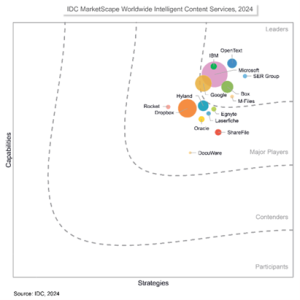
As such, OpenTextTM has been named a leader in the IDC MarketScape for intelligent content services as well as by FORRESTER (Q1 2025)
The interview with Christophe Gaultier highlighted three major dimensions of artificial intelligence adoption within the enterprise:
- AI offering for customers,
- Corporate AI (internal),
- and Shadow AI.
1) OpenTextTM‘s AI Offering for Its Customers
OpenTextTM offers strategic integration of AI within its solution portfolio. The goal is to optimize information management and increase business efficiency by leveraging AI for workflow automation, data security, and unstructured data analysis.
OpenTextTM offers a comprehensive suite of AI tools embedded in its information management portfolio. Its Aviator AI platform optimizes automation, security, and advanced data analytics. It covers various domains: OpenText Content Cloud (document management and AI workflow), OpenText Business Network Cloud (B2B integration and automation), and OpenText Cybersecurity Cloud (data security and threat detection). Through AI, OpenText improves decision-making, regulatory compliance, and business productivity. Its cloud-first solutions ensure intelligent and secure information governance at scale.
The main OpenTextTM AI products and solutions:
- OpenText.AI: a strategic program launched in 2022-2023 to integrate AI into all OpenText products.
- Aviator: a family of LLMs (Large Language Models) tailored to specific sectors and needs (e.g., OpenText Content Aviator, OpenText Security Aviator, OpenText Business Network Aviator).
- Unstructured data analysis and tagging: “OpenText helps its customers process vast volumes of data by making them actionable through AI. A concrete example is supporting a multinational seeking to classify 800 TB of unstructured data.“
- Security and DevSecOps: “AI is integrated into solutions like Fortify to improve vulnerability detection and reduce false positives, a major challenge in IT risk management.“
Christophe also highlights the challenges for customers:
– “Companies that don’t integrate AI are falling behind and risk being overtaken by the competition.”
– “AI is now a prerequisite for any company seeking to process large volumes of data and automate its processes.”
2) Corporate AI: OpenTextTM and Its Internal Strategy
AI integration at OpenTextTM is not limited to its customer products. The company has also developed an internal AI strategy to improve its productivity and optimize certain internal processes.
Examples of AI used internally:
- Support incident database: OpenTextTM has implemented an AI to leverage its support ticket database and enable faster retrieval of existing solutions.
- Request for Proposals (RFPs) optimization: An AI analyzes and responds to RFPs by automatically identifying relevant answers, thus reducing manual work time.
- Sales data: OpenTextTM uses AI to better structure and leverage its sales databases.
Christophe mentioned the internal challenges related to AI:
- Model enrichment: “The more an AI is used, the more efficient it becomes, but it must be continuously fed with quality data.“
- Team adoption: “Some salespeople perceive these tools as constraining if they don’t work immediately at 100%.“
3) Shadow AI: The Invisible Threat
Shadow AI refers to the use of artificial intelligence tools outside the official solutions approved by the company. OpenTextTM strictly prohibits the use of ChatGPT or any unvalidated tool on its infrastructures.
Why is Shadow AI a problem?
- Leakage of sensitive data: “If some salespeople record conversations or use third-party AI to analyze confidential exchanges with customers (e.g., discussions with cybersecurity managers of multinationals).“
- Non-compliance with GDPR and internal policies: “The use of external tools can pose security and legal compliance issues.”
- Lack of control: “If an external AI is used, the company cannot guarantee the reliability of responses nor the security of processed data.”
OpenText’s Strategy to Counter Shadow AI
- Framework for AI usage: rather than a total ban, it is preferable to provide secure internal alternatives to prevent employees from circumventing the rules.
- Team awareness: OpenText has implemented training programs to inform its employees of the risks associated with using uncontrolled AI tools.
- Development of alternative solutions: The company has just launched its own internal AI for sales support, Sales Aviator.
Christophe also emphasizes that many companies still need to refine their approach on this issue. Not addressing the Shadow AI question means accelerating its informal adoption, which could harm their security and competitiveness.
Christophe Gaultier’s Advice to Entrepreneurs
Everyone must have an AI strategy, or risk falling behind in the market. AI is no longer an option, but a competitive necessity, and its implementation must be thoughtful to be effective and secure. He insists that companies must adopt a progressive and supervised approach. They should start by identifying priority use cases, then ensure employee training to maximize adoption and efficiency of AI tools. Finally, he recommends continuous monitoring and performance evaluation of implemented AI solutions. The goal is to ensure alignment with the company’s strategic objectives and ensure strict compliance with current regulations.