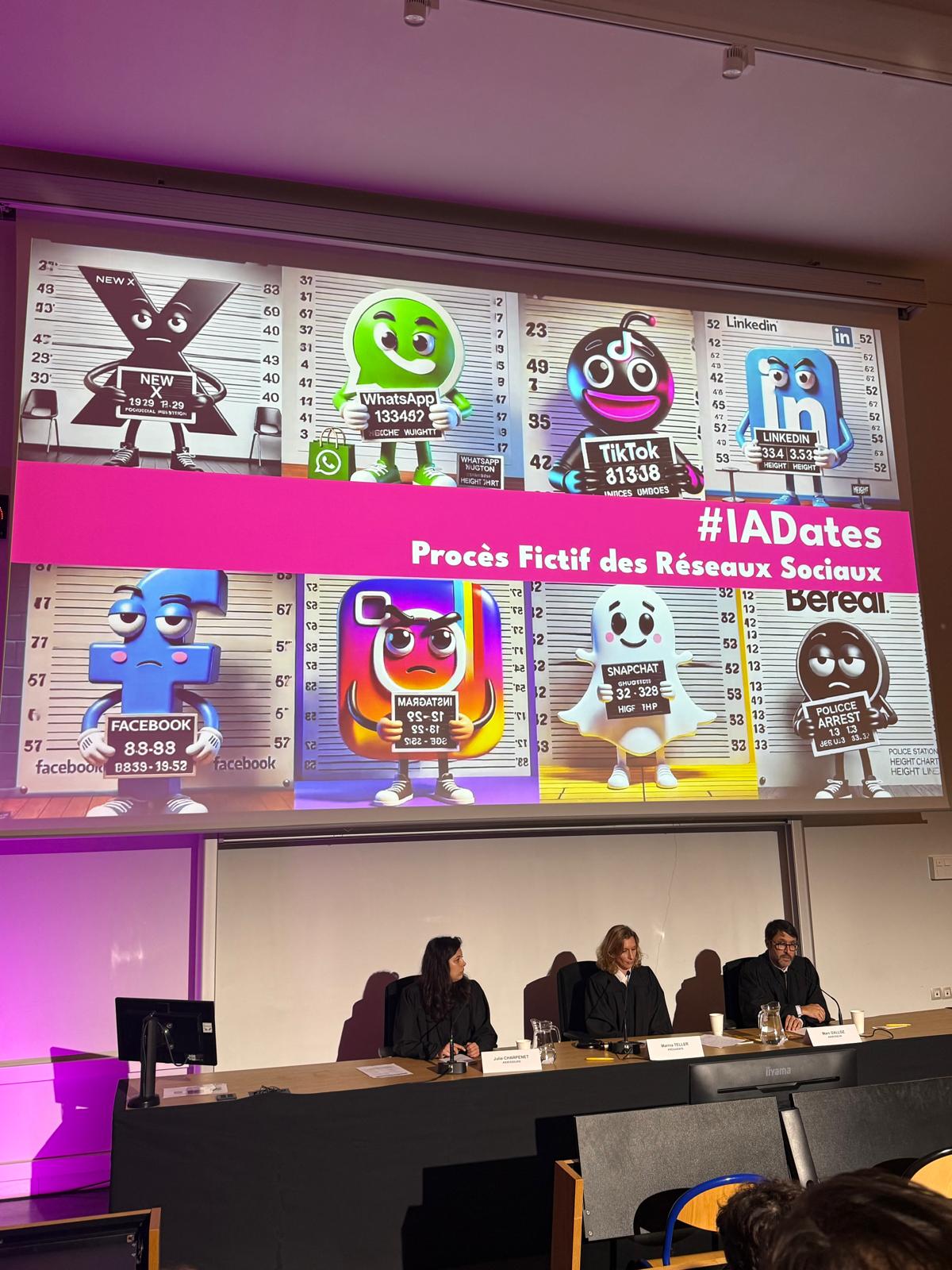
 In a packed room at the Polytech premises, the EuropIA Institute, chaired by Marco Landi, organized a mock trial of social media, highlighting the multiple facets and challenges related to these digital platforms. Although fictional, this event allowed for an in-depth exploration of the impacts of social media on our societies, raising fundamental questions about freedom of expression, content moderation, polarization, and the responsibility of tech giants.
This simulated trial proved to be much more than a simple academic exercise. It confronted diametrically opposed visions on the role of social media in an interconnected world. Between accusations of manipulation and defense of positive contributions, this debate revealed complex tensions that shape our era.
The director of the Polytech school and the representative of the Université Côte d’Azur kicked off this trial, emphasizing its importance. “Social media and artificial intelligence are evolving topics, requiring collective reflection to anticipate their impacts.” This statement highlighted the event’s ambition to provide a space to question the practices of digital platforms.
Marco Landi, president of the EuropIA Institute and emblematic figure of the event, recalled the objective of this exercise. “We must examine the responsibilities of social media in an era marked by societal and digital upheavals. This is an opportunity to lay the foundations for balanced regulation.”
This trial took place under the presidency of Marina Teller, professor at the Université Côte d’Azur. The mock court brought together legal experts, psychologists, and students to debate three counts: mental manipulation, attacks on democracy, and incitement to hatred.
Testimonies: The Complexity of Social Media
Experts in communication, legal professionals and youth representatives provided varied perspectives, highlighting the strengths and weaknesses of social media.
Among these testimonies, we particularly note that Generation Z can be considered augmented citizens. These youth representatives defended their ability to exercise critical thinking when faced with online information. However, they acknowledged that social media could lead to addiction and loss of discernment, especially among less informed users.
Marina Borriello, a communication expert, explained how algorithms exacerbate cognitive biases, notably confirmation bias, which traps users in information bubbles. She also suggested solutions, such as introducing algorithms that diversify the proposed content.
 The Prosecution: A Dark Portrait of Social Media
Armed with these testimonies, prosecutor Laurent Kratz, founder of Neofacto, accused social media of exploiting cognitive biases to captivate users. He denounced the use of algorithms optimized to maximize time spent on platforms, often at the expense of users’ mental health. “These algorithms serve only one objective: to maintain interest at all costs, by favoring emotionally charged content, such as fear or anger.”
He argued that this mental manipulation was not simply a side effect, but a deliberate business model based on attention management. Concrete examples, such as the impact of excessive content on young TikTok users or the spread of fake news on X, were cited to support his argument.
Social media was also accused of weakening democracies by giving a disproportionate platform to extremist and polarizing discourse. Significant events such as the assault on the Capitol in the United States and European electoral manipulations were mentioned.
“They have allowed radical voices to dominate public debate, creating information bubbles where truth becomes relative,” declared the prosecutor. He also highlighted the role of social media in spreading populist and conspiracist discourse.
Finally, the prosecution pointed to social media’s responsibility in spreading malicious discourse that fuels violence and harassment. Laurent Kratz cited recent cases, such as targeted attacks against public figures, to demonstrate the real consequences of this hatred amplified by the platforms.
To address these accusations, the prosecutor proposed drastic measures:
- The creation of a “posting permit”: requiring users to complete training before being able to publish content.
- A credibility score for each user, based on the reliability of their publications.
- A weekly algorithm-free day, where content would not be automatically sorted or promoted.
 The Defense: Between Host and Publisher
Maître Ilène Choukri, defense attorney and specialist in new technology law, presented a structured plea, emphasizing the neutrality of social media as digital tools. “Platforms do not create content, they merely host it. The responsibility for statements lies with their authors, not with technical intermediaries.”
Maître Choukri particularly emphasized the legal distinction between host and publisher. According to the law on confidence in the digital economy, a host is limited to storing content published by third parties and cannot be held responsible for illegal content as long as they are unaware of it. A publisher, on the other hand, plays an active role in selecting or modifying content, which engages their responsibility.
The defense contested accusations that algorithms would transform social media into publishers. “These tools do not intentionally favor polarizing content. They are designed to personalize the user experience based on preferences. This is not an editorial line, but technological optimization.”
However, cases such as Meta’s, which recently reduced its moderation efforts to favor “total freedom of expression,” were cited as unclear examples where the line between host and publisher becomes uncertain.
Maître Choukri also highlighted the positive contributions of these platforms. They allow isolated individuals to connect and create support communities, particularly during natural disasters or social crises. Education and inclusion: Social media has amplified important campaigns, such as those against school bullying or for women’s rights. By creating new professions and facilitating small businesses’ access to global markets, platforms contribute to economic growth.
The defense acknowledged the limitations of current moderation mechanisms but insisted that social media cannot monitor all content in real time without infringing on freedom of expression. “Total surveillance would be contrary to the democratic values we seek to protect,” stated Maître Choukri.
She also pleaded for co-responsibility, calling on governments, tech companies and citizens to work together to create a safer digital environment.
A Symbolic Verdict: An Invitation to Reflection
Although this was a mock trial, this event addressed crucial issues for our societies. Should social media be considered simple neutral tools or responsible actors? How should the distinction between host and publisher be framed? What balanced regulation can guarantee both freedom of expression and online safety?
This mock trial organized by the EuropIA Institute, under Marco Landi’s direction, laid the foundations for a necessary debate on the future of digital platforms. The event highlighted the urgency of developing appropriate regulation, capable of meeting 21st century challenges while preserving fundamental freedoms.
Ultimately, this exercise demonstrated that social media can neither be demonized nor exonerated from all responsibility. They reflect the complexity of our societies and require a collective approach to balance innovation, freedom and ethics.