Gartner’s 2024 Hype Cycles: What Entrepreneurs Need to Know About Artificial Intelligence and Emerging Technologies
In a constantly evolving technological world, understanding emerging trends is essential for any entrepreneur seeking to remain competitive. Gartner’s 2024 Hype Cycles offer a clear roadmap of technology evolution, particularly those related to artificial intelligence and emerging innovations. This article deciphers these cycles and explores how entrepreneurs can leverage them to create value in their business.
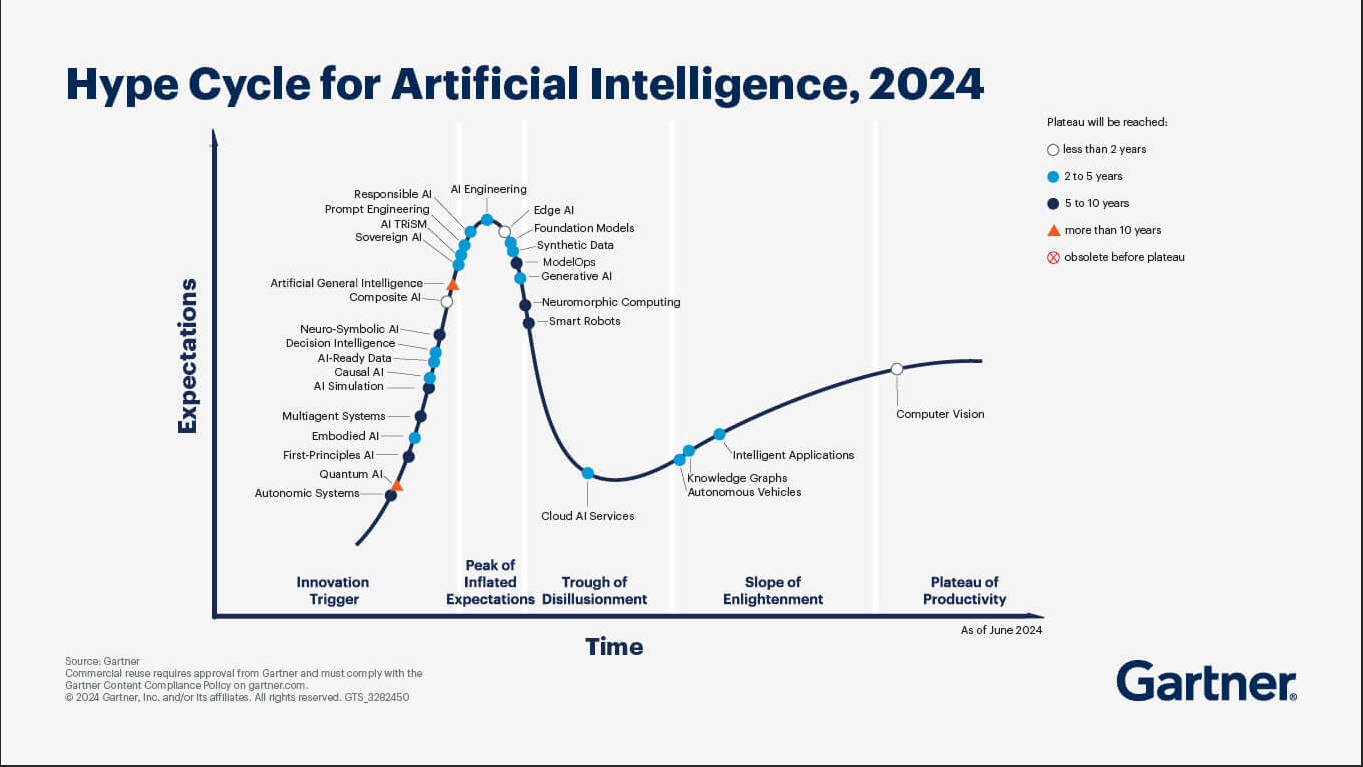
Gartner’s Hype Cycles illustrate the journey of technologies from their emergence to widespread adoption. This model, divided into five stages, helps decision-makers understand where an innovation stands in its lifecycle:
- Innovation Trigger: An emerging technology attracts attention through breakthroughs or prototypes.
- Peak of Inflated Expectations: expectations skyrocket, often fueled by excessive media coverage.
- Trough of Disillusionment: a period of disillusionment where technical and operational limitations appear.
- Slope of Enlightenment: the technology matures, concrete applications emerge.
Plateau of Productivity: the technology is adopted at scale and the key to success lies in a combination of vision, experimentation, and pragmatism.
Gartner highlights two main areas: artificial intelligence and emerging technologies, each bringing unique opportunities.
Take generative AI: it captured attention with tools like ChatGPT or DALL·E. According to Gartner, it has passed the peak of inflated expectations and is entering a phase where its uses must focus on concrete cases.
The promises are significant, ranging from task automation to interaction personalization, including content creation.
Challenges for entrepreneurs:
- Project complexity: implementing generative AI at scale requires high-quality data, appropriate infrastructure, and specialized teams.
- Ethical issues: deepfakes and disinformation pose governance challenges.
- Uncertain profitability: use cases must be clearly defined to avoid proposals that fail to produce value.
Gartner also identifies Composite AI as the next logical step. By combining multiple techniques, such as machine learning, natural language processing, and knowledge graphs, it creates robust solutions capable of handling complex environments. For example, an e-commerce business can use this approach to analyze customer data and personalize recommendations, while enhancing transparency. At the same time, knowledge graphs enable explainable logic, thus meeting growing expectations for transparency.
In the same vein, AI Engineering emerges as an imperative to industrialize AI and fully leverage it. It relies on practices such as automated data flow management, standardized AI model deployment, and integration into existing applications. The goal is to create an industrial pipeline enabling rapid scaling of reliable solutions.
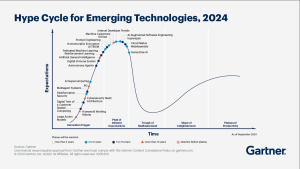 Emerging Technologies: The Four Key Themes of 2024
Emerging technologies, the other major theme of the Gartner report, encompass varied innovations, but structured around four key themes.
Autonomous AI stands out for its ability to make decisions and execute tasks without human intervention. Autonomous agents, humanoid robots, or AI supercomputing represent major advances in this category. These technologies promise to revolutionize entire sectors, from transportation to healthcare to logistics.
- AI Supercomputing: providing the necessary resources to train advanced models.
- Autonomous agents: used in logistics, finance, or decentralized platforms, these systems act autonomously to achieve their objectives.
- Humanoid robots: These robots combine sensory perception and autonomy to execute tasks previously reserved for humans.
Opportunity for entrepreneurs: Develop solutions combining autonomy and AI in areas such as transportation, healthcare, or industrial management.
Enhancing Developer Productivity
Through technologies like AI-augmented software engineering or cloud-native approaches, it becomes possible to automate repetitive tasks and create scalable applications. These innovations allow developers to focus on high-value tasks while accelerating development cycles.
- AI-augmented software engineering: automation of repetitive tasks in development workflows.
- Cloud-native technologies: creating scalable and dynamic applications.
- Prompt engineering: a key discipline to leverage generative AI models.
Human-Centered Security and Privacy
Security and privacy concerns are among the priorities. Gartner emphasizes the need to integrate solutions such as AI Trust, Risk and Security Management or cybersecurity mesh architecture. These strategies aim to ensure responsible and secure AI while strengthening user trust.
- AI Trust, Risk and Security Management (AI TRiSM): Framework ensuring responsible and secure AI.
- Cybersecurity Mesh Architecture: Modular and distributed approach to securing complex environments.
AI and Blockchain: A Promising Alliance
A particularly promising area is the integration of AI with blockchain. These two technologies complement each other innovatively, particularly in data security, automation via smart contracts, or even the creation of tokenized digital content in the form of NFTs. For example, a company in the healthcare sector could protect patient data through blockchain while using AI models for advanced diagnostics.
They complement each other in several ways:
- Securing AI data: blockchain guarantees the integrity and traceability of data used to train models.
- Automation via smart contracts: AI models can be integrated into smart contracts to execute tasks without human intervention.
Concrete example: a company in the healthcare sector could use blockchain to protect patient data and combine them with AI models for advanced diagnostics.
Total Experience: Revolutionizing Interactions
Improving customer and employee interactions is another explored avenue. Total Experience technologies aim to unify these experiences to maximize satisfaction and loyalty. The concept of the digital twin of the customer, which simulates behaviors and preferences, or spatial computing, which merges physical and digital environments, illustrate these new trends.
- Digital Twin of a Customer (DToC): Virtual models to simulate customer behaviors.
- Spatial Computing: Integration of physical and digital environments for immersive interactions.
Practical case: A retailer could use a DToC to anticipate customer needs and adapt its offering in real time.
Entrepreneurs must therefore approach these trends with a clear strategy. Identifying key technologies for their sector is essential, as is testing solutions before investing massively. Prioritizing data governance and transparency is also crucial, and also leveraging synergies between multiple technologies to maximize their impact.
Gartner’s 2024 Hype Cycles show that artificial intelligence and emerging technologies are both challenges and opportunities. Those who adopt a strategic approach, building on these insights, will be able to transform their organization and remain competitive in a rapidly evolving technological landscape. The key lies in a combination of vision, experimentation, and pragmatism.