
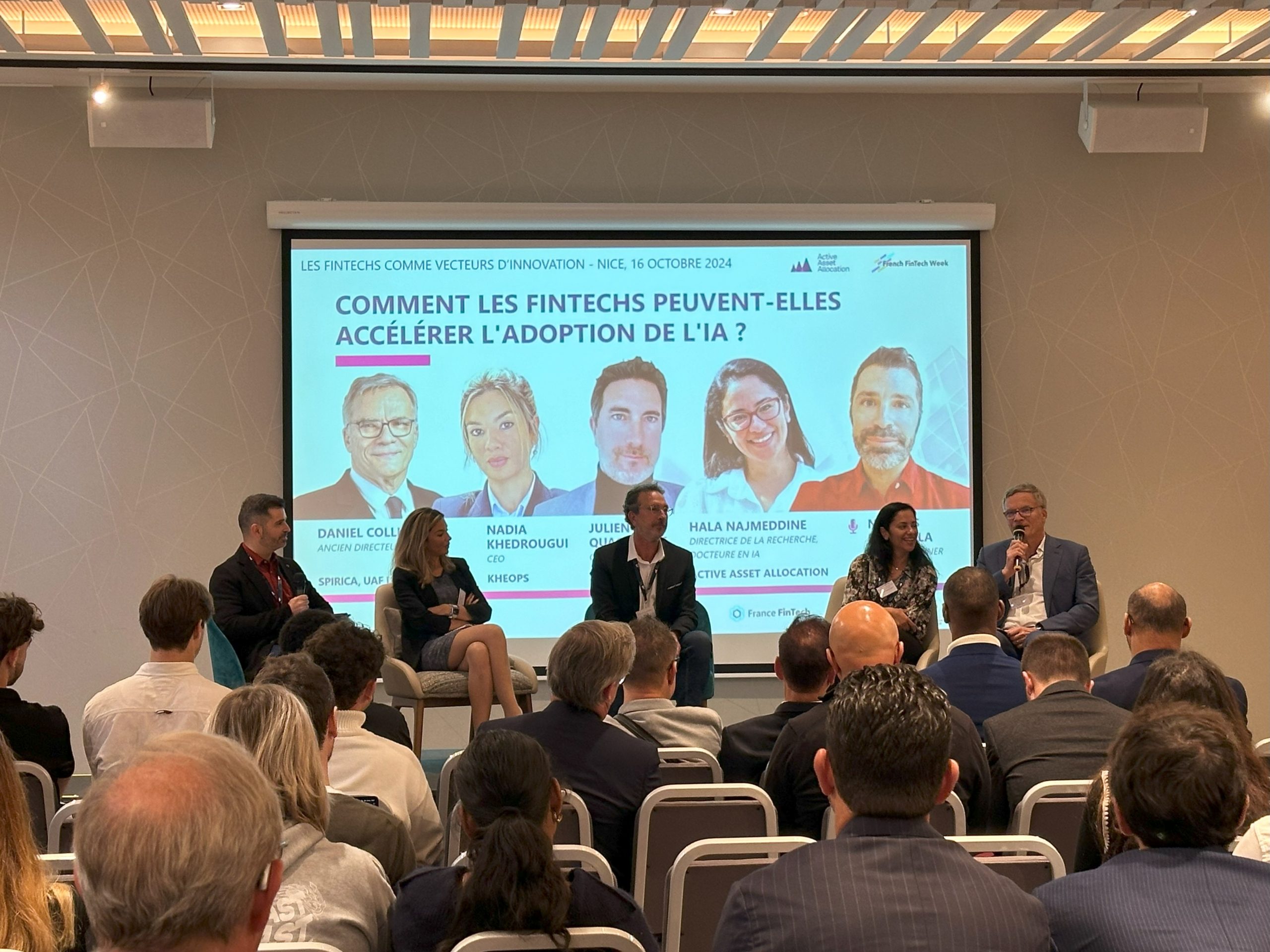
 The conference “Fintech as Drivers of Innovation” was organized by Active Asset Allocation.
Here is a focus on the topic “How can fintechs accelerate AI adoption?”.
This panel discussion brought together industry experts to debate how fintechs can play a central role in democratizing AI within the financial sector. Among the speakers were Julien Van Quackebeke from All4test, Hala Najmeddine, AI PhD at Active Asset Allocation, Nicolas Bentolila from Ipepper, Nadia Khedrougui from Kheops, and Daniel Collignon, Senior Advisor at Selencia. Together, they explored the opportunities and challenges associated with Artificial Intelligence in a context of increased digitalization.
Fintechs are startups that have distinguished themselves by leveraging two essential factors: first, regulatory openness that allowed them to practice professions once reserved for traditional players. They have also been able to capitalize on technological advances, including Big Data, Robotic Process Automation (RPA), blockchain, APIs, biometrics, and, of course, artificial intelligence. These companies aim to simplify financial services, making them more efficient, more secure, and less expensive.
Why is AI crucial for the financial sector?
As the speakers emphasized, it naturally imposes itself in finance due to needs in terms of productivity, cost reduction, and customer service. It enables processing large amounts of data, improving real-time decision-making, and automating processes, which provides greater agility. Moreover, fintechs can contribute to its democratization across the entire industry.
Obstacles to AI adoption.
The panel began with the presentation of the different speakers. Julien Van Quackebeke, founder of All4test, explained how his company specializes in software quality, using AI to automate test creation. For him, one of the main challenges lies in the reliability of AI systems themselves, and particularly how to test AI to ensure it functions reliably.
Hala Najmeddine, AI PhD at Active Asset Allocation, shared her expertise in real-time asset portfolio management, taking into account AI-assisted market developments. She highlighted the scarcity of AI specialist profiles, a major obstacle to faster adoption of this technology.
Nicolas Bentolila from Ipepper discussed the technical obstacles related to integrating AI into financial systems, such as the need for structured databases for AI to generate relevant results. For her part, Nadia Khedrougui from Kheops emphasized the importance of participatory inclusion in AI models and their application in automated processes.
Daniel Collignon shared concrete examples of AI’s potential impact in life insurance and customer relationship management. He particularly mentioned the difficulty leaders face in understanding and trusting AI, often perceived as an opaque technology.
Obstacles to overcome for broader adoption
One of the main obstacles to AI adoption mentioned by Hala Najmeddine is the talent shortage. Profiles capable of mastering AI, machine learning, and data modeling are rare, which slows the integration of this technology into financial processes. Julien Van Quackebeke added that another barrier is the very understanding of what AI is. For many leaders, AI remains an abstract concept, associated with risks such as data loss or security breaches.
Daniel Collignon explained that some insurers still have obsolete computer systems, which complicates the adoption of modern technologies. This hinders the transition to AI solutions, and business leaders often don’t know where to start to integrate this technology into their processes.
Nicolas Bentolila emphasized that companies must still overcome the challenge of data reliability. For AI to be effective, it must be able to connect to reliable and structured databases. However, in the financial sector, data is frequently heterogeneous, making interconnection difficult and limiting AI effectiveness.
Opportunities offered by AI in the financial sector
Automating repetitive tasks is one of the areas where AI can bring significant gains. This would allow employees to focus on higher value-added tasks, consequently increasing their productivity. For example, in the case of insurance contract management, an AI could systematically analyze documents submitted by customers, thus reducing processing times.
Julien Van Quackebeke also emphasized how AI can improve the reliability of software used in fintechs. By generating automatic tests, fintechs can ensure that their software functions correctly and that the data they process is accurate.
Hala Najmeddine, for her part, mentioned the effectiveness of AI algorithms in asset portfolio management, allowing financial advisors to optimize their decisions in real time. This represents a considerable competitive advantage for companies capable of integrating these technologies into their services.
Daniel Collignon mentioned AI’s enormous potential in fraud prevention, an area where the speed and accuracy of algorithms can make a difference. Thanks to AI, insurers can detect suspicious behavior upstream and take preventive measures.
Fintechs: pioneers of AI adoption
Fintechs have always been pioneers in adopting new technologies, and AI is no exception. They are able to test and integrate AI solutions into their processes with agility, which allows them to leverage this technology faster than traditional financial institutions. The speakers agreed that fintechs can pave the way for broader AI adoption in the sector by showing how these technologies can be implemented effectively and profitably.
Nicolas Bentolila explained that at Ipepper, they use AI to analyze vast datasets to help companies make decisions based on real-time information. This represents an important lever for companies seeking to improve their responsiveness in financial markets.
The future of AI adoption in fintechs looks promising, but many challenges remain to be overcome. One of the points raised by Khedrougui from Kheops is the need to improve the transparency of AI models. Today, many algorithms are perceived as black boxes, which poses trust problems for users. It is essential to make these models more explainable to enable broader adoption.
Julien Van Quackebeke mentioned that one of the important challenges is managing unpredictable events, such as economic or health crises, which can disrupt predictive models. Fintechs must develop algorithms capable of quickly adapting to unprecedented situations.
AI therefore represents a major opportunity for fintechs, but it requires a thoughtful and strategic approach to overcome technical and human obstacles. Thanks to their agility and capacity for innovation, fintechs can play a central role in large-scale AI adoption, while shaping the future of financial services.
Remarks collected by Pascale Caron