Revolution Summit Onepoint 2025 – A panel discussion sheds light on the emerging French AI startup scene that is shaking up global giants thanks to its agility, local roots, and capacity for technical innovation. A look back at a rich exchange between three visionary founders.
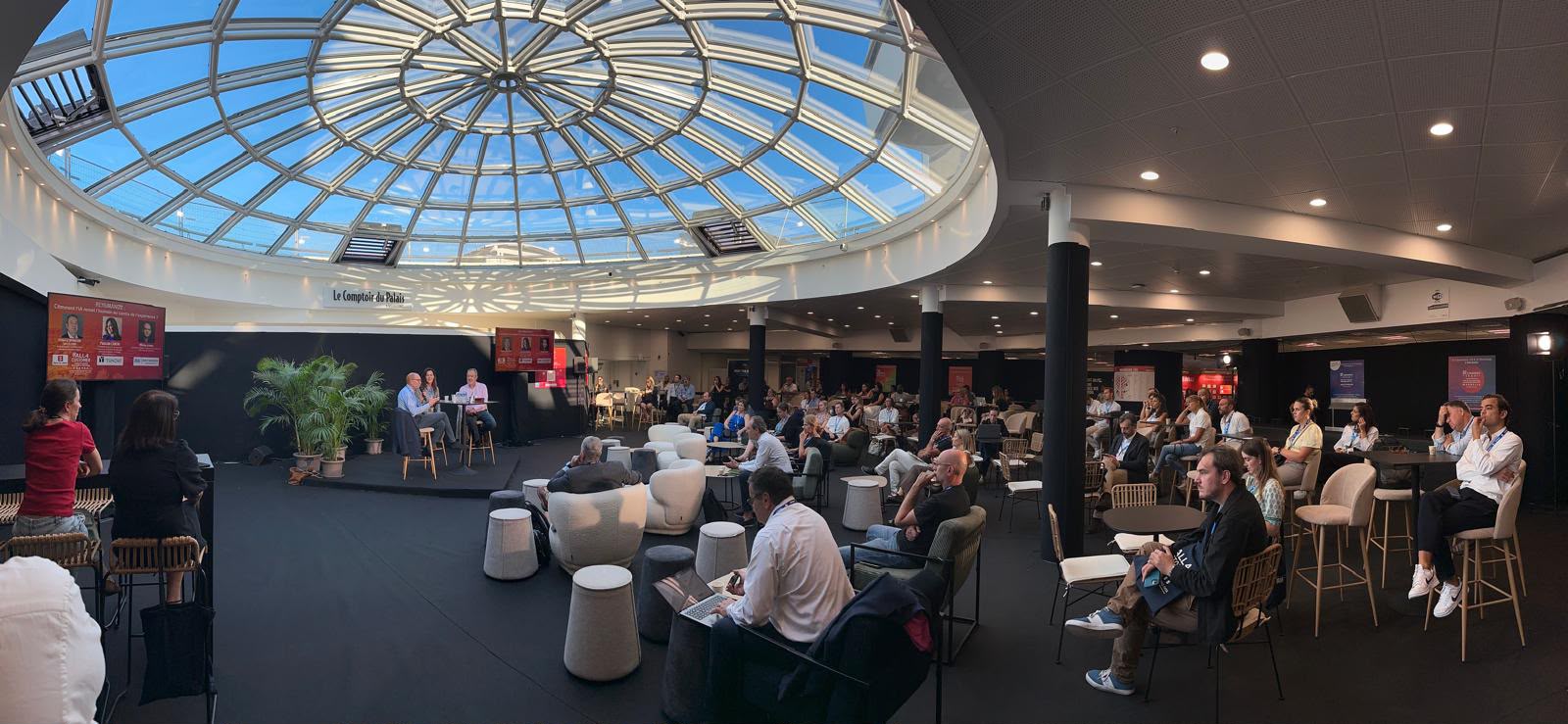
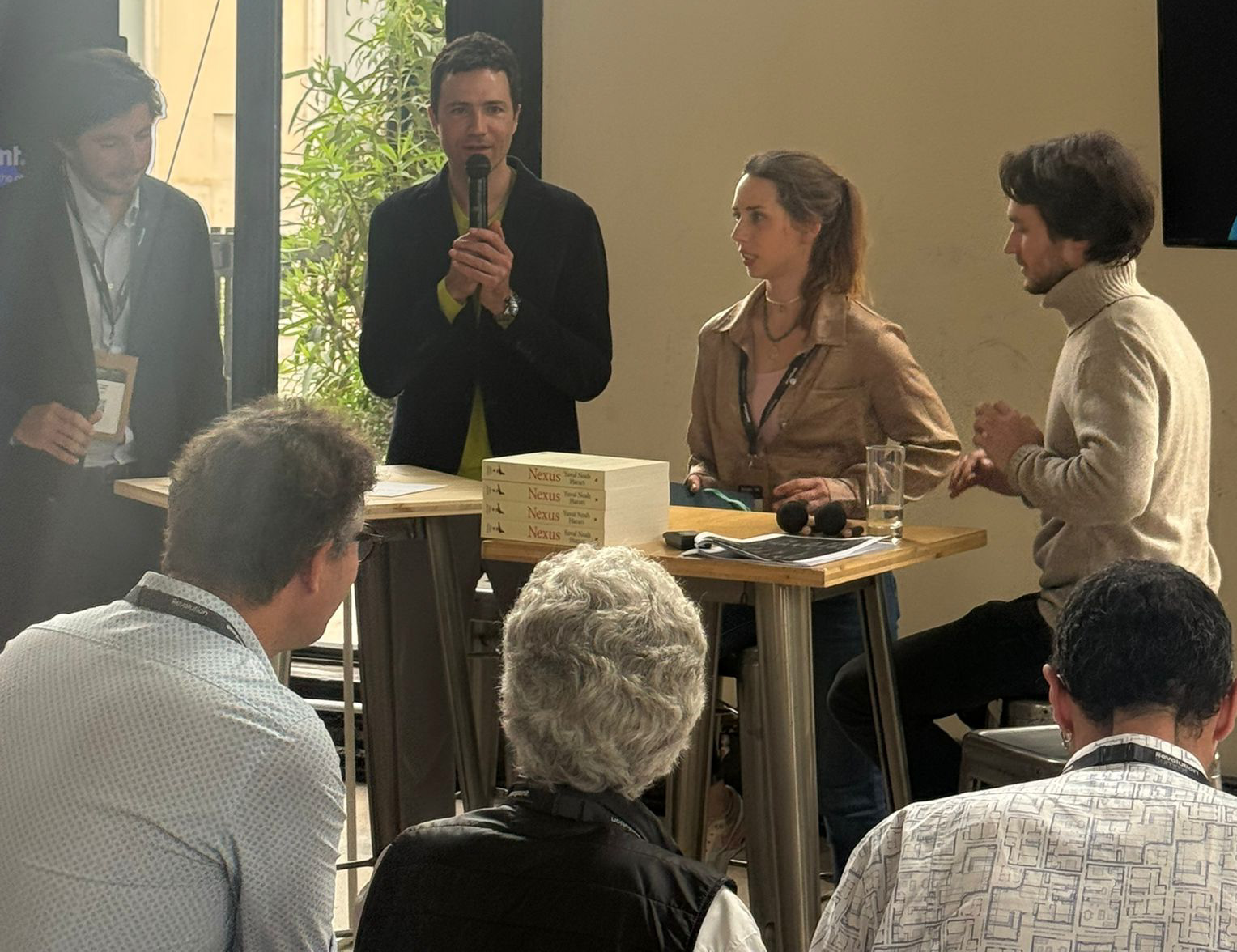
Paris, Palais de Tokyo. Artificial intelligence had a rendezvous with technological sovereignty. Moderated by Nicolas Bonnet, Partner at Onepoint, the Revolution Summit 2025 panel highlighted three flagships of French AI: Beink, Linkup, and Poolside. Three companies, three visions, three concrete responses to the challenges of agentification, web indexing, and augmented collaborative creation.
A bold French AI, rooted in reality
Despite the alarmist rhetoric about Europe’s technological lag, France is home to a thriving AI scene. The diversity of the invited speakers attests to this.
Jeanne Le Peillet, founder of Beink, embodies this hybrid generation, at the intersection of doctoral research and entrepreneurship. Her visual collaboration platform leverages images as a universal language to interact with AIs, beyond the limits of text. An approach that appeals to large groups in search of intelligent, adaptable, and visually expressive tools.
Beink, an AI that speaks the language of images
Beink offers a unique platform where visual thinking becomes a collaboration interface. Designed for decision-makers, the solution transforms linguistic friction into cognitive agility. “It’s when we visualize what we have in mind that we begin to ask better questions,” explains Jeanne Le Peillet. At the core of the technology: an AI trained not on indistinct masses of public data, but on the visual heritage of client companies. Beink thus makes it possible to reflect brands’ DNA while respecting confidentiality. No generated data is recycled, no input is pooled. A direct response to the demands of sovereignty and personalization.
Linkup, the working memory of AI agents
Facing her, Philippe Mizrahi champions Linkup, a new-generation search engine designed not for humans, but for AI agents. Its mission: to fill the temporal blindness of language models, which are unable to integrate recent facts. “We are an engine of facts, not links,” he sums up. Where Google offers pages, Linkup delivers ready-to-use context. Information is selected, filtered, and injected into client models. An architecture designed for agentification, in search of reliable and fresh data.
Based in Paris after a career in Silicon Valley, the Linkup team relies on the depth and excellence of French talent. At equal performance, the price-quality ratio and the local support ecosystem — BPI, innovation grants — create ideal conditions for deeptech projects.
Poolside, the European alternative to OpenAI for developers
At the crossroads of foundation models and business uses, Poolside develops AI models specialized in code generation. Far from generic SaaS, the company founded by the former CTO of Github is betting on radical personalization: each client receives their own model, retrained locally on their internal code bases.
“It’s a matter of sovereignty and security,” insists François, representative of Poolside. Thanks to this approach, large companies can adapt AI to their obsolete languages — such as COBOL — and integrate the practices specific to their technical environment.
Sovereignty, collaboration, contextualization
Throughout the discussion, three pillars emerge as foundations of this “French AI Tech”:
- Technological sovereignty, which is not limited to model hosting, but also involves mastery of data and training processes.
- Contextualization, made possible by an AI “fine-tuned” on specific assets (code, visuals, internal policies), instead of general-purpose models.
- Collaborative cross-functionality, illustrated by Beink, whose tool spans business functions and facilitates alignment between diverse teams — designers, engineers, sales.
This French dynamism, sometimes underestimated, also stems from a solid academic history: high-level mathematics, excellence in engineering, and a network of renowned technical schools. Proximity to clusters such as Saclay or Sophia Antipolis offers young startups fertile ground to experiment, recruit, and iterate quickly.
Global Benchmark: David Beats Goliath
Philippe Mizrahi recalls that Linkup is now ranked first in the world on factuality benchmarks, ahead of Perplexity or Google. A success made possible by total technological focus. “We’re not building a BtoC app. We do one thing, and we do it very well,” he states.
The success of these startups, beyond their technology, lies in their ability to choose their playing field. Not to imitate the giants, but to create niches with high added value, where personalization, security, and business understanding make the difference.
A collaborative model for mid-sized companies
Another strong point: active collaboration with mid-sized companies. Jeanne Le Peillet mentions her partnership with Groupe Pochet, a specialist in luxury bottle-making. Despite its 400 years of history, this company proved faster than many large groups in integrating collaborative generative AI into its workflows.
This agile dialogue between young startups and experienced industrial players illustrates a virtuous model of distributed innovation: tech does not tower over the existing, it transforms it from within.
Tailor-made models rather than universal ones
Poolside takes the opposite bet of all-in-one models. “We believe that to achieve true agentification, you need a specialized model per domain,” François asserts. Like embedded systems in automobiles, AI intended to generate code must be trained on specific data sets, execute code, and learn to iterate in closed environments.
AI at the service of business processes
This vision opposes AI as a generic tool. At Beink, the emphasis is on integration into validation, co-design, and review processes. The tool is not a replacement, but an extension of human skills.
“You are the only AI that crosses business functions,” Jeanne reports, quoting client feedback. A cross-functional AI that streamlines exchanges and accelerates collective decision-making: that is the ambition.
Each of the companies represented here embodies a strategic hybridization: between research and design, between France and Silicon Valley, between R&D and business pragmatism. This hybridity is not a compromise. It is a lever for producing a more robust, better integrated, and more human AI.
Resisting through targeted excellence
The panel concludes on lucid optimism. French startups do not necessarily aim to “beat” American giants on their home turf. But they succeed in creating value elsewhere: in precision, adaptation, and tailor-made integration.
Resistance through excellence, founded on a fine understanding of business needs, and a deep attachment to the quality of data and models.
The future is specialized, collaborative, sovereign
What this panel outlines is a future of AI that is fragmented, hypercontextual, and deeply rooted in real-world usage. Facing general-purpose models, French startups offer “fine and useful” AIs, capable of transforming reality based on the concrete needs of companies. A technological and economic manifesto in favor of an AI with a human face — shaped by French talent, but resolutely turned toward the world.