An unprecedented approach, co-designed by The Foreign Trade Advisors of France – Monaco and the International University of Monaco, with the support of His Excellency the Ambassador of France and the Francophone Employers’ Group.
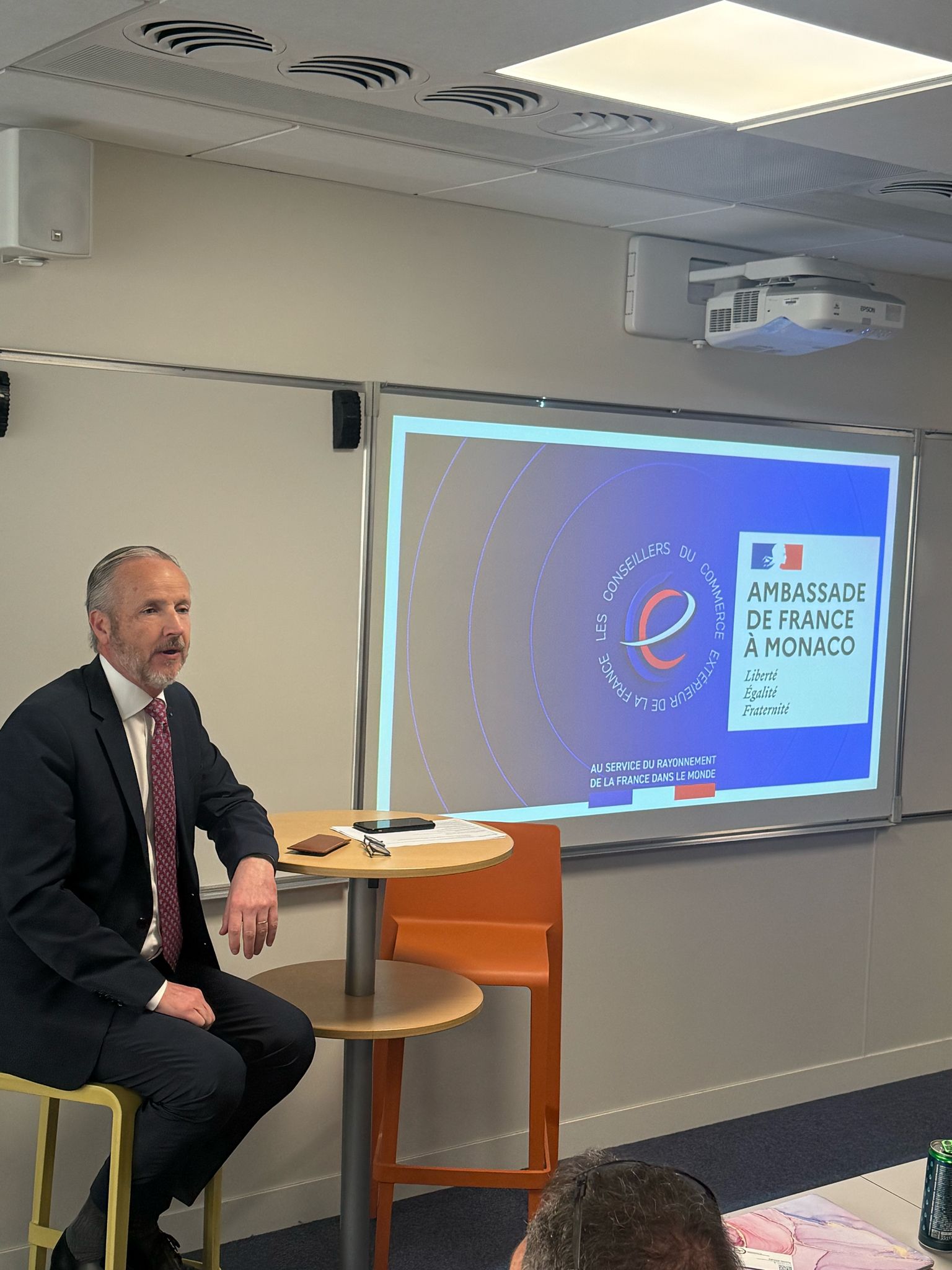
On March 6, the Foreign Trade Advisors of France – Monaco launched an ambitious project at the International University of Monaco (IUM) to explore the economic and strategic role of Francophonie in a rapidly changing world. The aim was to explore the perceptions of younger generations regarding the concept of Francophonie, its relevance and the opportunities it offers for the future, particularly in terms of economic development and international influence.
26 students engaged until June 10: over several months, these Master’s students in international business will work on five major themes related to Francophonie. The topics revolve around emerging economic sectors in French-speaking countries, artificial intelligence and digital transformation, Francophonie and sustainable development, the French language and education in international trade, and regional economic integration.
A launch attended by committed personalities
The introduction was delivered by Dr. Jean-Philippe Muller, Director General of IUM, and Sophie Arnaud Deromedi, President of the CCE Monaco committee – Board of Directors and Executive Bureau of the Foreign Trade Advisors of France. His Excellency Jean d’Haussonville, Ambassador of France to Monaco, then elaborated on the role of Francophonie in the world and the importance of cultural differences. Finally, Ms. Camille Safarov, Director of the Master’s program, presented the project to the students.
An international and multicultural context
From the start of the conference, one reality stood out: the diversity of the students’ backgrounds. While some are native French speakers, others are discovering the language and its implications in the business world. This diversity reflects the current state of international trade, where the power dynamics between cultural and economic blocs shape commercial opportunities and strategies.
 Sophie Arnaud de Romedi reminded the audience that Francophonie is not limited to the French language. It also encompasses a geopolitical and economic dimension, with major stakes in terms of influence and cooperation. Today, the French language is spoken across several continents and represents a real lever for economic development, particularly in Africa, where demographic growth and the rise of emerging markets reinforce its importance.
An expanding market: Francophonie as an economic asset
With more than 320 million speakers and sustained growth in Africa, Francophonie represents a considerable market for companies. According to the speakers, French-speaking companies have a competitive advantage, particularly in sectors such as:
- Luxury and the art of living, where the use of the French language confers an image of prestige.
- Infrastructure and innovation, where economic relations between French-speaking countries facilitate investment.
- Sustainable development and the circular economy, which rely on Francophone networks for collaborative projects.
The speakers also highlighted the key role of Francophone economic diplomacy, embodied by institutions such as the International Organisation of La Francophonie (OIF) and the Francophone Employers’ Group (GPF). These structures facilitate exchanges and strengthen the influence of French-speaking companies on the international stage.
A concrete academic project for students
As part of this conference, IUM students will have the opportunity to work on various case studies related to economic Francophonie. Their mission? To analyze the economic dynamics of Francophonie and propose strategic recommendations, like true consultants.
At the end of their work, their conclusions will be presented to experts from the business world, including CCEs, ambassadors, and leaders of international companies. This is a unique opportunity for students to apply their skills to real-world issues and develop a deep understanding of the economic stakes of Francophonie.
 Language and strategic thinking: an essential approach in business
During his speech, His Excellency Jean d’Haussonville, Ambassador of France to Monaco, emphasized the importance of language in shaping strategic thinking. He explained how language influences our way of interpreting the world and making decisions.
A parallel was drawn between the design of English and French gardens: the French garden, orderly and symmetrical, reflects a Cartesian and rational vision. The English garden, freer and more spontaneous, conveys a more empirical and pragmatic approach.
This analogy highlights how mastering several languages allows one to adopt diverse strategic perspectives, a major asset in business.
Towards greater awareness of the future of Francophonie
One of the challenges raised during the conference is the preservation and strengthening of the role of native languages in international business. While English dominates many fields, it is essential for French-speaking companies in particular to capitalize on their linguistic and cultural heritage to differentiate themselves.
He recalled that choosing words in an economic context is not trivial. For example, in the luxury sector, speaking of “vigneron” instead of “wine maker” or “haute couture” rather than “high fashion” helps preserve a strong cultural identity and assert a unique added value.
An opening towards concrete opportunities
This conference enabled students to become aware of the economic and strategic impact of Francophonie. Through their research and analysis, they will have the opportunity to bring a new vision to contemporary issues and engage with influential decision-makers.
Some groups will even have the opportunity to present their conclusions at an international forum in Paris, demonstrating that reflection on economic Francophonie extends beyond the university walls to take part in a global debate.
This initiative is part of an essential approach: fostering a new generation of leaders aware of the role of language and culture in the business world.