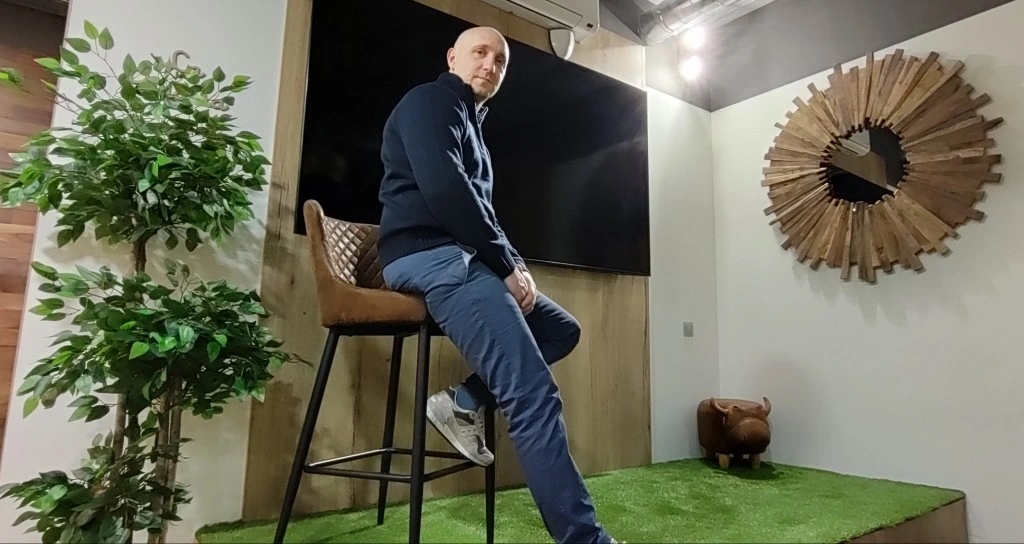
Jérôme Sageaux is an entrepreneur and business angel, actively involved in supporting and developing innovative startups. Founder of Gestrategia SL, he supports companies in their digital transition, financial structuring, and growth. At the helm of Seed Andorra, he energizes the digital ecosystem in Andorra by incubating and accelerating startups. In parallel, he co-leads the Elton LEWIN group, dedicated to the managerial transformation of small and medium-sized businesses. With a vision focused on innovation and sustainability, he combines expertise in venture capital, HR management, and real estate to build high-impact projects. He shares with us his experience of adopting and using AI in his companies.
A career rooted in tech
Jérôme Sageaux began his career at the very dawn of the web. Passionate about the possibilities offered by digital, he launched into website creation and affiliate marketing.
From 2008, he focused on online commerce. His first e-commerce sites specialized in market niches and achieved great success, attracting half a million customers and generating millions of euros in revenue. These successes enabled him to broaden his scope of activity to managing a web agency and developing software in Morocco. He created solutions such as ERPs and CRMs intended for both his companies and the local market.
Despite this diversification, Jérôme chose to sell some of his companies to dedicate himself to projects combining innovation and entrepreneurial freedom. He settled in Andorra, which although traditionally focused on trade such as alcohol and tobacco, offers a strategic platform for international companies. “It’s an ideal location for start-ups targeting a global market and not needing an extensive local presence,” he explains. The country’s low taxes and international openness are key assets for attracting them.
To boost the local tech ecosystem, Jérôme co-founded a digital incubator. The latter is not limited to a physical space: it is a virtual network connecting entrepreneurs from more than 35 nationalities. It offers a collaborative environment, covering fields as varied as cybersecurity, mobile applications, crypto, and the web.
The incubator operates primarily on a mutual-aid basis. Members meet monthly during informal meetups and take part in workshops in partner coworking spaces. These meetings allow for exchanges on issues encountered, testing new solutions, and strengthening ties between entrepreneurs. Currently, six projects are being supported, with priority given to their growth and technological development. Although financial support is not yet in place, it represents a future step to consolidate the incubator’s impact.
AI as a catalyst for transformation
Jérôme sees AI as a lever to accelerate the digital transformation of companies. In his various activities, he uses it to improve processes, save time, and optimize strategic decisions. He insists that AI must be considered as a tool, multiplying human capabilities rather than replacing them.
In the strategic consulting firm he runs, AI plays an essential role. They use ChatGPT in particular to create detailed reports, analyze complex data, and make accurate diagnoses. They have developed GPTs to respect the specificities of projects and offer solutions tailored to each client. “For example, during an audit, AI helps to quickly gather scattered data, identify trends, and propose concrete avenues for improvement.”
In the training center he co-directs, AI simplifies the creation of educational content. It generates guides, PowerPoint presentations, and exercise materials, allowing teachers to focus on interacting with students. “This has cut preparation time in half while increasing the quality and relevance of content.”
Moreover, Jérôme is exploring the use of AI to personalize training. The tools analyze learners’ needs and adapt the modules accordingly, thus creating a tailor-made experience.
Within the incubator, various projects use AI:
- A mobile application supports patients suffering from irritable bowel syndrome. By examining photos of users’ meals, it suggests dietary adjustments to reduce symptoms.
- An AI centralizes documents and automates tasks related to project management. It also oversees meetings by assigning actions to each collaborator.
- Creative YouTube channels that produce relaxing or educational videos. AI generates scripts, visuals, and scenarios to speed up production.
The challenges of AI
Despite its many advantages, AI faces human resistance. Some employees fear that their expertise will be undervalued or worry about losing control to automated systems.
Jérôme points out that suitable training is essential to reassure employees and show them how AI can enrich their work. From a technical perspective, integrating AI into existing structures remains complex, due to the fragmentation of tools and interoperability needs.
For Jérôme, AI is not an end in itself, but a means to rethink activities. The main idea is to relieve employees of tedious tasks. This will give them the opportunity to focus on strategic missions. This time savings frees up creative energy, essential for innovating and adapting to market developments.
“AI, when used well, transforms the dynamics of companies and allows them to reach a level of productivity never seen before,” he concludes.
Jérôme Sageaux’s advice for entrepreneurs
“Don’t implement AI solutions just to say you did it. Implementing AI without a real need or clear strategy can be useless and costly, especially for small businesses with limited resources. For those where AI has real potential, particularly in the technology and service sectors, he recommends integrating this technology in a targeted and thoughtful manner.
Start by consulting end users. Offer them a range of tools tailored to their constraints and identify how these solutions can simplify their daily lives, improve their performance, and save them time. This approach will help prioritize projects with the greatest impact on the organization.
The main objective should not be immediate innovation, but the increase in the quality of everyone’s work. This freed-up time will foster better strategic thinking and pave the way for natural innovation, driven by more available and engaged collaborators.”