Artificial intelligence works. It analyzes documents, generates content, synthesizes information, detects anomalies, automates certain tasks and is now beginning to act through agentic systems capable of chaining multiple operations. Yet as these capabilities advance, another question becomes central:
Why do companies with high-performing AI technologies not always manage to transform this technological power into measurable economic, organizational or strategic value?
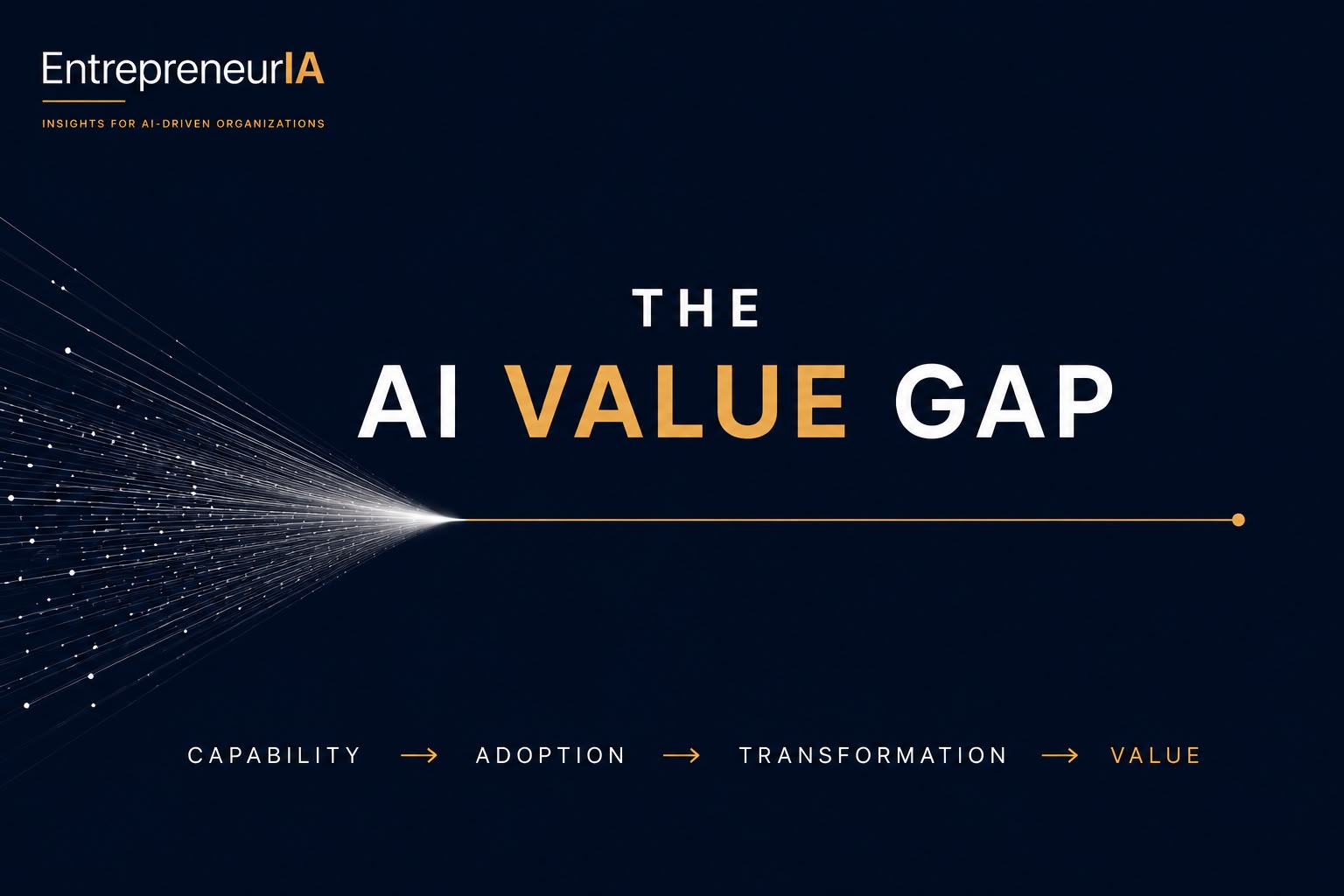
After several years dominated by experimentation, pilots and proofs of concept, this question marks a new stage in the maturity of AI in business. The problem is no longer just one of access to technology. It becomes one of converting it into impact. This gap can be called the AI value gap: the distance between what artificial intelligence technically enables and what the organization actually manages to transform, then capture in the form of value. This distinction is fundamental.
A company can succeed in an AI project on a technical level and fail in its adoption. It can achieve operational gains without transforming its processes. It can even transform certain processes without managing to convert these improvements into measurable economic results. The technology has then created a real capability. But the organization only captures part of the potential value.
From capability gap to value gap
For a long time, companies have mainly faced a capability gap. The question was first technological: is AI capable of performing the envisioned task? Can it understand a complex document? Analyze large volumes of data? Produce relevant content? Identify an anomaly? Automate a sequence of actions? This question remains important. But it is no longer sufficient. Model capabilities are progressing rapidly. Access to them is becoming democratized. Platforms are multiplying and organizations can experiment much faster than a few years ago. The center of gravity of the problem is shifting. When technology becomes more accessible, the limiting factor may gradually become the organization’s ability to integrate it, transform its practices and convert this transformation into results.
The challenge is therefore no longer just:
“What can AI do?”
It becomes:
“What are we capable of transforming thanks to what it enables?”
The difference seems subtle. It is strategic.
A working hypothesis: four stages between technology and value
The interviews I conduct as part of EntrepreneurIA with entrepreneurs, executives and professionals developing or concretely deploying artificial intelligence reveal several recurring situations.
From these observations, a framework emerges:
CAPABILITY → ADOPTION → TRANSFORMATION → VALUE
At this stage, this is not a scientifically validated model nor a fixed methodology. I use it as a working hypothesis to more precisely examine the mechanisms that separate technological potential from real impact. Each stage answers a different question.
- Capability: what does the technology actually enable?
- Adoption: who actually uses this new capability, under what conditions and with what level of trust?
- Transformation: what processes, roles or decision-making methods actually change thanks to this adoption?
- Value: what value does the organization manage to create, measure and capture thanks to this transformation?
The difficulty appears when a project passes one stage but fails to reach the next.
It is in these interfaces that part of the AI value gap is built.
First gap: the capability exists, but usage doesn’t follow
An available technology is not necessarily an adopted technology. The case of OpenText, discussed during my interview with Christophe Gaultier, illustrates this tension. The company integrates artificial intelligence into its solutions and into its own internal uses, while having to take into account another reality: shadow AI. Employees may use tools that are not those officially made available to them. This situation reveals a paradox. An organization can select a technically high-performing solution, compliant with its security requirements, and still find that some users prefer other tools. Adoption depends on multiple variables: ease of use, relevance of results, access to the right data, fit with actual needs, trust and integration into daily workflow.
An essential question then becomes:
Have we only designed what the system can do or have we also designed the conditions under which users will actually choose to use it?
Adoption therefore cannot be considered solely as a change management issue occurring after development. It also constitutes a design constraint.
Second gap: AI is used, but the organization doesn’t change
A company can succeed in adoption while keeping its processes practically unchanged. This is one of the traps of automation. Adding artificial intelligence to an existing organization does not necessarily mean transforming that organization. The developments described by Nadège Kaci and Francis Méléard at P3 provide an interesting perspective here. Business agents can intervene in loops comprising several steps: understand an objective, plan, produce, measure, adjust, start again or request human validation.
This evolution no longer simply consists of accelerating a task. It requires making the process functioning explicit. What is the exact objective? How do we measure its success? Which step can be automated? Which decision must remain human? What happens in case of exception? Who bears the final responsibility? AI then acts as a revealer. It brings to light organizational ambiguities previously absorbed by humans. An experienced employee knows how to interpret an imprecise rule, handle an exception or request validation when they identify a risk. Automation forces the organization to make some of these mechanisms explicit.
This is where a major difference appears between automation and transformation.
Automating consists of executing part of existing work differently. Transforming consists of asking whether this work should still be organized in the same way.
The most significant gains could precisely lie in this second stage.
Third gap: transformation exists, but value remains difficult to demonstrate
Even when a process is transformed, another difficulty appears: how to measure the value actually created? The cases mentioned by Arnaud Pinte at iPepper show the benefit of starting from identified problems, experimenting on specific scopes and measuring results before scaling. This approach seems obvious. It is nonetheless demanding. Companies naturally measure what technology makes easily observable: processing time, number of documents analyzed, execution speed, quality of a response or proportion of automated tasks. These indicators are useful but they do not necessarily constitute a measure of value.
Take saved time. If an AI system enables a team to save ten hours per week, an operational gain exists. But what happens to that time? Does it allow more customers to be served? Improve service quality? Reduce delays? Increase revenue? Avoid certain costs? Devote more resources to innovation? This is where it is necessary to distinguish value created and value captured. A gain can exist without being converted into an identifiable benefit for the organization.
It therefore becomes necessary to distinguish three levels:
Technical performance → operational result → organizational or economic value
The passage from one to another is never automatic.
Governance: the capacity for action changes the nature of the problem
The arrival of AI agents adds an additional dimension. When an AI produces a recommendation, the human generally remains responsible for the action that follows. When a system itself begins to act, the questions change in nature. The interview conducted with Anthony Levy, founder of Damn, highlights in particular the issues of agent identity, permissions and traceability. But behind these technical dimensions appears a strategic decision:
How far does the organization want to delegate?
Just because a technology can perform an action does not mean it should necessarily obtain the right to execute it without control. Autonomy must be viewed in relation to the level of risk, the reversibility of the action and associated responsibilities. Governance therefore does not only constitute a constraint intended to limit technology. It defines the conditions under which the organization agrees to trust it enough to integrate it into its processes.
The human role must also be rethought
Transformation does not only consist of determining what AI can do. It also requires redefining what humans must continue to do. The example of @aXel Perf and Romain Satiat is interesting in this regard. Artificial intelligence can accelerate data analysis and draw attention to certain anomalies, while interpretation of results and decision-making remain human. This organization is not necessarily a temporary limitation of technology. It may correspond to a deliberate decision architecture.
In certain situations, the value of human work shifts. It lies less in executing repetitive tasks than in interpreting an exception, taking context into account, arbitrating between multiple objectives or exercising responsibility.
The question then becomes:
Where do we want to position human judgment when certain cognitive or operational capabilities become automatable?
This is a question of organizational design as much as a technological question.
The POC only proves part of what the company needs to know
This distinction also leads to questioning the role of the proof of concept. The POC remains essential for verifying a technological hypothesis. But we must avoid asking it to demonstrate what it cannot establish. A POC can prove a capability. It does not necessarily prove adoption. It can demonstrate performance. It does not necessarily demonstrate transformation. It can automate a task. It does not necessarily redesign work. It can produce a result. It does not necessarily demonstrate value. This distinction may explain why some organizations accumulate technologically convincing pilots without managing to sufficiently industrialize their uses.
The problem is then not necessarily that AI doesn’t work. The organization simply has not yet built the entire path to convert this capability into value.
Where does your organization lose the potential value of its AI?
The Capability → Adoption → Transformation → Value framework can then be used not as a definitive answer, but as a questioning tool.
For each AI project, five questions seem particularly useful to me:
- Capability. What new capability have we actually created?
- Adoption. Who will use this capability when experimentation is over?
- Transformation. What process, role or way of deciding must evolve to take advantage of it?
- Governance. What autonomy do we actually want to grant the system and where should we maintain human responsibility?
- Value. What proof will enable us to establish that this transformation actually creates and captures value?
These questions do not only relate to strategy. They influence product design, its functional architecture, its interface, its validation mechanisms, its metrics and its deployment. If no answer exists on expected usage, sharing of responsibilities or measuring impact, part of the system actually remains undefined.
The next AI challenge will also be organizational
Companies have invested heavily to access artificial intelligence capabilities. The next stage will be different. It will require complementing technological experimentation with organizational discipline: determining what the company actually wants to transform, how it wants to transform it and how it will know that this transformation produces a result. This is probably where certain performance gaps will widen. The same models will be accessible to many companies. The same platforms as well. Access to technology will remain important, but it will become more difficult to make it alone a sustainable differentiating advantage.
The differentiator could increasingly lie in the ability to effectively connect:
technological capability → actual adoption → work transformation → measurable and capturable value
The AI value gap is therefore not just an ROI problem. It reveals the distance between technological innovation and organizational capacity to take advantage of it. And it leads to a conviction that structures my work:
Artificial intelligence creates a capability. Organizations create value.
The next stage of AI in business will therefore not only be one of increasingly high-performing technologies. It will also be one of organizations’ ability to transform increasingly accessible technological power into measurable economic, organizational or strategic advantage. The question for executives evolves with it.
It is no longer just about asking:
“Where should we deploy AI?”
But perhaps more:
“Where in our organization are we currently losing the potential value of AI?”