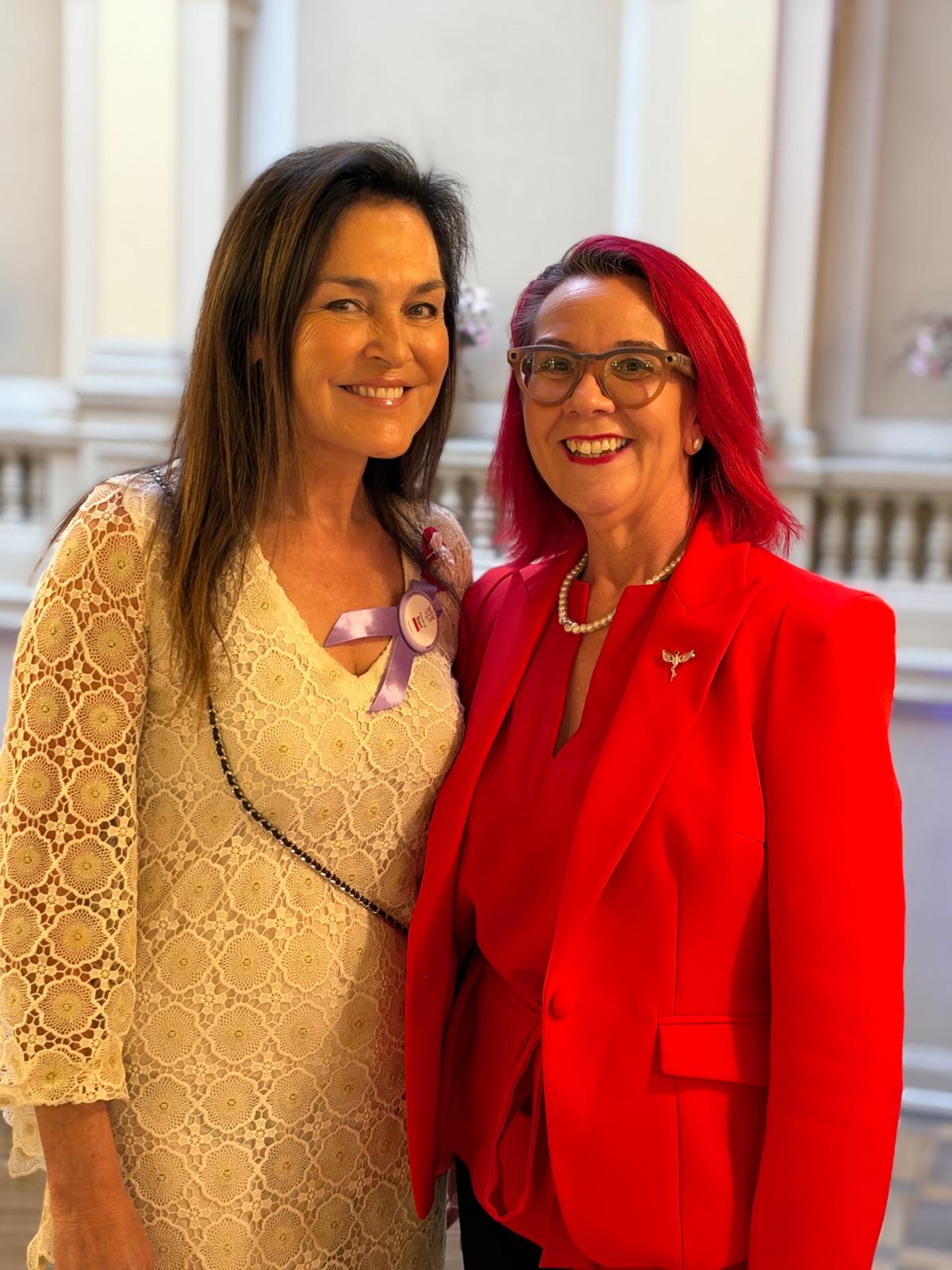
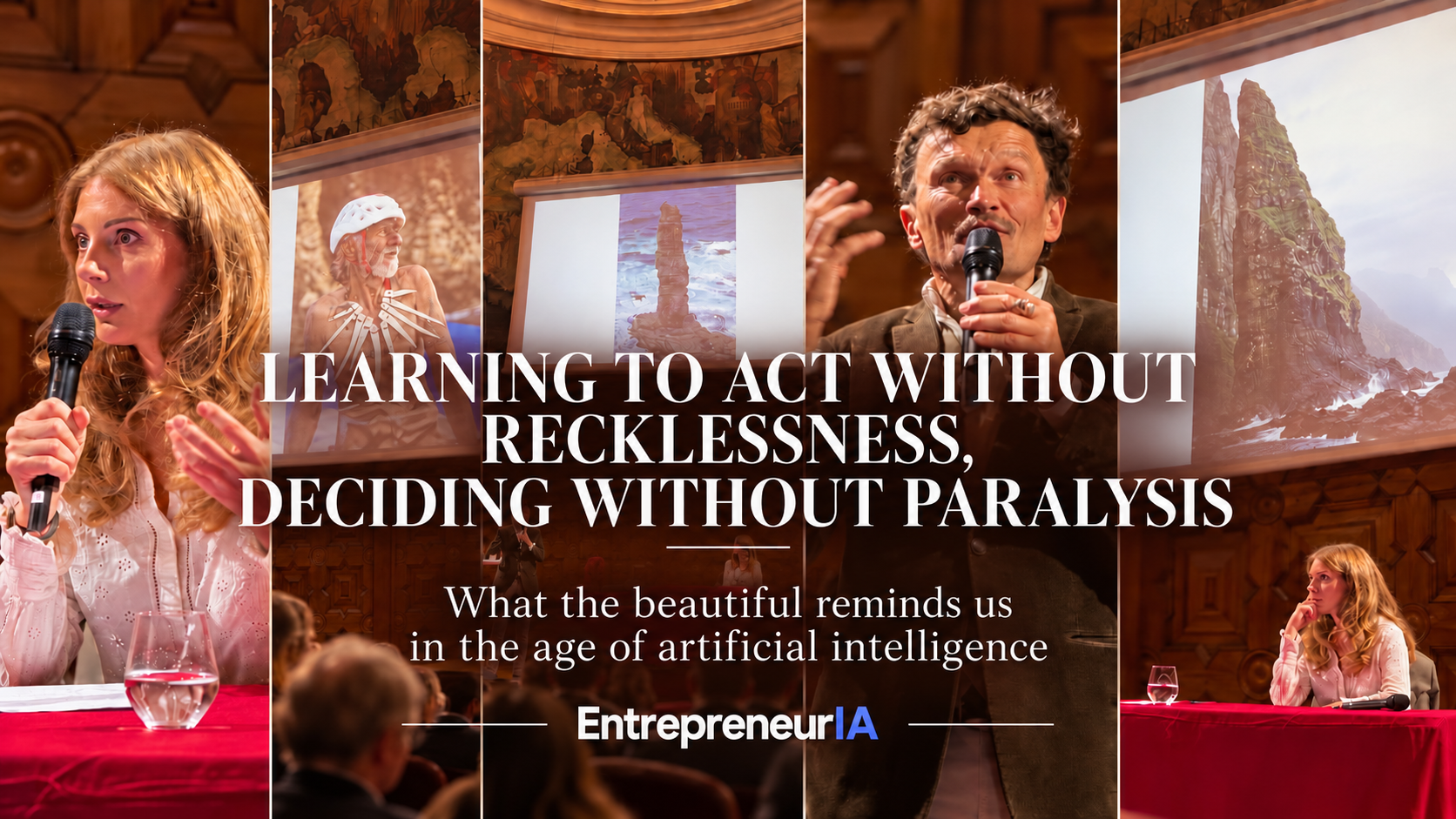
Sylvain Tesson and Catherine Van Offelen at the Centre universitaire méditerranéen in Nice
At the Centre universitaire méditerranéen in Nice, CJD Nice Côte d’Azur brought together philosopher and essayist Catherine Van Offelen and writer-traveler Sylvain Tesson on Monday, October 12. The meeting posed a question that directly concerns business leaders: how to act without recklessness and decide without paralysis? For nearly two hours, Aristotelian philosophy, entrepreneurial experience, and adventure stories dialogued around risk, uncertainty, courage, and judgment. Until this final sentence from Sylvain Tesson, which suddenly gave the entire evening a different depth: “You have to be crazy to put a screen between yourself and the beauty of the world.”
The hall of the Centre universitaire méditerranéen in Nice was particularly suited to this meeting. Created as a place for transmission, debate, and intellectual influence, the CUM hosted a plenary session organized by CJD Nice Côte d’Azur, this time open well beyond its members. The movement, which brings together nearly 6,000 business leaders in France and is approaching 90 years of existence, has claimed since its inception a conception of business that goes beyond mere economic performance. It also involves questioning the responsibility of the business leader, their capacity to evolve, the place of human beings, and the impact of their decisions on society. The conference announcement clearly summarized the proposed dilemma: deciding too quickly can lead to recklessness, but waiting to possess all necessary information can indefinitely postpone taking action. Between the two, there may be a third way, that of “lucid courage.”
This idea had been established at the evening’s introduction. The business leader was compared to the high-level athlete, forced to train, learn, take care of themselves, and surround themselves if they wish to last. The entrepreneur, too, acts, takes risks, bears uncertainty, and sometimes experiences failure. But action should not be confused with rushing forward. “We wanted to honor risk-taking and courage. But not just any risk, and not just any courage. Lucid courage,” the meeting’s introduction recalled. A courage that looks at obstacles, doubts, and consequences without choosing immobility.
Prudence is not what we think it is
Catherine Van Offelen then begins with a conceptual shift. The word she places at the center of her intervention is Greek: phronēsis. It is generally translated as “prudence,” but this modern translation has gradually weakened its meaning. We readily associate prudence with restraint, precaution, or even a certain timidity. The philosopher reminds us, on the contrary, that Aristotelian prudence belongs entirely to the field of action.
“Greek prudence is rather flair in action. It’s intelligence about circumstances, it’s the art of adapting. It’s ultimately a form of practical wisdom.”
Then comes a formula that illuminates the entire demonstration: in doubt, phronēsis does not necessarily command abstaining. It invites action despite uncertainty. Because all action contains a part of the imponderable. One can prepare, measure, calculate, and anticipate, but something always escapes the decision-maker.
This reflection takes on immediate resonance for the business leaders present in the room. Contemporary management has considerably developed forecasting tools, methodologies, data, and control systems. Yet no market study, no dashboard, and no predictive model can totally abolish risk. Entrepreneurship precisely involves making a decision before reality has delivered all its answers. True prudence is therefore not the absence of boldness. It may constitute one of its conditions.
Catherine Van Offelen insists on this paradox. An “audacious prudence” seems to be an oxymoron for moderns. It would have been almost a pleonasm for the Greeks. Phronēsis does not offer certainty. It provides a way to move forward when certainty is impossible.
Deciding means learning to navigate
The image of the sailor returns several times. It helps understand this particular intelligence. One who takes to sea does not order the wind to change direction and does not ask the waves to disappear. They observe, interpret, adjust their course, and compose with what they do not control. The great strategist acts in the same way. Governing, directing, or entrepreneurship means less controlling reality than developing the capacity to maneuver within it.
In Aristotle, Pericles embodies this figure of the phronimos, the prudent man capable of leading the city. Catherine Van Offelen also mentions, according to eras and cultures, de Gaulle or Churchill, but also entrepreneurial figures like Gilbert Trigano and Marcel Bich. The common point does not lie in an identical decision model. It lies in the capacity to perceive circumstances, to sense the moment, and to transform an intuition into action.
This is where one of the most interesting concepts of the conference appears: the ability to read signs. The philosopher goes back to hunter-gatherers who reconstructed the presence of an animal from a footprint, a fragment of fur, or a displaced branch. The doctor still acts this way when interpreting symptoms. The detective reconstructs a scene from clues. The experienced sailor observes the color of the sky, the water, or the behavior of birds.
“The entrepreneur examines the small traces, the microscopic symptoms of a society and manages to guess what needs to be done.”
This capacity belongs neither to magic nor to a mysterious intuition. It often results from experience accumulated over years, to the point of becoming difficult to explain. “In the mountains, they say a good guide is an old guide,” she recalls. Judgment is sharpened by repeated confrontation with reality.
Calculation and intuition are not enemies
Another idea runs through the intervention: modern thought has become accustomed to separating what phronēsis precisely seeks to unite. On one side, reason, numbers, demonstration, and analysis. On the other, intuition, sensitivity, experience, and the body. Yet good decision-making often simultaneously mobilizes these two registers.
Catherine Van Offelen speaks of an “elastic rigor,” a “reasoned intuition,” or even an “intelligent heart.” She quotes Bergson: “One must act as a man of thought and think as a man of action.” The formula summarizes well the tension of the entire evening. It is neither about celebrating instinct against reason nor reducing judgment to an equation. It is about holding together several forms of intelligence.
This question becomes particularly contemporary when she addresses our obsession with security and our increasing reliance on decision-support systems. Experts, software, consulting firms, big data, and now artificial intelligence are mobilized to increase the quantity of available information.
“We think that the more data there is, the more we will protect ourselves from all risks. In fact, we would like to know all the risks in order to take none.”
The remark deserves attention. The accumulation of data can considerably improve a decision. It does not, however, transform an uncertain world into a certain world. More profoundly, it does not eliminate the responsibility of the person who decides. Phronēsis thus recalls an essential limit to any automation of decision-making: information can be augmented, forecasting refined, scenarios multiplied, but there remains a moment when someone must choose.
The right measure rather than zero risk
Catherine Van Offelen also devotes a significant part of her intervention to the notion of the right measure. Again, this is not about seeking lukewarmness. She compares this position to a ridgeline. The prudent person is neither one who systematically refuses risk, nor one who blindly throws themselves into action. They seek the point of balance that depends on the situation.
This conception is diametrically opposed to excess, Greek hubris. Achilles, Antigone, or certain figures of radical idealism illustrate this inability to compose with circumstances. Ulysses, on the contrary, advances through adaptation, cunning, detours, and learning. He fails, suffers, starts again, and returns different from the one who left. The straight line is therefore not always the path of practical intelligence.
The philosopher also recalls that a decision cannot be judged solely on the elegance of the intention. Phronēsis has an ethical dimension, but also a requirement for effectiveness. The decision-maker must achieve a result without losing sight of the purpose of their action. Cunning without moral purpose becomes manipulation. Virtue without the capacity to act risks, conversely, remaining powerless.
With Sylvain Tesson, philosophy leaves the amphitheater for the cliff
When Sylvain Tesson takes the floor, the change in register is spectacular. He himself announces that he will be responsible for providing a physical illustration of what Catherine Van Offelen has just theoretically exposed. Aristotelian concepts will now encounter the sea, cliffs, kayaks, ropes, weather, and some situations in which a bad decision can have very concrete consequences.
The writer begins, however, by returning to the place. Paul Valéry, first administrator of the Centre universitaire méditerranéen, wanted to develop there a “politics of the spirit.” Tesson observes that Catherine Van Offelen has perhaps just exposed there a “politics of action,” or even a “spirit of action.” The expression is accurate. The entire purpose of the evening consists precisely in refusing the separation between thought and movement.
He then ironizes about the famous definition attributed to LinkedIn co-founder Reid Hoffman, according to which creating a company would be like jumping off a cliff while building the plane during the fall. For Tesson, who has himself experienced a very real fall, the metaphor has its limits. The real challenge is not to rush into the void hoping to improvise a solution. It would rather be to jump after having sufficiently prepared what will prevent the crash. The entire difference between recklessness and courage is already there.
The “stacks,” laboratories of decision-making
Sylvain Tesson then takes the audience on a journey around the world. For several years, with mountaineer Daniel Dulac, he undertook to climb sea stacks, those rocky pillars that erosion has gradually detached from the coasts. Étretat, Newfoundland, the Marquesas, Tasmania, Palawan, Easter Island, Cape Horn, Ireland, and Scotland mark this journey. The projected photographs show stone needles rising from the sea, sometimes difficult to access and often subject to changing conditions.
Tesson loves these geological formations for their symbolic power. The coast recedes, the pillar remains. He sees in it the figure of the dissident, the refractory, the one who maintains their position while everything moves around them. But behind the poetry of the narrative lies methodical preparation. To reach these summits, one must take into account the state of the sea, the weather, the tide, the quality of the rock, the equipment, the physical capabilities of each person, and the possibilities of retreat.
“If we had ruminated too long on all the difficulties and dangers of such an enterprise, we would have been completely paralyzed.”
Conversely, leaving without preparation would have led to failure, or even tragedy. Tesson then almost proposes an operational definition of this practical wisdom mentioned by Catherine Van Offelen: take risks, but back them with the maximum possible preparation.
Mountaineering here becomes a particularly relevant metaphor for entrepreneurial decision-making. There is a time to analyze and a time to act. Confusing the two leads either to imprudence or to paralysis. The difficulty consists in recognizing the moment when analysis has sufficiently reduced uncertainty for action to become reasonable, without ever becoming totally certain.
Knowing how to give up is also part of courage
The final discussion on failure brings an essential nuance. Not all of Tesson and Dulac’s attempts succeeded. On two occasions, the state of the sea even prevents them from reaching the base of the pillar. Swells exceeding 2.50 meters make the passage from kayak to rock too dangerous. They give up.
This detail is important because it destroys a simplistic vision of courage. Being bold does not mean pursuing systematically. The ability to give up when conditions are no longer acceptable also belongs to judgment. Tesson recounts, however, what follows: back on shore, disappointed, they look for another stack and set off again. Failure becomes neither a romantic glorification nor a definitive condemnation. It modifies the trajectory.
“Failure is part of learning.”
Catherine Van Offelen places this experience in a broader perspective. The child falls before learning to run. One who learns a language makes mistakes before mastering it. Similarly, the decision-maker’s experience is formed through slow “sedimentation.” Situations experienced, mistakes, successes, and renunciations gradually form what we call judgment.
This idea deserves to be heard by organizations. There is a contradiction in simultaneously demanding innovation, boldness, and the total absence of failure. A company that systematically punishes error often ends up producing fewer risky decisions, therefore fewer experiments. The relevant question is not how to eliminate failure, but how to distinguish failure resulting from prepared experimentation from that which proceeds from negligence.
“Stackism,” or the intimate geography of freedom
In the last part of his intervention, Sylvain Tesson goes beyond mountaineering to propose what he calls “stackism.” The idea consists of identifying in one’s existence a few places to which one attaches particular value, then organizing part of one’s life around this personal constellation. These places can take very different forms: a mountain, a library, a beach, a farm, a theater, a tree, a table, or a piano. All have in common offering a space of freedom, beauty, autonomy, or retreat.
The proposal might seem distant from the initial question of decision-making. Yet it constitutes one of its most interesting extensions. Deciding presupposes knowing what matters. Without personal hierarchy, without reference points, without criteria, all options end up being equivalent and freedom of choice can itself become paralyzing. Tesson thus reverses Pascal’s formula about man unable to stay in his room. According to him, the problem is perhaps not that man leaves it, but that he can now go everywhere without always knowing where he really wants to go.
This reflection resonates singularly with our digital environments. We can access everything, almost immediately. An infinity of content, destinations, opinions, and possibilities constantly present themselves to us. But the abundance of options does not mechanically produce meaning. It can even make building a direction more difficult.
Rehabilitating human judgment
At the end of the evening, Catherine Van Offelen and Sylvain Tesson seemed to have taken radically different paths to reach the same point. The former started from Aristotle to recall that human beings must learn to decide in a contingent world. The latter set out to assault rocky pillars to show that the most audacious action requires preparation, observation, experience, and sometimes renunciation.
Their dialogue ultimately poses a very contemporary question. As we increase our capacities for calculation, prediction, and assistance through technology, do we simply want to make better decisions or are we unconsciously seeking to eliminate the necessity of deciding? It’s not the same thing. The first ambition is reasonable. The second is probably illusory.
Phronēsis reminds us that the human world is not an equation. Circumstances change. Purposes are debated. Individuals react differently. The unexpected occurs. Judgment remains necessary precisely because reality resists complete modeling. Artificial intelligence can help illuminate a decision, detect signals, compare hypotheses, and multiply scenarios. But it dispenses neither with responsibility nor with this intelligence of circumstances that Catherine Van Offelen places at the heart of prudence.
And perhaps it ultimately took Sylvain Tesson to bring this intellectual reflection back to something much more elementary: our direct relationship with the world. Throughout his intervention, his photographs had shown tiny men facing cliffs, the sea, the wind, and immensity. Human beings forced to observe before acting, to feel before calculating, then to decide.
“You have to be crazy to put a screen between yourself and the beauty of the world.”
In an era that promises us ever more technological intermediation, the formula goes far beyond criticism of mobile phones. It forces us to ask ourselves what we want to continue to see, to experience, and to decide for ourselves. Technology can increase our knowledge of the world. It should never make us forget to look at it.