EntrepreneurIA Article • Pascale Caron
When beauty compels us to slow down
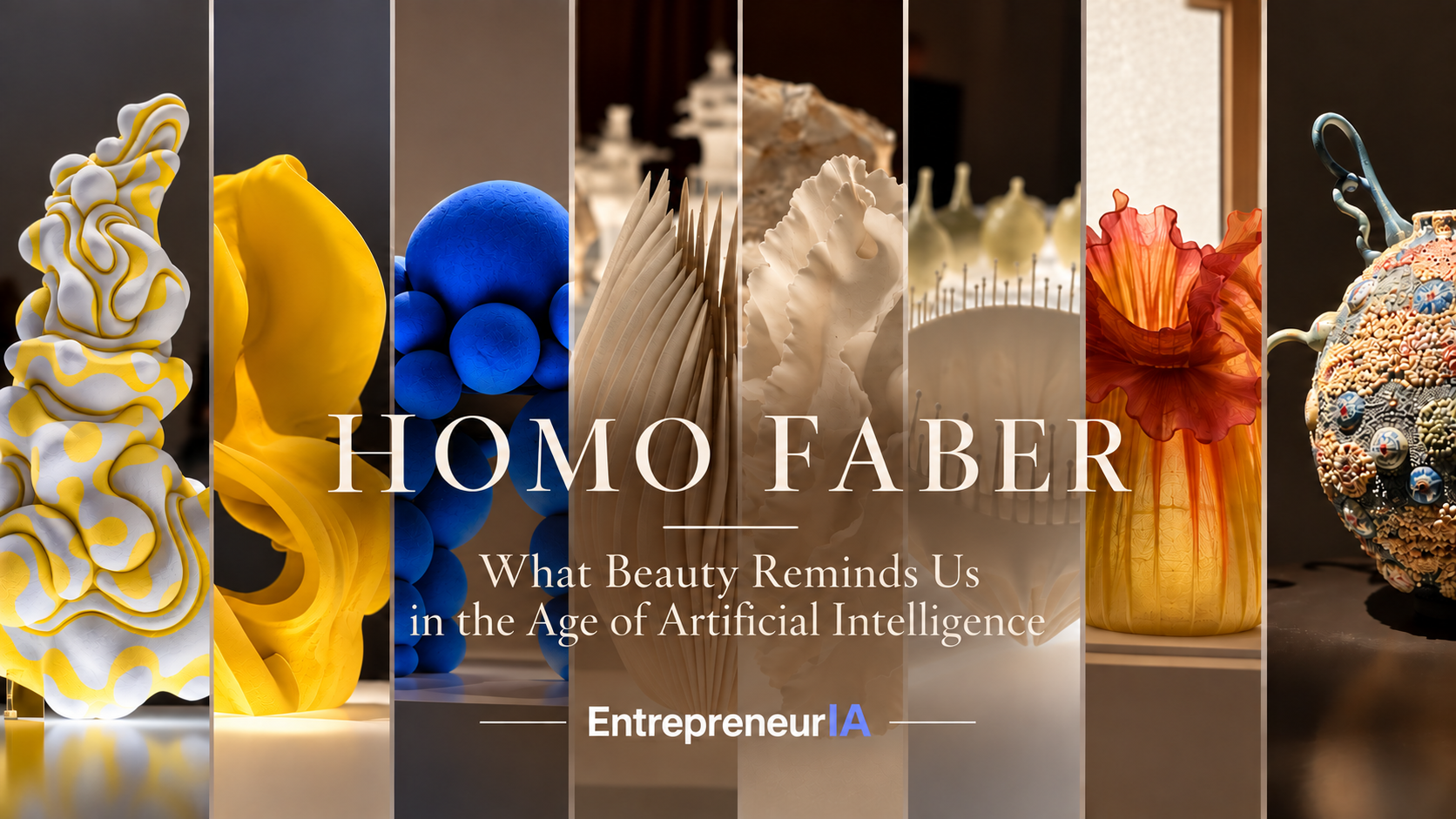
This week, in Venice, Homo Faber offered me a true aesthetic shock. I went there to discover the excellence of art craftsmanship. I came out with a much broader reflection on our relationship to creation, matter, time and human value.
For three years, I have been immersed in generative artificial intelligence. I observe its advances, uses and transformations in companies. I meet entrepreneurs who integrate it into their organizations. I watch models progress at a spectacular speed and gradually transform our way of producing, creating, analyzing and deciding.
And then, at Homo Faber, I looked at works.
Works whose matter, complexity and sometimes strangeness stopped me. I observed organic forms, plays of light, volumes, textures, objects whose creation we instinctively try to understand. Behind them, the human hand was rarely visible. Yet it was everywhere.
This is perhaps what troubled me most. After three years spent observing what machines are becoming capable of generating, I was captivated by objects that silently bore the trace of time, gesture and human mastery. Before certain pieces, I stopped for a long time. Not to search for information. Not to understand a new technology. Simply to look.
I then surprised myself thinking something very simple: this is good for my brain.
This is what the book Your Brain on Art: How the Arts Transform Us, by Susan Magsamen and Ivy Ross talks about. The authors explore how artistic and aesthetic experiences interact with our perception, emotions and various cognitive processes. I am obviously not trying to transform a personal sensation into a neuroscientific demonstration. What struck me was much more immediate. After three years of immersion in a largely digital universe, I was rediscovering the power of a profoundly sensory experience: looking at matter, changing angles, observing light, trying to understand how an object could have been born.
And above all, slowing down.
The hand behind the work
We talk enormously about intelligence since the emergence of generative AI. Yet we often use this word to designate certain capabilities: reasoning, calculating, memorizing, synthesizing, producing language or solving a problem.
Homo Faber reminds us that other forms of intelligence exist. The intelligence of gesture is one of them.
Even when the craftsperson is not before us, their presence remains perceptible in the object. A material has been chosen, observed, worked. Decisions have been made. Gestures have been repeated, corrected and perfected. This knowledge is partly explicit. It can be taught and described. But it is also profoundly tacit. It is acquired through observation, repetition, sensation and experience. This is perhaps what makes certain works so fascinating. We see the result, but we sense behind it something invisible: the time necessary to learn to produce it.
Yet this notion of time takes on particular significance in the age of artificial intelligence.
When production becomes easy, where does value shift?
Generative AI is gradually bringing us into an economy of abundance. Certain production capabilities once rare are becoming accessible to a considerable number of people. This abundance obviously does not mean that all productions are equal. Quality, intention and judgment remain determining factors.
From this, an economic as much as cultural question arises: when the result becomes abundant, where does value shift?
Homo Faber made me envision an answer. Toward provenance, perhaps. Toward the process. Toward the know-how. Toward singularity. Toward the manufacturing story. And toward human time.
An artisanal object is not only valuable for its appearance. It carries with it the conditions of its fabrication. Someone learned to produce it. A material resisted. Decisions were made. Knowledge was transmitted.
Artificial intelligence could thus provoke a fascinating paradox: the easier production becomes, the more we might want to know how things were produced.
Ateliers de France: preserving the intelligence of gesture
This experience also brought me back to my interview with the Ateliers de France Group conducted for EntrepreneurIA. Our conversation focused on a question that took on particular resonance before the works of Homo Faber: how to preserve and transmit know-how that sometimes relies on decades of experience?
In art and heritage crafts, not all knowledge can be recorded in a manual. One part is explicit and can be documented. Another is much more difficult to grasp. It resides in the gaze, in the perception of matter, in the repetition of gesture and in a multitude of micro-decisions acquired with experience.
This is precisely where digital technologies, and tomorrow more so artificial intelligence, can play an interesting role.
During my interview with Ateliers de France, we discussed the possibility of documenting certain rare gestures through video, photography and data capture. The example of gestures related to making Louis XIV cremone bolts particularly struck me. Filming an experienced craftsperson obviously does not allow transferring their know-how. But when the image can be enriched by other information, such as certain working temperatures of the material, part of the tacit knowledge becomes documentable.
Technology does not perform the gesture. It helps preserve its memory.
This distinction seems essential to me. AI does not necessarily aim to replace what the human hand knows how to do. It can also help document, organize and transmit knowledge that might otherwise risk disappearing.
AI can thus participate in preserving gestures it cannot replace.
This is probably one of the most interesting encounters between artificial intelligence and craftsmanship: not systematically automating know-how, but using technology to increase our capacity to transmit it.
Toward an economy of human provenance?
This reflection extends far beyond art crafts. It concerns luxury, design, fashion, gastronomy, creative industries and perhaps tomorrow part of our intellectual production.
For a long time, we valued the ability to produce because this ability was rare. It required particular skill, time, training or significant means. Artificial intelligence is gradually modifying this equation.
If millions of people become capable of producing sophisticated images, videos, texts or digital objects of acceptable quality, scarcity does not necessarily disappear. It changes nature.
We could thus see a true economy of provenance emerge. Who created? How? With what tools? What part of the process was automated? What human know-how intervened? How much time was necessary?
In a universe saturated with synthetic productions, knowing that an object was fashioned by a person could in itself constitute information creating value.
What artificial intelligence will make rare
We wonder a lot about what AI will make possible. We wonder what tasks it can accomplish, how much time it will save and what processes can be automated. But we think less about what it might make rare.
Yet this is perhaps where part of the next value creation lies.
Human time could become more precious precisely because it is limited. A machine can generate a thousand proposals. A craftsperson can only dedicate their attention and hands to a limited number of pieces.
Provenance, gesture, experience, singularity and human trace could thus gain importance as synthetic production becomes abundant.
The challenge is therefore not to choose between hand and machine. It consists of determining what we wish to entrust to each. If technology makes it possible to document knowledge, preserve its memory and improve its transmission, it does not necessarily diminish the value of human expertise. It can on the contrary help protect it.
The power of beauty
I left Homo Faber with a different conviction from the one I had entered with.
For three years, I have been observing what machines are becoming capable of doing. In Venice, I looked at what human beings are capable of creating after years devoted to mastering a material, a technique and a gesture.
I do not believe these two worlds must oppose each other. On the contrary. Artificial intelligence could force us to look more carefully at what we had ended up considering ordinary: a hand that knows, an eye that distinguishes, a material that resists, a gesture that is transmitted.
Homo Faber also reminded me of something much simpler. Beauty matters.
In our reflections on technology, we talk about productivity, performance, value creation, skills and transformation. We talk much less about what beauty, matter and wonder provoke in us.
This week, it was good for my brain. But above all, Homo Faber made me look at artificial intelligence differently.
We talk a lot about what artificial intelligence will make abundant. We should perhaps think more about what it will make rare. Human time. Provenance. Gesture. Singularity. Presence.
In a world where we can generate almost everything, what will we still want to know was made by a human hand?