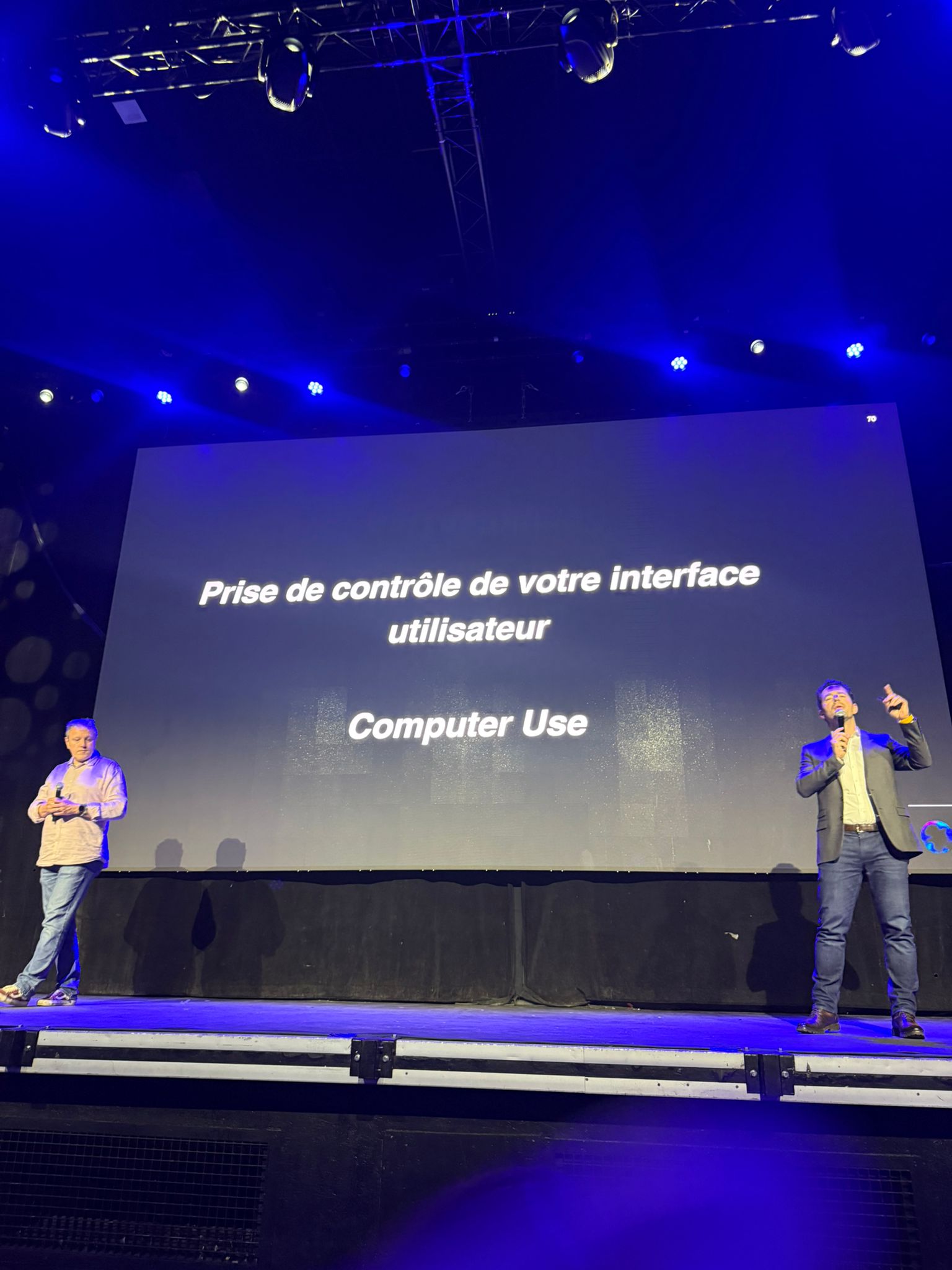
Onepoint’s Revolution Summit concluded its morning session with both an educational and thought-provoking presentation on autonomous intelligent agents. Titled “AI Agents, Are You Ready?”, this conference led by Xavier Galezowski, generative AI leader, and Jean-Paul Muller, data and AI leader, offered a synthesis of the technical, strategic, and ethical challenges posed by this new generation of artificial intelligence.
A Definition That Urgently Needs Clarifying
Far from being a vague buzzword, the speakers immediately laid the groundwork: an AI agent is not simply a chatbot. It is a system capable of performing complex tasks autonomously, by understanding an intention, acting, observing the effects of its actions, and adjusting its strategy. An augmented brain with tools, memory, and decision-making capabilities.
Towards AI That Does, Not Just Thinks
The agent goes beyond the cognitive function of traditional LLMs to enter the realm of action. Through plan orchestration, access to APIs, management of decision loops, these systems can act, interact, learn from their actions, and even collaborate with other agents. A change of scale comparable to the shift from writing to language.
Concrete Use Cases: From Finance to Software Engineering
Numerous use cases were illustrated: in-depth information research (intelligent benchmarking), code generation, automated testing, direct interaction with software interfaces (CUA), and orchestration of complex workflows. The speakers emphasized: the agent doesn’t replace generative AI, it encapsulates it within a chain of deliberative actions.
The Promise of a Single Interface
In the near future, agents could control all digital services through a single interface. An AI assistant connected to Notion, capable of managing complex tasks without human intervention, illustrates this paradigm shift towards Agent-as-a-Service. Satya Nadella recently announced it: the end of SaaS in favor of agents.
Industrialization: Demanding Architectures
But the promise of autonomy faces technical challenges. Multi-agent architecture requires orchestrators, servers compatible with emerging protocols (MCP, A2A), memory engineering, governance, and iteration cycles. And above all, extreme rigor to avoid infinite loop effects and exponential cost overruns.
Don’t Fall for the Prototype Illusion
The speakers warned: the demo effect is powerful but can mask the complexity of real implementation. The expressed intention must be perfectly translated. Loss of control is the major risk, especially if AIs are allowed to negotiate, dialogue with each other, or generate their own code.
Towards an Ethics of Agents
With the rise of AI agents, new ethical and regulatory questions arise: how do we audit interaction loops between agents? How do we ensure that the final decision remains compliant with company policies? At what point do we cede too much sovereignty to the machine? These are all issues that the law will need to anticipate.
Concrete Recommendations
To initiate an agentic strategy, Onepoint experts recommend: deploying sandbox environments, starting with an advanced LLM, limiting actions to whitelisted tools, imposing energy and financial budgets. And above all, moving step by step, from simple agents to more complex multi-agent architectures.
From Technology to Cultural Transformation
More than a technological leap, the deployment of autonomous agents questions governance, work organization, and corporate culture. It engages a paradigm shift: how to accept that decisions are made without direct human control, while ensuring traceability, performance, and security?
A Frontier to Cross with Clarity
AI agents may represent the next productivity standard in business. But their implementation requires method, critical thinking, and strategic vision. The race is on, but failing to prepare properly could be costly.
Jean-Paul Muller concluded: “It’s not the technology that’s frightening. It’s our lack of control if we refuse to understand what we’re doing.” A clear call to cross this new frontier with discernment.