Las Vegas, CES 2026. This year, one topic dominated the aisles: humanoid robotics powered by artificial intelligence. One observation is clear—China is emerging as the major rising force in this sector, while Europe remains marginal.
A Dominant Chinese Presence at the Show
According to official CES 2026 figures, 21 of the 38 exhibitors dedicated to humanoid robots were Chinese companies, representing more than half of the players present in this category.
This dominance is explained by a complete ecosystem. Companies like Unitree Robotics, AgiBot, Noetix Robotics, and UBTech showcased their latest innovations, ranging from spectacular prototypes to production-ready models.
This distribution of floor space is not trivial. It reflects a clear national strategy: making humanoid robots a pillar of applied technology, not only in laboratories but also in actual production.
Leadership Through Patents and Innovation
Beyond the show floor, the global competition is also playing out in patents. A Morgan Stanley financial report highlights a striking fact: China has filed more than 7,700 patents related to humanoid robotics over the past five years, compared to 1,561 for the United States.
This imbalance illuminates the gap between industrial strategies. While the United States focuses on certain levers such as vertical integration and proprietary technologies, China is betting on the accumulation of patents and a complete ecosystem.
One might object that patents do not guarantee commercialization. That’s true. But they measure a capacity for invention and anticipation—crucial factors in an industry where speed of adoption often conditions commercial success.
Europe on the Margins: Absent from the Podium
By comparison, Europe does not appear on this podium. No major national delegation rivaled the Chinese visibility. No figures comparable to China’s are publicly announced. The continent struggles to structure a coherent response to the global rise of humanoid robots. This void raises a central question: does Europe want to be an actor or merely an observer of this revolution?
This absence is not merely quantitative. It is also strategic. Europe debates, it philosophizes about ethics, regulation, and the societal impact of AI. These discussions are necessary. They question the role of technologies in our societies, privacy, employment, security. They interrogate the very nature of artificial intelligence and machine consciousness.
But these debates are not enough to advance an industry. They do not build companies capable of competing in global markets. They do not drive production chains, educational ecosystems oriented toward physical robotics, or massive funding dedicated to emerging technologies.
The Risk of Contemplation
One might fear that Europe is falling into a double trap: over-regulating to develop nothing, or over-philosophizing while others take the lead. This posture, if it persists, risks leaving our continent dependent on foreign technologies, with the economic, social, and geopolitical consequences that entails.
This fear is not unfounded. When physical production of key technologies is outsourced, dependencies are created: on components, on software, on cloud platforms, on value chains. They can become levers of economic power or vulnerabilities in times of crisis.
A French Paradox: Fear of Acting vs. Need to Experiment
In France, this observation is particularly acute. Fear of failure, a predilection for analysis, and cultural restraint in the face of risk inhibit experimentation. This is not gratuitous criticism, but a diagnosis based on systemic observation of our innovation practices. In response, immobility cannot be the answer.
We cannot simply demand that companies adopt AI while crying out for strict regulation or absolute caution. Innovation requires tolerance for error, rapid feedback loops, and bold funding. Without this, we will remain spectators of the technological transformations that are redefining our economies and societies.
Positive Signals Are Emerging
Yet, initiatives do exist. They are rare, but significant. In France, Dassault Aviation is participating in a $200 million fundraising round for sovereign combat AI, alongside the young startup Harmattan AI. This move is a strong signal: the French defense industry wants to invest in advanced AI capabilities, including robots and autonomous systems.
This funding, if it materializes, can catalyze technological developments, attract talent, and create synergies between research, industry, and application. It shows that when capital is linked to a strategic vision, it is possible to build credible alternatives to American and Chinese leadership.
Between Fundraising and National Strategies
On a global scale, AI fundraising continues to break records. In the United States, players like xAI have recently raised over $20 billion, reflecting investors’ appetite for cutting-edge technologies.
These amounts are not trivial. They represent resources for recruitment, research, prototyping, marketing, and deployment. A humanoid robot is not simply a collection of motors, sensors, and algorithms: it is a complex platform, expensive to design, manufacture, and bring to market.
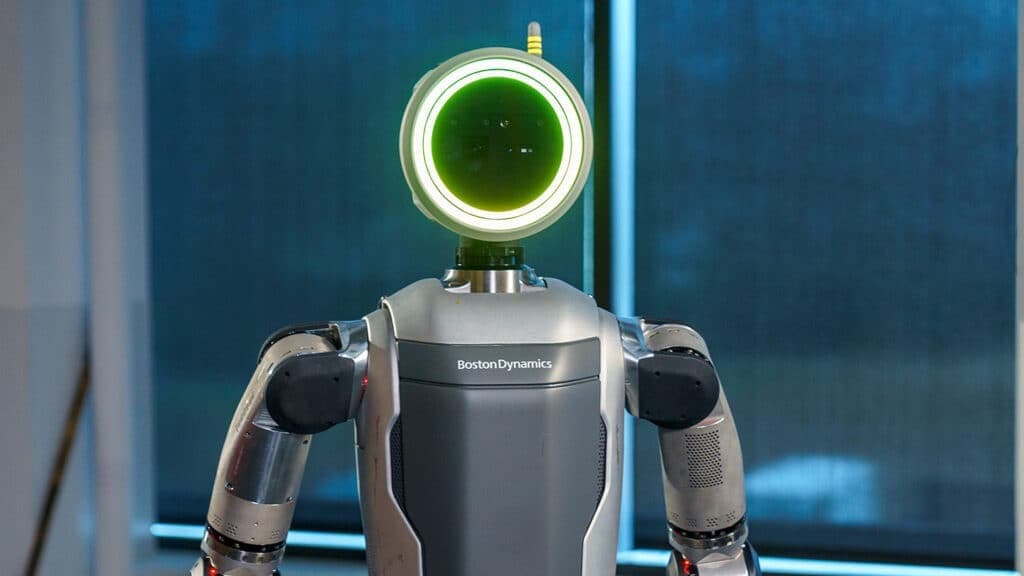
Meanwhile, strategic alliances are forming: Google DeepMind is partnering with Boston Dynamics, a marriage between advanced AI and physical robotic mobility. This type of partnership has the potential to accelerate the commercialization of intelligent robots in real-world environments—from industry to logistics, from healthcare to personal services.
However, this dynamic also reveals a major tension: data governance and digital sovereignty. While the European Union pursues regulatory frameworks on data protection, agreements such as the sharing of certain biometric data with the United States are taking shape. In this context, the question of digital sovereignty arises acutely: how can we protect citizens while participating in a global AI ecosystem?
Digital Sovereignty: Between Regulation and Empowerment
To answer this question, we must move beyond simplistic oppositions. Regulation must not be a brake on innovation. It must be a framework that protects without stifling. This requires a strategic vision, targeted investments, incentives for experimentation, and transnational coordination within Europe.
A worthy industrial policy must integrate fundamental research, startup creation, talent absorption, and financial mechanisms that cover market risks. It must also accept that some experiments will lead to failures—and turn these mistakes into sources of learning rather than occasions for blame.
Conclusion: Boldness Rather Than Wait-and-See
The CES 2026 figures are eloquent. They tell a story where China deploys resources, patents, companies, and robots in a dynamic of global leadership. Europe, for now, watches.
This observation must not be merely a diagnosis. It must be a strategic alert. The future of intelligent robotics, digital production chains, autonomous services, and industrial competitiveness is being determined today.
In this race, inaction is not an option. It is as costly as rushing forward without strategy. France and Europe have the opportunity to turn their ethical reflections into catalysts for innovation. They can decide to act, experiment, invest, and learn quickly.
The question is no longer: will we participate in the AI and robotics revolution? It is rather: how will we position ourselves to influence, rather than endure, what is coming?
- CES 2026 – Humanoid robots: https://interestingengineering.com/ces-2026/china-leads-humanoid-robotics-at-ces-2026
- Number of AI patents China vs. USA: https://www.perplexity.ai/page/china-dominates-humanoid-robot-T9W9J2BtSEmVIIUcII7dHw
- Unitree, UBTech, AgiBot at CES: https://www.ajupress.com/view/20260109111809890
- Chinese robotics: industrial strategy: https://autonews.gasgoo.com/articles/news/the-tech-extravaganza-becomes-home-turf-how-chinese-robots-are-upending-the-global-race-2011397168089116673
- DeepMind – Boston Dynamics alliance: https://www.lepoint.fr/high-tech-internet/les-robots-humanoides-du-ces-2026-posent-la-question-de-notre-cohabitation-future-JYVGLJNKH5HVPJAETZZSGUEGRU
- Dassault Aviation investment — defense AI: https://www.linkedin.com/posts/daphneelucenet_ia-et-robots-la-chine-monte-en-puissance-activity-7416720679074668544-RaPB