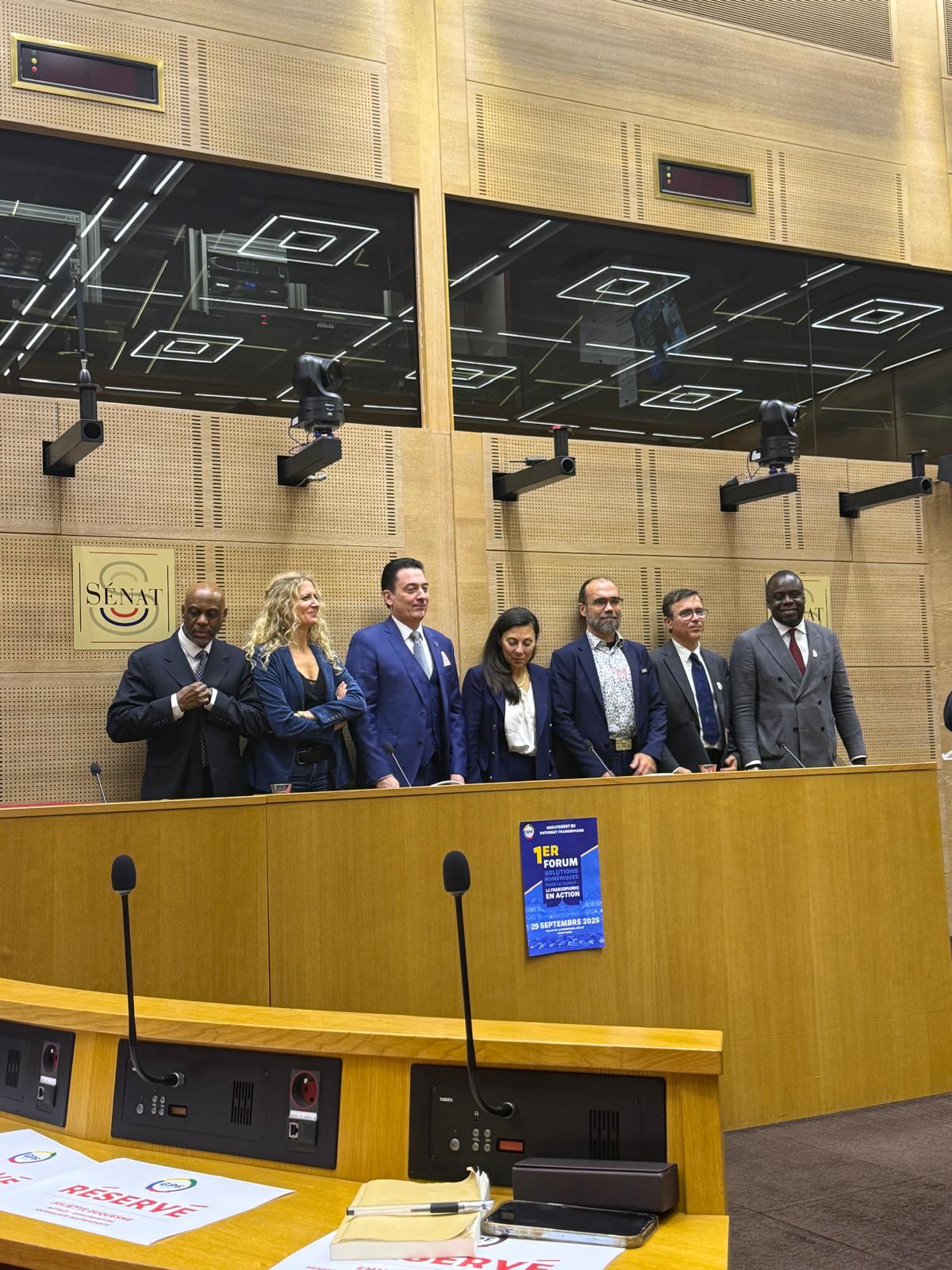
1st Francophone Business Forum at the Senate: when artificial intelligence meets the climate challenge
Paris, Senate — In the hemicycle of the Palais du Luxembourg, the Francophone Business Group (GPF) launched its first Forum “Digital Solutions for Climate”. This event, unprecedented in its scope and ambition, brought together political decision-makers, diplomats, entrepreneurs and experts to debate a complex equation: how to reconcile ecological transition and digital transformation in the Francophone world?
The venue was no accident: the Senate, an institution at the heart of French democratic life, provided a solemn setting for a discussion that extends far beyond France’s borders.
Opening speeches marked by commitment
Patrick Baruel, President of the GPF’s Climate and CSR Commission, had the honor of opening the proceedings. In a confident voice, he emphasized the role of Francophone business in ecological transformation:
“We must move beyond intentions to action. This forum must be a place of concrete commitment. Francophone companies, through their diversity and capacity for innovation, have a decisive role to play.”
The floor was then given to Bestine Kazadi, Minister of Francophonie of the Democratic Republic of Congo. She recalled Africa’s strategic importance in this equation, emphasizing both the continent’s wealth of natural resources and the need for fair international governance.
“Africa is at the center of climate and digital challenges. Our resources, our youth and our expertise must be fully integrated into building sustainable digital technology and a just transition. Francophonie is the natural framework for this cooperation.”
Finally, Jean-Loup Blachier, President of the GPF, placed the event in a broader perspective: that of Francophone economic power. For him, Francophonie constitutes a major lever of cooperation and competitiveness against the American and Chinese blocs:
“Francophonie represents a market of more than 320 million people. It’s a community of interests and values. If we can pool our skills, talents and innovations, we can create an alternative model serving the planet.”
Panel 1: AI and the environment, cross perspectives
The first panel discussion, moderated by Stéphane Tiki, Development Director and Spokesman for the GPF, focused on: “Artificial intelligence for the environment: a Francophone approach to sustainable resource management”.
Five experts came to share their visions: Florent Bouguin (Optel, Canada), Juliette Duquesne (journalist), Jean-Marc Le Pevédic (Calcool Studio), Emmanuelle Prono (The Advisory) and Georges Phinorson (entrepreneur).
Florent Bouguin: traceability as a lever for sustainable competitiveness
First to speak, Florent Bouguin advocated the need for increased transparency in supply chains to reduce companies’ environmental impact.
“Through traceability, we can measure the carbon footprint of logistics chains, identify emissions related to deforestation, track biodiversity through satellite imagery. But beyond the numbers, it’s also a matter of human rights: we cannot separate social justice from climate urgency.”
According to him, sustainability cannot be separated from competitiveness: modernizing value chains also means securing their economic performance.
Digital technology too resource-hungry
Specialist journalist and author of L’humain au risque de l’intelligence artificielle, Juliette Duquesne painted a harsh picture:
“Digital already represents 4% of global greenhouse gas emissions. We’ll probably reach 5% in 2025. And it’s not just about CO₂: the extraction of rare metals needed for these technologies will reach its limits.”
She warned against a naive vision of digital transition:
“We need different digital, yes, but also less digital. Sensors, data centers, equipment weigh heavily on the environment. 60% of digital pollution comes from equipment manufacturing.”
For her, only local solutions, such as reusing servers to heat building water, offer a credible path.
Territorial innovation through upcycling
Jean-Marc Le Pevédic, President of Calcool Studio, continued along the same line of frugality. His company works with second-life servers and develops upcycling technologies.
“Our goal is to give digital infrastructure a second life, optimize cooling and recycle heat produced by data centers. We work with local stakeholders, social housing providers, to create concrete synergies on the ground.”
For him, the future lies in territories: adapting AI to local needs rather than multiplying giant infrastructures.
Circular economy amplified by AI
Senior Advisor at The Advisory, Emmanuelle Prono broadened the debate to natural resource management. She sees AI as a tool capable of optimizing energy networks, water management and industrial flows.
“Artificial intelligence can anticipate water needs, prevent shortages, integrate renewable energy surpluses into networks. It can facilitate the design of low-carbon and circular products.”
She cited a study by the Ellen MacArthur Foundation estimating the economic potential of the circular electronics economy, accelerated by AI, at $90 billion per year.
Francophone sovereignty as a strategic horizon
Finally, Georges Phinorson placed the debate in a geopolitical perspective. For him, AI cannot be considered solely from an ecological angle:
“Artificial intelligence is still a child learning to walk. But if we continue to depend on foreign clouds, Nvidia chips and American models, we’ll be condemned to suffer the consequences.”
He calls for building a sovereign Francophone ecosystem, relying on Mistral for language models and OVH for cloud, to avoid dependence on foreign giants.
Between ecological urgency and strategic sovereignty
The discussions revealed a productive fault line.
- For Florent Bouguin and Juliette Duquesne, the absolute priority is climate urgency, which demands immediate frugality, regulation and transparency.
- For Georges Phinorson, the central issue is digital sovereignty, a condition for any long-term political and economic autonomy.
These two approaches are not entirely opposed, but they reveal a fundamental tension. Acting quickly to reduce digital’s environmental impact, while preparing Francophonie’s strategic future in a world dominated by the United States and China.
An economic Francophonie under construction
This first GPF forum at the Senate laid the groundwork for a structuring debate for economic Francophonie. All speakers agreed on one point: with its 320 million speakers, its expertise and its resources, the Francophone world has unique potential to invent an alternative model, reconciling digital innovation and ecological transition.
What remains is to transform these exchanges into concrete policies and tangible partnerships. Because as Florent Bouguin summarized in his closing words:
“The climate won’t wait. The urgency is to act now. Francophonie must find not how to copy others, but how to invent what doesn’t yet exist.”