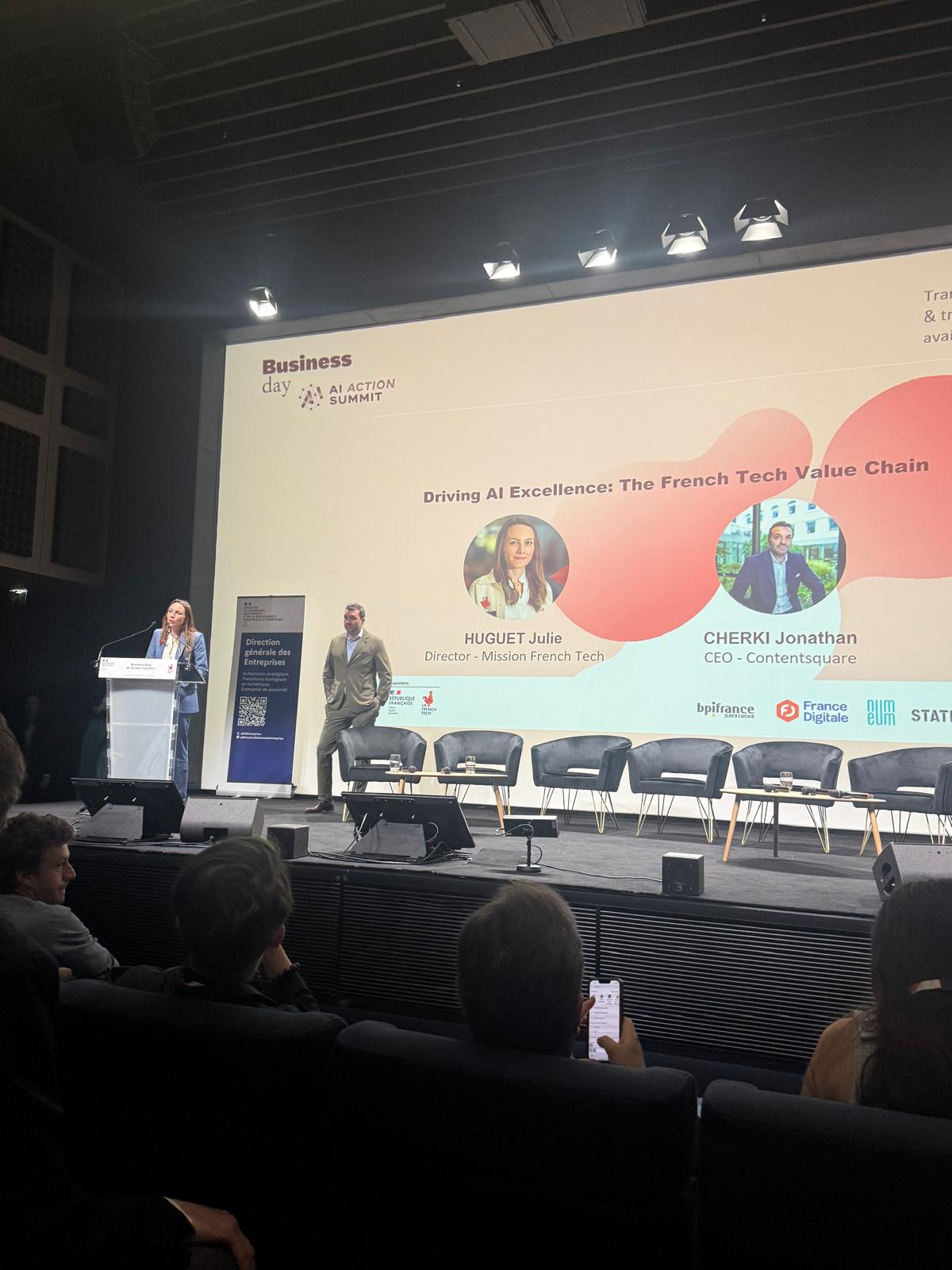
The panel titled “Driving AI Excellence: The French Tech Value Chain” highlighted the exceptional dynamics of the French AI ecosystem, its rapid growth, challenges, and ambitions for the future. Presented by Julie Huguet, Director of the French Tech Mission, this panel brought together major figures from French AI. Present were Jonathan Cherki (CEO of Contentsquare), Pascal Langlois (Co-founder of Scintil Photonics), Albane Bruyas (COO of Scaleway), Laurent Daudet (CEO of LightOn), and George-Olivier Raymond (CEO of Pasqal). Together, they explored how French Tech is developing a robust and competitive ecosystem to propel France to the forefront of global AI.
French Tech, a Dynamic and Growing Ecosystem
Julie Huguet opened the panel by emphasizing the unity and enthusiasm of the French AI community. With over 1,000 companies specializing in AI, France has already raised 30 billion euros and created 50,000 jobs in the sector. The country also stands out with 16 AI unicorns such as Mirakl, Mistral, and Contentsquare, which testify to the dynamism and innovation within the ecosystem.
France is also a global leader in AI research, ranking third in Stanford’s AI Vibrancy Index. Prestigious institutions such as CNRS, CEA, and Paris-Saclay contribute to this excellence.
With the goal of training 100,000 AI experts per year by 2030, France is positioning itself as a key player in the AI revolution.
Contentsquare: A French Tech AI Success Story
Contentsquare is a French company specializing in digital user experience analytics. Founded in 2012, it helps brands understand how customers interact with their websites and mobile applications, providing valuable insights to improve user experience and increase conversion rates. Since its inception, Contentsquare has experienced rapid growth, completing several significant funding rounds, including a $500 million raise in 2021, bringing its valuation to $2.8 billion. The company has also made several strategic acquisitions to strengthen its market position and expand its service offerings.
Jonathan Cherki shared his experience of international growth. Since establishing operations in New York, he has observed exceptional energy in the French AI ecosystem. Contentsquare has become a global leader in web and mobile user experience analytics, with 600 R&D employees and a strong AI focus.
He highlighted 3 strategic phases for AI at Contentsquare:
- AI assistance: deployment of decision support solutions, such as AI Alerts and automatic user session summaries.
- AI agent: advanced automation with models capable of anticipating and executing actions without human intervention.
- Hyperpersonalization: using AI to create web and mobile experiences entirely tailored to users’ preferences and behaviors.
Contentsquare plans to increase its AI investments fivefold and launch new products as early as May 2025.
Scintil Photonics: Hardware Innovation for AI
Pascal Langlois, co-founder of Scintil Photonics, presented a breakthrough innovation: using light to accelerate data transfer. Why is this crucial for AI? AI models are growing exponentially, requiring enormous computing power. Optoelectronics enables faster data transfer while consuming less energy. Founded in Grenoble, Scintil Photonics illustrates how French Tech is innovating not only in software but also in hardware, an essential component for the future of AI.
Scaleway: Building European Cloud Infrastructure for AI, a Sovereign Alternative to American Giants
Scaleway is a French company specializing in cloud computing and web hosting services. Founded in 1999 by Xavier Niel under the name Online SAS, it is a subsidiary of the Iliad group. Scaleway offers a comprehensive range of cloud services, including dedicated servers, storage solutions, Kubernetes services, and serverless applications. It focuses on building, training, deploying, and scaling artificial intelligence models and intelligent applications on a resilient and sustainable cloud ecosystem. The company owns and operates several data centers in Île-de-France, providing infrastructure services to various clients. It is recognized for its commitment to transparency, data security, and compliance with European regulations, particularly GDPR. Scaleway positions itself as a European alternative to hyperscalers, guaranteeing data sovereignty for its clients. In addition to its cloud services, Scaleway actively supports the open source community, with public repositories on GitHub, and offers dedicated programs for startups to help them grow using its infrastructure.
Albane Bruyas, COO of Scaleway, highlighted the need for sovereign cloud infrastructure to train and run AI models in Europe. Scaleway has installed over 5,000 NVIDIA H100 GPUs, becoming one of the leading AI compute providers in Europe.
Scaleway relies on open source technologies to avoid dependence on proprietary solutions. Its Generative API tool allows companies to choose between different LLM models (Mistral, Llama, GPT, etc.), ensuring flexibility and sovereignty.
LightOn: Advancing LLMs in Europe
LightOn is a Paris-based company specializing in advanced artificial intelligence (AI) research and the development of large language models (LLMs). Founded by Laurent Daudet, it is distinguished by its work on integrating photonics with artificial intelligence.
Laurent Daudet, CEO of LightOn, is a key player. The company’s mission is to push the boundaries of AI research, focusing particularly on improving the efficiency, scalability, and accessibility of large models. The company uses unique technologies, such as optical computing, to accelerate machine learning processes and reduce the energy consumption associated with training AI models.
LightOn positions itself as an important player in the AI landscape in Europe, contributing to the development of LLMs, which have become essential for many AI applications. Their work also emphasizes the sustainability and feasibility of cutting-edge AI research, especially in the context of Europe’s growing desire to innovate while preserving its technological sovereignty.
Laurent Daudet, CEO of LightOn, presented Paradigm, an innovative project that marks a significant advance in the field of language models and AI in Europe. Paradigm is a tool designed to optimize the capabilities of large models (LLMs) by combining photonic computing technologies with artificial intelligence algorithms.
The goal of Paradigm is to make the training of large models faster, more energy-efficient, and more scalable. It leverages the properties of photonics, which allows processing vast amounts of data at exceptional speed. LightOn seeks to solve one of the main current challenges in the field of AI: the massive energy consumption and high cost associated with training LLMs.
The project is part of an effort to make AI more accessible and sustainable, and to strengthen Europe’s technological independence from the large American companies that currently dominate the AI technology market.
The 3 requirements for an enterprise LLM:
- Security: data protection and access control.
- Customization: adaptation to specific business needs through tailored models.
- Scalable deployment: ability to scale AI models to handle thousands of simultaneous users.
LightOn stands out for its sovereign and European approach, avoiding any dependence on American or Chinese infrastructure.
Pasqal: AI and Quantum Computing, a Synergy for the Future
George-Olivier Raymond, CEO of Pasqal, explained how quantum computing could revolutionize AI. Why is quantum computing essential? Classical processors (CPUs and GPUs) are reaching their limits in the face of exponential growth in AI models. Quantum Processing Units (QPUs) pave the way for unprecedented computing capabilities. Pasqal collaborates with European players such as GENSEA (France), CEA, EUROHPC, and EDF, thus contributing to building European quantum sovereignty.
The Energy Challenge of AI and EDF’s Role
The explosion of AI data centers represents a major energy challenge. EDF forecasts that the electricity consumption of global data centers will reach 1,500 TWh by 2030, equivalent to France’s total electricity consumption.
Why is France well-positioned?
- 97% of French electricity is decarbonized (nuclear and renewable).
- Export capacity: France exported 90 TWh of electricity in 2023.
- Ready industrial sites: EDF offers suitable sites to host AI data centers with available and reliable energy.
Europe can thus develop greener and more responsible AI, a competitive advantage over the United States and China.
Can France Become a Global AI Leader?
The panel “Driving AI Excellence: The French Tech Value Chain” demonstrated the vitality of the French AI ecosystem. Thanks to:
- Strong support for innovation (French Tech Mission, French Tech 2030, Next 40)
- Expanding AI unicorns (Contentsquare, Mistral, Mirakl, etc.)
- Leadership in research and training
- Sovereign infrastructure (Scaleway, EDF, Pasqal)
- Advances in hardware and cloud computing
France has all the assets to become an AI superpower. However, global competition is fierce. The key challenge will be to accelerate AI adoption by businesses and institutions. French Tech has a mission: Transform Europe into a global leader in artificial intelligence.