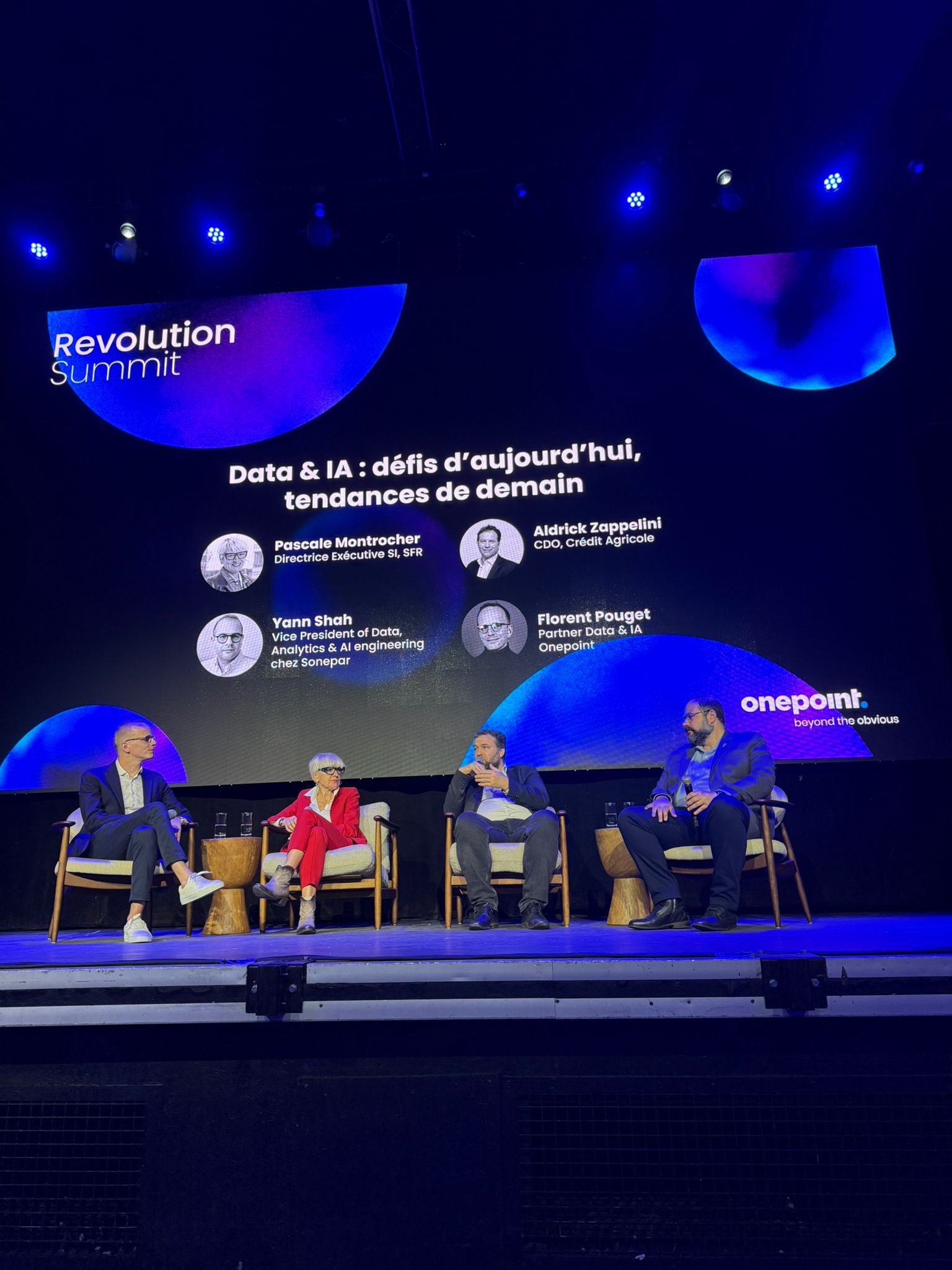
Paris, Palais de Tokyo – The opening conference of the Revolution Summit, organized by Onepoint, set the tone for a day packed with technological and strategic reflections. Titled “Data & AI: Today’s Challenges, Tomorrow’s Trends,” this roundtable brought together four leading speakers: Pascale Montrocher (SFR), Aldrick Zappelini (Crédit Agricole), Yann Shah (Sonepar), and Florent Pouget (Onepoint). Together, they shared their experiences and visions in a candid, no-holds-barred dialogue.
Generative AI: An Accelerated Collective Awakening
Florent Pouget opened the session by noting that the past year marked a turning point: the dramatic emergence of generative AI in the strategic debate of executive committees. “A striking entry,” in his words, which forced companies to question not only use cases but, more importantly, the quality of their data foundation. This dynamic, though techno-centric, brought much-needed attention to often-neglected fundamentals of information systems.
Pascale Montrocher: “No AI Without Data”
For Pascale Montrocher, Executive Director of IT at SFR, the primary condition for any AI deployment remains data quality. She warns against a common pitfall: believing that value can be extracted from AI by layering it on top of a siloed information system or one inherited from multiple mergers and acquisitions.
She also emphasizes the need to make business units accountable as owners of their data. In her view, this is the only way to ensure effective and sustainable governance. “AI won’t solve the structural problems of a fragmented IT system. Without reliable data, no promise will hold,” she summarizes.
Aldrick Zappelini: From Use Cases to Industrial Maturity
The testimony of Aldrick Zappelini, Chief Data Officer at Crédit Agricole, highlights the stages of a controlled adoption process. With several months of perspective on implementing generative AI projects, he provides a nuanced assessment. Some use cases, once scoped, prove technically unfeasible or economically unviable. Others are rejected for ethical or security reasons.
“Generative AI acts as a revealer. It makes systemic gaps in document governance or reference data quality visible,” he notes. He also underscores the need to relearn collaboration: data scientists, IT, and business units must now design projects together from the initial scoping phase.
The Human Challenge: A Strategic Issue
Beyond technology, Zappelini emphasizes the human factor. Skills development, distribution of responsibilities, and collaborative work culture are crucial levers for successfully integrating AI at scale. He also mentions a form of renewed maturity: “It’s no longer about giving in to trends, but about abandoning poorly calibrated projects when necessary. That’s a sign of strategic discernment.”
Yann Shah: Toward Platformization of AI Products
Taking a very practical approach, Yann Shah, VP Data, Analytics & AI Engineering at Sonepar, shares lessons learned from international deployment. Operating in over 40 countries, his group faces massive heterogeneity in data systems. The adopted solution: rigorous platformization of AI products, integrating governance, resilience, security, and interoperability requirements from the outset.
He points out a striking figure: 80% of AI use cases never reach production. This rate climbs to 90% for custom projects. The cause? The absence of an operational ecosystem. “We must stop thinking in isolated use cases. What matters is the complete lifecycle of the AI product, from design to adoption,” he states.
Industrialize Without Losing Sight of the Human Element
Shah advocates for a holistic approach to AI, integrating issues of trust, clarity, diagnostic assistance in case of incidents, and scalability. He discusses the emergence of a new paradigm: the agent mesh, where autonomous intelligences must collaborate in networks. In this context, without end-to-end visibility, AI becomes inoperable or even dangerous.
His approach is based on a modular, interoperable architecture designed to be governed. A form of technological pragmatism rooted in industrial reality.
AI Agents: Promises and Safeguards
One of the trends discussed at the end of the session was autonomous intelligent agents. Florent Pouget and Aldrick Zappelini agree on one principle: AI agents must be deployed within a strict governance framework. They can automate certain workflows, provided the risk of errors is acceptable.
Zappelini uses payment systems as an example: a 2% error rate, tolerable in a pilot project, becomes unacceptable at scale. He advocates for controlled adoption, rigorous evaluation of benefits, and deployment restricted to low-criticality areas.
Try Fast, Fail Fast: Toward a Strategic Funnel
At SFR, Pascale Montrocher champions a method inspired by the try fast, fail fast principle. The idea is to experiment quickly, rapidly eliminate low-value projects, and focus efforts on those that can be industrialized. This funnel approach channels resources toward solutions with measurable impact.
But she also reminds us that the revolution won’t come from automation alone. It requires rethinking business processes with AI built in, which implies a profound cultural transformation.
A Process Revolution, Not Just a Technological One
For Montrocher, the real breakthrough lies in companies’ ability to redefine their business processes by natively integrating AI capabilities. She cites the automotive sector as an example, where some brands are attempting to design mechanical parts using generative AI. “It’s not for tomorrow, but the direction is clear.”
She also emphasizes the importance of employee inclusion. Faced with AI-generated anxiety, leaders have a key role: to reassure, explain, and demonstrate that humans will remain at the center.
Information Systems: The Revenge of Architecture
On several occasions, the speakers emphasized that AI brings renewed attention to an old topic: IT architecture. “AI is a new building block, but it rests on the same foundations as digital technology for the past 20 years,” Montrocher reminds us. Without APIs, well-controlled flows, and clean reference data, no AI project will endure.
Technological Sovereignty: Beyond Rhetoric
The debate concluded on a sensitive topic: sovereignty. Yann Shah recalls that at Sonepar, a strict technological risk management policy has been implemented. Each supplier is classified by criticality, and alternative plans are systematically considered.
Zappelini, for his part, prefers to speak of risk management and dependency. He calls for recreating diversity in technological solutions, particularly by supporting the European ecosystem.
Open Source as a Strategic Lever
Finally, Montrocher invites revaluing European contribution to open source. “We have brilliant engineers. If we organized ourselves to contribute massively to open source communities, Europe could carry much more weight in global technological balance.”
This conference at the Revolution Summit highlighted a paradigm shift. Far from abstract or purely prospective discourse, the speakers shared concrete feedback, sometimes critical, often demanding. Three convictions emerge: AI can do nothing without reliable data; its integration must be based on robust architectures; and its success depends above all on the women and men who drive it. The revolution is underway, but it will only make sense if it is governed with clarity, method, and collective ambition.