By Pascale Caron — for EntrepreneurIA
For over a decade, Elon Musk has been redefining the contours of global technological capitalism. By creating companies with high disruptive potential — Tesla, SpaceX, Starlink, Neuralink, xAI, X (formerly Twitter) — he is not merely investing in the future. He is designing its architecture, sector by sector. Through this strategy, Musk proposes a future where technology no longer responds to society: it precedes it, anticipates it, even reprograms it.
But behind this narrative that is both mobilizing and controversial, what do we really find? What are Elon Musk’s strategic intentions? And above all, what can entrepreneurs and innovators who, on their own scale, participate in this collective transformation take away from it?
An automated society: promise or tipping point?
One of the structural pillars of Musk’s vision rests on the idea that work could become optional. Artificial intelligence, coupled with robotics, would enable the automation of all productive tasks.
“In less than 20 years, AI will be able to do everything. Work will become a choice.”
(Public statement, Berlin, 2023)
At this stage, this is not a detailed economic theory, but a technological hypothesis. Musk does not specify the transition mechanisms or redistribution models. Yet the idea is thought-provoking: in a world without mandatory work, what would be the new rules of the economic game?
A “high” universal income: warning signal for social models
To accompany this transformation, Musk evokes a high universal income, distinct from the minimalist forms generally debated.
“AI will generate enough value for everyone to receive a high income.”
(X, April 2023)
This is a strong signal: the technological transformation would be such that it would necessitate an overhaul of compensation logics. But without an operational plan or associated political framework, this idea remains declarative.
Starlink: connectivity as a lever of influence
Starlink, a SpaceX subsidiary, is one of Musk’s most advanced projects. Through a constellation of low-orbit satellites, it already provides Internet access in over 50 countries, including areas without terrestrial infrastructure.
This project is not neutral. By controlling a global connectivity infrastructure, Musk positions himself as a strategic player in global telecommunications. Starlink is moreover expected to become a direct access channel to X, further strengthening the convergence between media, data, and network.
X: toward a total platform
Since acquiring Twitter, rebranded as X, Musk has announced his intention to build a unified platform. Objective: to bring together social communication, payments, video, conversational AI, and automatic translation.
“X will be the global digital public square.”
(Elon Musk, 2023)
The ambition is clear: to create a universal interface, accessible from any point on the globe, capable of centralizing all flows — personal, economic, cognitive. Such a platform could play a structural role in daily usage, competing with the closed ecosystems of GAFAM.
Optimus: automating manual labor
Simultaneously, Tesla is developing Optimus, a humanoid robot designed to perform repetitive physical tasks. Musk goes so far as to claim it could “eliminate poverty” by replacing the most arduous jobs with low-cost automated labor.
To date, Optimus remains a prototype, without industrial deployment. The intention, however, aligns with the overall strategy: to delegate an increasing share of human productive burden to machines.
An unprecedented industrial convergence
Tesla, SpaceX, Starlink, Neuralink, xAI, X: all of Musk’s companies are interconnected. Together, they cover:
- Automated production (Tesla, Optimus)
- Connectivity (Starlink)
- Social communication (X)
- Algorithmic computing (xAI)
- Cognitive interface (Neuralink)
- Extra-atmospheric exploration (SpaceX)
This convergence creates an integrated technological ecosystem, driven by a single strategic vision. It blurs the boundaries between industry, services, media, defense, mobility, and intelligence.
For entrepreneurs: understand, don’t replicate
Should one imitate Elon Musk? No. But it is necessary to understand his entrepreneurial grammar. He does not build isolated companies. He erects interconnected infrastructures, designed to last, scale, and durably modify usage patterns.
What entrepreneurs can take away:
- Think in ecosystems rather than single products
- Design a long-term vision, beyond the Minimum Viable Product
- Take positions on societal issues through innovation
- Anticipate the political effects of technical architectures
AI as a systemic agent, not as a tool
For Musk, artificial intelligence is not a tool. It is a cognitive infrastructure. It is what makes automation, adaptation, personalization, and real-time decision-making possible.
With xAI, Musk is developing a proprietary model. He wants to integrate it into X, Tesla, Optimus, and the future global communication OS. This choice of vertical integration has a major consequence: AI becomes a lever of strategic unification.
But where are the checks and balances?
This vision of the future, however coherent, poses a fundamental problem: the absence of external regulation. State institutions, European or international regulators are virtually absent from the discourse. Regulation is reduced to an engineering issue, not one of democratic legitimacy.
For entrepreneurs, this raises an essential question:
Can one innovate without integrating the political stakes of one’s own impact?
 A mobilizing narrative… but incomplete
Elon Musk proposes an articulated vision of the future. It mobilizes imaginations, attracts capital, stimulates innovation. But it remains partial. It evades social resistance, geopolitical fractures, ecological tensions.
For innovation actors, this vision can inspire. Provided it is complemented. By ethical awareness. By an inclusive approach. And by the ability to integrate the living, the social, and the political into technological ambition.
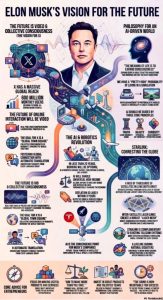
Infographic widely circulated on LinkedIn, shared notably by Joy Chandra Gope under the title “Elon Musk’s Vision for the Future: AI, Robotics, and UBI”.