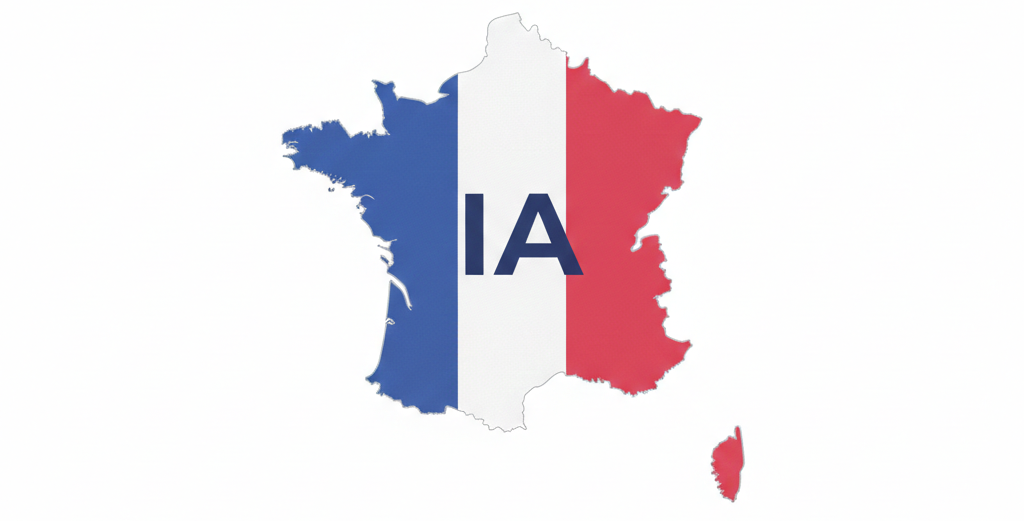
France values narratives that organize strategic thinking: French Tech, national champions, ambitious budget announcements. Yet artificial intelligence is not measured by intention, nor even by promise. It is revealed through the observation of tangible flows: circulation of talent, mobilized capital, access to compute, production of models, and above all the ability to transform projects into sustainable businesses. Two recent reports allow us to move beyond commentary and into factual analysis. The first is a detailed mapping of AI startup founders in France, identifying the academic and professional origins of 834 profiles involved in 403 DeepTech companies. The second is the Global AI Index, published by The Observer, which ranks countries according to three aggregated indicators—investment, innovation, implementation—and highlights geopolitical dynamics in AI.
These two analytical frameworks, while complementary, do not tell the same story. One describes a network dynamic: how, where, and by whom AI company founders are formed. The other assesses a country’s ability to industrialize these talents to turn them into an economic and strategic lever. This tension raises a fundamental question: is France building AI power, or is it simply feeding a training and spin-off pipeline whose real value is captured outside its sovereign perimeter?
The first lesson from the mapping, nicknamed “French AI Mafia,” is clear: the French ecosystem relies essentially on public research institutions.
Inria appears as the leading incubator of founders by volume, closely followed by CNRS and CEA. This deep public-scientific foundation constitutes an undeniable strength, but it also entails structural constraints: long timeframes, transfer rigidities, complex valorization mechanisms. Another striking finding: France establishes itself as a major European base for Big Tech research laboratories. The professional backgrounds of identified founders massively include experience within Google (DeepMind), Meta (FAIR), and IBM. This reflects a high level of porosity between the public sector, French grandes écoles, and American tech giants. This fluidity certainly creates a training effect. But it also poses a central strategic question. To what extent does France retain “follow-on rights” over the talents it trains, when they become embedded in industrial, technical, and financial architectures that do not fall within its sphere of governance?
The study also shows that results change radically when reasoning not in raw volume, but in density relative to staff size.
In this sense, CNRS appears as the most efficient institution, and Inserm emerges as a rapidly growing pool, particularly in the health field. On the education side, École polytechnique dominates widely, representing 15% of identified founders alone, while HEC establishes itself through its incubation and acceleration role via its programs and platforms like Station F. This model, combining public research, elite grandes écoles, and bridges to Big Tech, constitutes an effective engine for producing founders. The question remains whether this engine is also capable of producing sustainable companies, able to operate, grow, and structure value chains within the French economy.
In contrast, the Global AI Index 2025 paints a much more unbalanced landscape.
The United States dominates overwhelmingly, concentrating nearly 90% of global private AI funding in the first nine months of the year, while Europe caps at 3.8%. China, meanwhile, is accelerating strongly. Asian countries like Taiwan, South Korea, or the United Arab Emirates are progressing rapidly. Three synthetic indicators testify to Europe’s decline. First, the drop in the EU’s share of scientific publications at major international conferences, falling from 16% to 12%. Second, the share of cutting-edge models from Europe remains modest, with only 13% of “state-of-the-art” models. Added to this is Europe’s particularly weak contribution to major AI fundraising rounds. This diagnosis goes beyond the mere question of scientific prestige: it is a major industrial risk. Not mastering AI means potentially missing the most strategic disruptive technology since electricity. The British example illustrates a well-known mechanism: the UK trains, attracts, but does not retain. Profiles migrate to where compute, capital, and scaling conditions converge.
From this perspective, France’s rise in rankings—from 13th to 6th place according to recent editions—cannot be read as an autonomous indicator of success. We must question the nature of this progress: is it driven by startup volume, by open source, by media visibility, or by a genuinely industrializable dynamic?
The underlying question is structural: is France a factory of founders, or a factory of champions?
Three critical transitions must be examined. The first concerns the transition from laboratory to product: despite the richness of public research, transfers remain slow and complex. The second involves the transition from Series A to international scale: a country can succeed at seed stage, then see its headquarters, teams, and intellectual property move to where capital is more abundant. The third concerns the transition from model to actual deployment: the index values implementation, meaning adoption in the real economy, well beyond demonstrators.
The hard knot in this chain is well known: compute, capital, and follow-on rights over talent. Without direct access to high-performance training and inference capabilities, “frontier” ambitions become dependencies. Without patient capital, capable of supporting long and uncertain trajectories, innovations are constrained. Without retention mechanisms, talents circulate toward dominant ecosystems. The articulation of both readings is then crystal clear: Europe trains, the United States transforms.
We must therefore reread the “French AI Mafia” not as a ranking, but as a strategic asset.
A network is only useful if it enables three key functions: formation of complementary teams, access to initial markets, and access to critical resources (compute, funding, infrastructure). In the data, two sectoral verticals clearly stand out. The first concerns health and biotech, where the Inserm/Owkin pairing illustrates a beginning of industrial anchoring; The second touches defense and aerospace, with players like Dassault, Airbus, Thales, and strategic acquisitions such as Preligens by Safran. These domains combine sensitive data, critical use cases, established players, and often substantial public procurement. They can become implementation drivers, not just laboratories.
Three blind spots must be addressed lucidly.
The first is the social and educational concentration of the pipeline: Polytechnique, HEC, a few major institutions. Effective in the short term, this model can impoverish the diversity of profiles, use cases, and therefore innovation. The second is functional dependence on Big Tech: if “frontier” profiles massively pass through non-European architectures, the value chain will reconstitute itself elsewhere. The third is the gap between innovation and diffusion: a country can shine in research and fail to have its innovations adopted by SMEs, local governments, or major public services.
These data call for action.
For entrepreneurs, the priority is to secure an autonomous trajectory: compute strategy from the start, structuring clients in data-intensive sectors, anticipating governance issues from Series A. For research institutions, transfers must be streamlined, scientific entrepreneurship valued without degrading academic rigor, and concrete productization pathways created. For the State and major contractors, it is urgent to stop measuring performance by announcements. What matters is retention, actual growth, and industrial impact.
The real question today is therefore not whether France produces talent. It is whether this talent will remain masters of their trajectory. The challenge is not to transform an exceptional pipeline into a strategic pool… for others.
Sources
Finck, L. (2026). French AI Mafia: Which Companies and Schools Produce the Most AI Founders? The Big Byte (Substack).
White, J., Cesareo, S., Schuller, H., & Clarke, P. (2025). The Observer Global AI Index 2025. The Observer.
Tortoise Media. (2024). The Global Artificial Intelligence Index 2024.
Tortoise Media. (2024). The Global AI Index – Methodology Report.
Maslej, N., Fattorini, L., Perrault, R., et al. (2025). Artificial Intelligence Index Report 2025. Stanford Human-Centered AI Institute.
French AI Mafia and Global AI Index: how to transform a pool of founders into industrial power