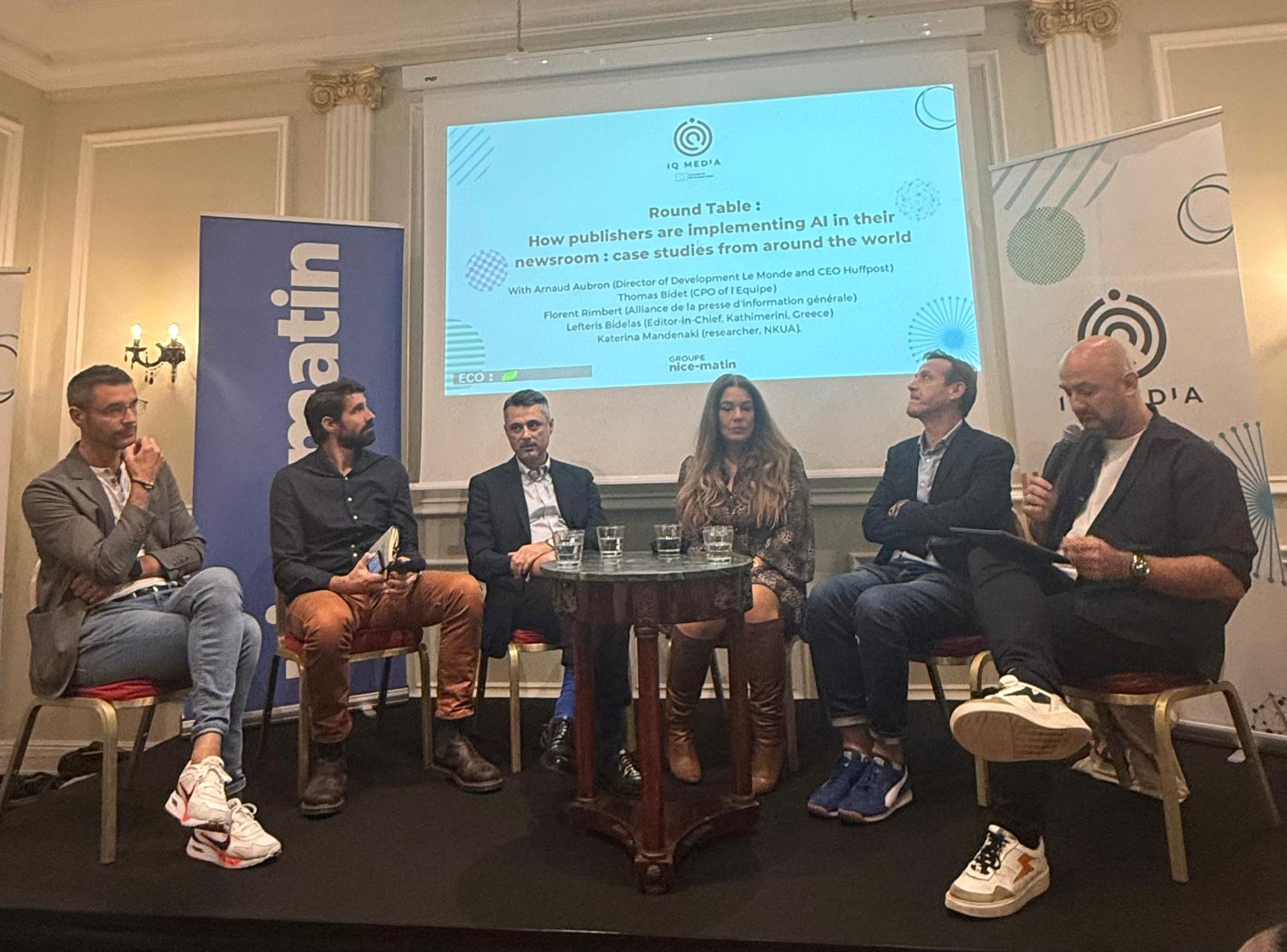
Panel discussion titled “How are media organizations using Artificial Intelligence in their newsrooms?”
Remarks collected by Pascale Caron.
This event was organized by Nice Matin and IQ Media during the conference on November 7-8 in Nice. It brought together several experts on the theme of AI’s growing role in journalism. Moderated by Jérôme Olgovitch, professor of journalism, this discussion explored how AI is being integrated into newsrooms and the implications for their future.
The guests were Arnaud Aubron (Development Director at Le Monde and CEO of HuffPost), Thomas Bidet (CPO of l’Équipe), Florent Rimbert (Alliance de la Presse d’Information Générale), Lefteris Bidelas (Kathimerini, Greece), and Katerina Mandenaki (researcher at the National and Kapodistrian University of Athens), who completed this panel. Each commented on how AI is transforming the media landscape by reshaping working methods, editorial approaches, and reader engagement.
Katerina Mandenaki studied how professionals use artificial intelligence in four countries: France, Greece, Portugal, and Cyprus. This survey, conducted among 186 journalists and media managers, shows not only the extent of AI adoption, but also the differences in perception between various professions and generations in the sector.
The analysis aimed to understand AI consumption in newsrooms. How do professionals envision leveraging AI to improve their profits, and what are the hopes and concerns related to AI?
It reveals that managers and journalists have different perspectives on the benefits of AI. The former are motivated by opportunities to increase revenue and expand audiences through enhanced digital experiences, while the latter prioritize qualitative aspects.
Young media professionals, often more familiar with AI and software, express greater confidence in their ability to use it. In contrast, those aged 60 and over display more skepticism, highlighting a need for continuous training and adaptation to new technologies.
The majority of respondents have used AI for specific tasks such as analyzing audience data and producing performance reports. Very few venture into automatically generated article writing. 74% of newsrooms have not yet integrated AI into their process, citing a lack of transparency and control over current tools.
In the four countries surveyed, media continue to rely on traditional business models (advertising, sponsorship, subscriptions). AI is perceived as an asset for improving reader engagement and conversion, but professionals remain divided on AI’s actual effectiveness in generating significant revenue.
There is reluctance to use AI, mainly related to lack of training. 60% feel they do not master these technologies sufficiently to assess their impact on content quality, and 77% have no risk management protocol associated with AI.
There is also a marked difference between newsroom sizes. Large media organizations are more ready to integrate AI into their daily operations, as they have the necessary resources to do so securely and in a structured manner. In contrast, smaller newsrooms are more conservative, expressing concerns about technical challenges and costs when implementing these tools.
We are in a transition period where AI generates both expectations and legitimate concerns. Digital transformation must go beyond simply integrating AI. It requires a fundamental change in how media approach content production and their relationship with audiences.
Lefteris Bidelas, editor-in-chief of Kathimerini in Greece, discussed ethical concerns, emphasizing the risk of losing journalistic identity with excessive dependence on AI. He considers it a support tool, not a substitute, used cautiously for certain tasks. Bidelas also insisted on the need to train staff so they master these technologies without compromising editorial quality. At Kathimerini, they are adopting AI gradually, balancing innovation with preservation of professional values.
Arnaud Aubron explained how Le Monde uses AI to translate its articles (between 30 and 40 each day) into English, a crucial initiative for reaching an international audience. They use software like DeepL. However, unlike other media, Le Monde has implemented a rigorous process where each translation is reviewed by translators and journalists to ensure impeccable quality. AI is a tool, not an end in itself. He emphasized that in their case, AI allows them to expand their audience without compromising editorial quality.
Thomas Bidet from l’Équipe explained that they implemented a daily podcast feature during the Olympic Games. It was designed to provide a two-minute overview of sporting events, with highlights and rankings. This format was very popular, allowing readers to stay informed despite their lack of time, one of the main reasons for subscription cancellation identified by l’Équipe. This podcast uses an AI voice which, although still improvable, offers quick and fluid narration, complementing long articles.
They also implemented automated summarization of user comments on certain topics, such as football matches. The objective here is to use AI to extract the essence of discussions and avoid potential bias from too large a volume of feedback. By applying specific rules (filtering emojis, exaggerated words), AI produces a representative synthesis of general opinion, a valuable tool for journalists who can thus immediately grasp readers’ sentiments.
Florent Rimbert presented Spinoza, a project led by the Alliance de la Presse d’Information Générale. Spinoza provides reliable information on complex topics like climate change. This approach involves verified databases and AI-generated messages that are directly linked to sources, ensuring traceability and offering journalists the ability to confirm facts.
This project uses the Hugging Face platform to host and test AI models related to climate change. RAG technology allows for gathering multiple databases, including scientific reports such as those from the IPCC, legal information, and environmental studies. Spinoza has implemented GPT-4 mini, chosen for its low energy consumption and optimized performance, while leaving the possibility to experiment with new advances as they become available. Professionals can ask questions, obtain excerpts of scientific and legal data with direct links to sources, thus guaranteeing the traceability and credibility of information.
Spinoza is already being tested with 100 Alliance members and will evolve to meet the specific needs of local and national newsrooms. This project embodies an ethical approach to AI, where the objective is to help journalists without replacing them, by offering verifiable data and facilitating access to complex knowledge. The next hackathon organized by the Alliance will allow each publication to use Spinoza for its own content, thus strengthening its adaptability.
Several speakers expressed concerns about the quality of information generated by AI. Florent Rimbert mentioned that some media tend to “lose their unique voice” by using it in too generalized a manner. Excessive dependence on AI can lead to content homogenization, erasing the diversity and depth of traditional media.
Arnaud Aubron recalled that for Le Monde, AI is a means of exploring new markets, but never at the expense of quality. They have implemented an ethical charter to guide the use of AI in newsrooms.
Media must be ready to embrace AI’s potential while remaining faithful to their core values. The key lies in thoughtful adoption where AI serves to improve the reader experience without sacrificing journalistic rigor.