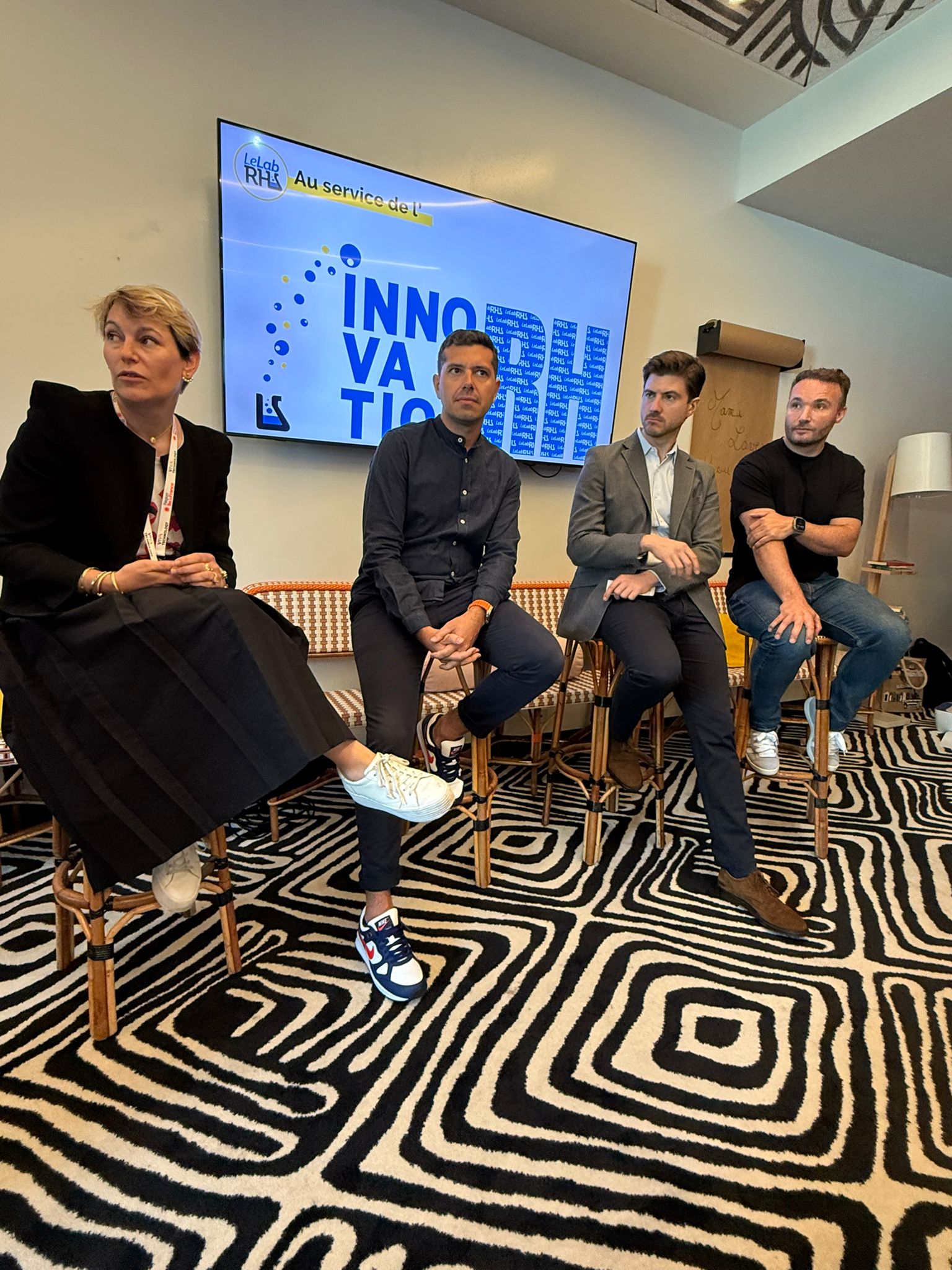
A look back at Morning Lab #2 organized by Forvis Mazars and Le Lab RH on the sidelines of VivaTech 2025
Towards a new organizational architecture centered on skills
On June 12, 2025, at Mama Shelter Paris West, on the sidelines of VivaTech, a strategic conference on the future of organizations was held: “How to become a Skills-Based Organization with artificial intelligence?” Organized by Forvis Mazars and Le Lab RH, this event brought together CHROs, HR data experts, researchers, entrepreneurs and institutional representatives to collectively envision a new organizational paradigm.
The question is central: in a changing world, under demographic and technological pressure, is organizing work around fixed positions still viable? For the speakers, the answer is clear: no.
An engaged introduction by Séverine Loureiro
Séverine Loureiro, General Director of Lab RH, opens the morning with a strong reminder: Lab RH is celebrating 10 years of commitment to HR innovation. The choice of VivaTech to celebrate this turning point is no coincidence: tech, startups and new practices occupy a central place there. She emphasizes the four major challenges defined this year by Lab RH, particularly the transition to HR models centered on skills and people in all their complexity.
Mathilde Le Coz: “The war for talent has become a war for skills”
Mathilde Le Coz, CHRO of Forvis Mazars and president of Lab RH, sets the tone: “Our raw material is skills.” In a context of geopolitical uncertainty, rapid technological change and shortage of qualified workforce, she emphasizes that organizations must imperatively rethink how they detect, map and mobilize skills.
She denounces an inherited model, too focused on working time and FTEs, out of step with modern aspirations for flexibility and valuing expertise. The salary paradigm is, according to her, in crisis: “It’s no longer time that we remunerate, but the value created by skills.”
Vincent Barat: “AI finally makes visible what was intuitive”
The co-founder of Albert, Vincent Barat, brings a lucid and pragmatic vision. The concept of Skills-Based Organization (SBO) is not a theoretical novelty, he reminds us: learning organizations or DDOs (Deliberately Developmental Organizations) already laid these foundations more than a decade ago.
But it’s the arrival of AI that changes the game: by facilitating the creation of dynamic frameworks, objectifying skills, cross-referencing internal data and sector benchmarks. Vincent insists however on an essential nuance: SBO doesn’t eliminate jobs, it makes them more fluid. “A player can have several skills, but only plays one role at a time.”
He also warns of two major risks: the disappearance of junior roles (cannibalized by generative AIs) and the loss of critical knowledge held by seniors, particularly in legacy systems (like COBOL in banking).
Jérémy Lamri: “Soft skills don’t exist”
With his perspective as a researcher and practitioner, Jérémy Lamri, CEO of Tomorrow Theory, challenges certainties. He recalls a surprising reality: there are more than 700 academic definitions of the word “competence” in francophone literature. This lack of consensus hinders the operational implementation of an SBO model.
He proposes a simple and effective definition: “A skill is a set of behaviors mobilized to achieve a result.” And adds: “The real issue is not the skill, but the activity.”
His Athena model, developed with Paris Descartes, identifies 60 sub-factors of competence (cognition, conation, emotion, sensorimotor…). This granularity enables much more precise instructional design, and ultimately, a new way to recruit, train and evaluate.
Éric Delisle (CNIL): “GDPR still applies. And it is well written.”
The CNIL representative, Éric Delisle, reminds us at the right time that handling HR data means handling sensitive personal data. “GDPR does not prohibit innovation, but imposes principles: transparency, minimization, security, proportionality.”
He insists: even in the context of AI and skills mapping, the protection of fundamental rights remains the foundation. He calls on companies to integrate GDPR reflexes from the design phase of tools and reminds that CNIL is also there to support, not just to sanction.
A necessary double pivot: technological and cultural
The second part of the panel discussion brought out concrete levers to operate the pivot toward a Skills-Based Organization:
- At Forvis Mazars, the transition began with a complete overhaul of job and skills architectures. Each role is now linked to an expected contribution and observable actions, defined by level.
- AI is not there to replace humans, but to redefine expected contributions. What was routine is automated; what remains is profoundly human: creativity, judgment, ethical sense.
- The skills taxonomy has been reduced and standardized to remain actionable. Hypercomplexity is the enemy of implementation.
Towards a hybrid and agile system
Several key messages emerged:
- Skills don’t replace jobs, they enrich them.
- Employees must be able to evolve laterally, be repositioned quickly according to projects.
- AI becomes an amplifier of HR capabilities, provided it is well governed.
A new role for the HR function
The consensus is clear: the HR function is no longer just a process manager. It becomes an organizational architect, guardian of human value, skills strategist. This posture implies a triple role:
- Map the existing with explainable and ethical AI tools.
- Project future needs, at the intersection of business models and demographics.
- Support transitions, ensuring organizational justice, continuous skills development, and meaning given to work.
And tomorrow?
The perspectives opened by SBO are exciting, but they also raise many questions:
- How to pool frameworks to create a common inter-company foundation?
- Can we evolve compensation grids based on skills rather than status?
- What new forms of social dialogue does this imply?
- How to prevent data technocracy from replacing managerial intuition?
A profound transformation, but still incomplete
This Morning Lab showed that SBO is much more than a buzzword: it’s a structural, slow, but irreversible transformation of companies. It requires alignment between strategic vision, managerial culture, technological tools and data governance.
The conference also highlighted the importance of an interdisciplinary approach, combining HR, tech, law and research. Because to navigate uncertainty, it’s not enough to map skills: you must also know how to mobilize the right human intelligence at the right time.