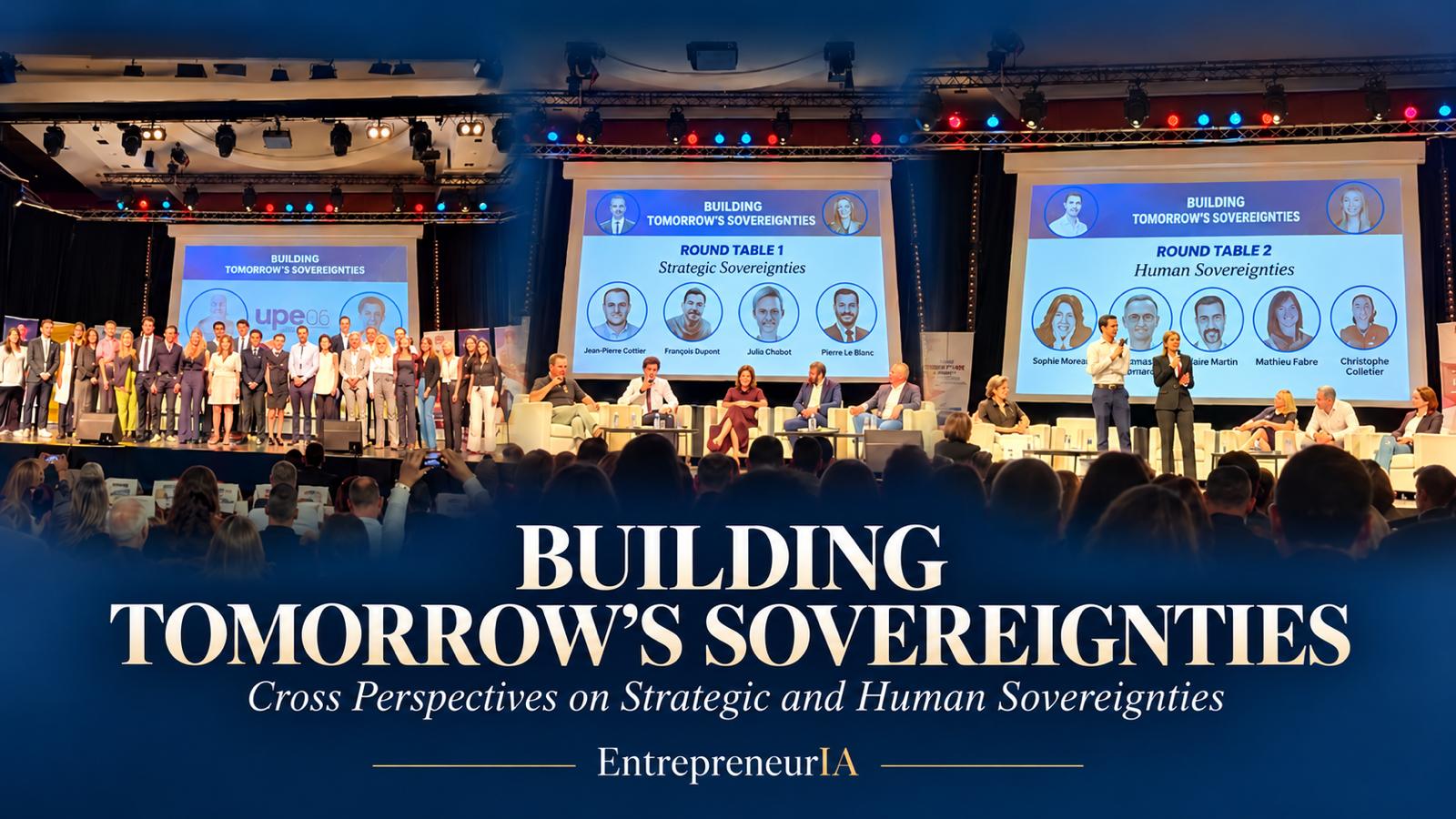
 The “Le Plongeoir” event offered a very broad panorama of the French Tech ecosystem and the ambitions carried at the national level. From the opening, Élodie Bondi and Lucie Finet recalled the scale of the movement: 18,000 startups, 450,000 jobs, a network of initiatives structuring the territories, and a clear determination to strengthen the economic impact of French innovation.
Among the highlighted initiatives, the “Je choisis la French Tech” (I Choose French Tech) program occupies a strategic place. It encourages companies and public organizations to favor solutions developed by French startups. The goal is to stimulate domestic demand while supporting emerging players in their maturation.
But institutional ambition is not enough. It must be supported by human dynamics capable of facing cycles, transforming failures, and maintaining constant rigor. It is in this context that the intervention of Alain Bernard, Olympic champion turned sports innovation actor, stands out as a key moment of the event.
The Fundamentals of Excellence: Alignment, Propulsion, Breathing
Alain Bernard opens his presentation with a return to basics. Swimming is based on three fundamentals: alignment, propulsion, breathing. The entire challenge consists of improving these simple gestures for years, repeating them, visualizing them, mentalizing them.
This repetition has a goal: to approach an ideal gesture while knowing that perfection does not exist. Records are ephemeral. They fall, sometimes on the same day, sometimes ten years later.
This awareness forges a mentally stable posture: aiming for excellence while accepting that nothing is immutable.
In a technological ecosystem where innovation cycles are accelerating, the lesson is direct. How can we maintain high ambition without deluding ourselves about the permanence of what we build? Innovation requires this constructive tension.
 Transforming a Massive Workload into a Lever for Fulfillment
As a teenager, when his friends went out in the evening, Alain Bernard would repeat: “I can’t, I have swimming.” Not out of constraint, but by choice.
The nuance is decisive. High-level performance involves a colossal volume of effort — two training sessions per day, weight training, physical therapy, osteopathy, strict lifestyle. But this effort only makes sense when aligned with personal intention.
He mentions young athletes pushed by their parents, who, at 15 or 16, mentally collapse because the project was not theirs.
The entrepreneurial parallel is immediate: what is the real origin of our commitment?
Without inner alignment, no sustainable rigor is possible.
The champion also reminds us that high-level performance is not a fragmented activity.
“You’re not a high-level athlete twice a day, you are 24 hours a day.”
In a startup, the logic is similar: the effort is not punctual. It is part of a continuity that goes beyond visible tasks.
Rigor as a Lever for Emancipation
Alain Bernard insists: rigor is not a constraint. It becomes a lever for emancipation.
Nothing in his early days predestined him to become an Olympic champion. His progress was gradual, driven by daily discipline and obstinate repetition of fundamentals.
Rigor provides structure. It reduces uncertainty. It offers a framework within which it becomes possible to express oneself fully.
This conception directly interests entrepreneurs. In an information-saturated environment, how can we use rigor to sort, prioritize, decide?
The 17-Hundredths Failure: A Founding Pivot
The story of his failed attempt at the Athens Games constitutes the emotional core of his presentation.
At 20, after an entire year dedicated to this goal, he misses qualification by 17 hundredths of a second.
The failure is brutal.
Yet, analyzing it, he identifies a support point: despite toxoplasmosis and mononucleosis, he finishes 7th.
If he had swum in full health, he would have had every chance of joining the French team.
This reading transforms failure into a resource.
Four years later, he becomes Olympic champion by 11 hundredths.
The same unit of measurement that had sanctioned him becomes the one that crowns him.
This symbol opens a key question for entrepreneurs:
How can we transform a negative weak signal into a strategic lever?
The Power of Simplification: “You Dive, You Swim, You Win”
Shortly before a decisive race, his coach tells him:
“You dive, you swim, you win.”
A simple phrase, almost basic, but one that concentrates the essential: reducing mental noise, sequencing action, staying in the moment.
In a world where projects become increasingly complex, this strategy raises questions: what key phrases can we use to bring a team back to the essential?
Investing in Commitment, Not Raw Talent
As a teenager, Alain Bernard observes technically gifted swimmers, physically brilliant, but inconsistent.
Why does his coach spare them when they miss a training session? Why, conversely, is he more demanding with him and other less talented swimmers?
The answer appears over time: the coach invests his energy in those who commit, not in those who shine occasionally.
Innovation follows the same logic. Endurance, consistency, the ability to get through rough patches matter more than isolated talent.
Career Transition: Transmitting, Analyzing, Innovating
At 29 years old, Alain Bernard ends his career. Several paths open up to him: police force, coaching, public engagement.
Ultimately, he chooses transmission, experience sharing, and gets involved in sports innovation.
He notably becomes a business developer for Vivo Sport, a sports performance player.
He also develops expertise in video analysis, a field that has become strategic in gesture optimization.
Two Startups Illustrate This Dynamic: Vogo Scope and Pool-On
Vogo Scope offers a complete video analysis system, combining above-water and underwater cameras. Coaches can monitor propulsion, alignment, frequency, and trajectories in real time, thanks to instant replays and slow motion. This granularity allows correction of details otherwise invisible.
Some facilities are already exploring operational optimization paths: adjusting water management — particularly disinfection — based on pool occupancy rate, a technological evolution possible in the medium term.
Pool-On, a young startup created by former swimmers, offers an immersive innovation: a subaquatic video projector transforming the pool floor into a screen. Learning, rehabilitation, health sports, entertainment: the uses are multiple. The device, plug-and-play and non-invasive, immediately modernizes existing pools.
These innovations show how French sportech combines technology, pedagogy, and user experience.
The presence of such startups within the ecosystem concretely illustrates the spirit of the “Je choisis la French Tech” program: supporting local innovation to strengthen national competitiveness.
Management, Constructive Confrontation, and Duration
The fifteen-year relationship between the swimmer and his coach is based on direct communication, sometimes harsh, but always sincere.
One day, after a discussion about training volumes, the coach tells him:
“If you’re not happy, go train somewhere else.”
A rare phrase, which testifies to deep conviction and long-term thinking.
This ability to assert a framework while remaining attentive questions modern management:
How can we confront without breaking, how can we challenge without demobilizing?
These questions also run through technology organizations, where growth requires difficult trade-offs.
An Ambition Both Collective and Personal
The “Le Plongeoir” event highlights two levels of ambition.
First, collective ambition, embodied by French Tech: structuring an ecosystem of 18,000 startups, supporting employment, encouraging local purchasing via “Je choisis la French Tech,” developing sovereign solutions.
Then individual ambition, embodied by journeys like that of Alain Bernard: rigor, resilience, commitment, continuous learning.
The central question that emerges, at the intersection of these two dynamics, is simple and decisive:
how can we articulate personal rigor and collective structuring to transform French innovation into lasting power?