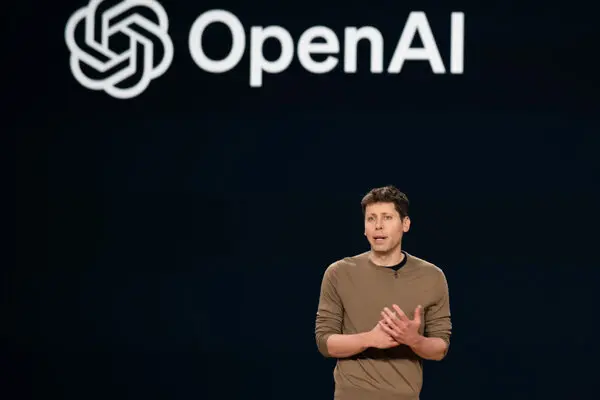
The headline hits like a warning. “18 months until bankruptcy?” The idea is circulating, driven by an op-ed by Sebastian Mallaby and relayed in France by ZDNet.
But the real question isn’t whether OpenAI “will disappear.” It’s more structural. Who can sustainably finance the industrialization of generative AI when demand is growing faster than margins?
Massive Adoption, Atypical Income Statement
In three years, OpenAI has become a central player in generative AI, with unprecedented consumer and business adoption.
The key point, highlighted by ZDNet, lies in the gap between usage and monetization. A large user base remains free, while infrastructure costs accumulate.
This gap is all the more paradoxical given that, on the enterprise side, utility signals are real. Wharton School reports that three-quarters of surveyed decision-makers report a positive ROI on their GenAI investments.
In other words: AI “creates value” for customers. But this value doesn’t automatically land in the model provider’s margins.
The Critical Factor: Capital, Not Audience
Mallaby’s op-ed, as reported by ZDNet, offers a simple diagnosis: generative AI resembles heavy industry more than traditional software.
Servers, GPUs, energy, redundancy, security. Everything costs. And the cost isn’t linear.
ZDNet reports that OpenAI could follow a spending trajectory exceeding $40 billion by 2028, based on information attributed to The Information. The outlet also mentions a significantly higher estimate concerning, over the longer term, infrastructure needs related to data centers.
This isn’t just a “burn rate” problem. It’s a structural economic problem: the more performant AI becomes, the more compute it consumes, thus more capital.
OpenAI isn’t “without revenue.” It’s seeking a monetization architecture capable of absorbing the cost of compute.
In public debate, two things are often confused: revenue growth and model sustainability. OpenAI reports having exceeded $20 billion in annualized run rate in 2025, after $6 billion in 2024 and $2 billion in 2023, and links this growth to increased available compute capacity.
This changes the reading. The question isn’t “is there a market?” The market exists. It becomes: what monetization mix can absorb a high marginal cost while funding the next generation of models?
models?
This is where recent signals matter. OpenAI formalized in 2025 a reported $40 billion funding round, intended notably for infrastructure and product scaling.
In parallel, the company is exploring monetization levers inspired by media and platforms, including introducing advertising for certain use cases and diversifying offerings. It’s also studying pricing more oriented toward value created, via outcome-based payment, or licensing models.
The Blind Spot: “Software” No Longer Has Software Margins
Generative AI blurs a dividing line. SaaS publishers have long benefited from low marginal costs: selling one more user cost little.
With large models, serving an additional user has a direct cost: responding, generating, reasoning, executing agents mobilizes compute, thus energy and hardware depreciation.
Consequence: the sector is shifting toward a “utilities” economy.
Structural winners aren’t just those with the best model. They’re those who control infrastructure, distribution, and long-term capacity contracts.
In this logic, the hypothesis of consolidation around cloud giants has nothing ideological about it. It becomes industrial mechanics. ZDNet formulates it explicitly: ultimately, absorption by a player already possessing platforms and balance sheet (Microsoft, Amazon) becomes a credible scenario.
Four Plausible Scenarios at 18–36 Months
1) The “Platform” Trajectory
OpenAI stabilizes unit costs, standardizes enterprise offerings, sells building blocks (API, agents, automation), and captures a larger share of value created at customers.
In this case, the risk isn’t bankruptcy. It’s price increases, harder usage segmentation, and B2B prioritization.
2) The “Consolidation” Trajectory
The cost of the frontier model race forces a capital rapprochement with a giant. Independence decreases, but investment capacity increases.
For customers, this could improve resilience… or reinforce dependence on an ecosystem.
3) The “Open Source Compression” Trajectory
Open models and cheaper alternatives progress. Differentiation shifts from raw performance to integration, security, compliance, and support.
The risk here: a price war that makes the equation for frontier models even more strained.
4) The “Economic Pivot” Trajectory
Advertising, bundles, distribution agreements, licenses, revenue sharing with partners. AI aligns with models already seen in consumer internet.
This option raises a sensitive question: how to reconcile commercial exploitation with confidentiality requirements, particularly in enterprise and European contexts?
What This Changes for European Companies
For a leader, the issue isn’t to speculate on a “catastrophe scenario.” It’s to govern supplier risk.
If AI economics tighten, three effects are likely.
- Volatility of access conditions: quotas, price increases, limitations on certain intensive uses.
- Reinforcement of multi-model: avoid lock-in, arbitrate between cost, performance, sovereignty, and compliance.
- Increased weight of governance: traceability, security, usage policy, and contracting (SLA, audit, reversibility).
In this context, Wharton School provides a useful contrast: companies report obtaining ROI, but they also identify risks of skills loss and a need for stricter guardrails.
The debate “Can OpenAI hold on?” thus becomes a debate on organizational maturity: do they know how to industrialize AI without depending on a single technological and financial trajectory?
“18 Months” as Symptom, Not Prophecy
The alert relayed by ZDNet plays a role. It forces us to view generative AI not as a magic product, but as a heavy-cost industry where access to capital becomes a competitive advantage.
Recent figures communicated by OpenAI on its annualized revenue show that monetization already exists, and it’s growing fast.
The structural question remains: can this growth surpass, then domesticate, the growth of compute costs?
The outcome will say less about “OpenAI” than about the future of frontier models.
A future where intelligence becomes an industrial service. A future where financial strategy is as decisive as research strategy.