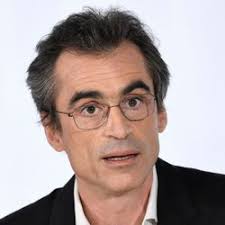
 On April 2, 2025, at the Westminster Hotel in Nice, as part of the ISCAE meetings, philosopher Raphaël Enthoven delivered a dense, stimulating, and subtly provocative lecture on a seemingly simple theme: “Is artificial intelligence an oxymoron or a pleonasm?” The deliberately paradoxical question opens up a deeper reflection: what does “intelligence” mean, and to what extent can it be artificial? By invoking philosophical tradition—from Aristotle to Kant, from Jankélévitch to Nietzsche—he invites his audience to think differently about AI, not as a threat or a promise, but as a revealer of our limits, our fears, and our illusions.
This is not a lecture about technology in the strict sense, but a meditation on humanity, on what makes it irreducible to the machine. Enthoven questions not only artificial intelligence’s capacity to think, but also how this belief reveals our own difficulty in grasping the essence of thought. The question is not so much: what can AI do? But: what are we becoming by constantly comparing ourselves to it?
Defining Intelligence: Between Technical Faculty and Human Depth
From the first minutes of his presentation, Raphaël Enthoven proposes a fruitful alternative: to consider the expression “artificial intelligence” as either a pleonasm or an oxymoron. It all depends, he explains, on what we mean by “intelligence.”
If we refer to a functional definition—the ability to classify, analyze, synthesize—then there is nothing surprising about an artifact being called “intelligent.” In this sense, artificial intelligence is merely a logical extension of our own information processing capacity. The term is therefore superfluous. A pleonasm.
But if we mean by “intelligence” something deeper—the complicity between two beings, intelligence of the heart, that subtle form of attention that escapes all algorithmization—then the expression becomes contradictory. Intelligence, thus conceived, cannot be artificial. It is embodied, emotional, intuitive, unpredictable. It presupposes a mind, that is, an irreducible element. In this sense, “artificial intelligence” is an oxymoron.
He does not seek to choose between these two readings. On the contrary, he proposes to keep them both alive, to make this tension the starting point of critical reflection. Because it is precisely in this in-between, in this constitutive ambivalence, that fertile thinking resides. AI is not just a technical feat; it is also a testing ground for our definition of humanity.
He revisits the arguments developed in his latest book, Le temps gagné, where he defines “spirit” as what artificial intelligence cannot synthesize. Spirit is not intelligence; it is its limit. It is not a deficit of calculation, but an ontological difference. Where AI shines through its processing power, spirit resides in wonder, in living memory, in non-reducible simplicity.
Teaching Philosophy: Inhospitable Territory for AI
One of the most striking demonstrations of the lecture lies in the connection established between artificial intelligence and the teaching of philosophy. Enthoven argues that AI and philosophy belong to two radically different orders. To demonstrate this, he summons three key notions: wonder, memory, and simplicity.
Wonder
Artificial intelligence, Enthoven observes, is based on a simple principle: not being surprised by what one has not yet seen. Like the mollusk Aplysia, studied by ethologists and mentioned by Yann LeCun in “Quand la machine apprend,” AI learns through repeated exposure. It adapts its responses to known stimuli, until it can predict unprecedented situations. Artificial intelligence is predictive, reactive, adjusted.
Yet philosophy begins at the exact opposite. Since Aristotle, it is born from wonder. But not wonder at the extraordinary or unusual—Enthoven ironizes here by evoking a naked man singing The Internationale. What founds thought is the ability to wonder at what is taken for granted. To question evidence, habit, common language. To philosophize is to wonder at what we see every day without seeing it anymore.
Thus, while AI trains not to be surprised, philosophy strives never to cease wondering. The orientation is reversed. One seeks to reduce the unknown, the other to reopen the known.
Memory
Second point: memory. The experience we have of our own memory—especially the night before an exam—is one of lack, doubt, fear of no longer knowing anything. Our memory is neither exhaustive nor panoramic. It eludes us precisely when we want it to unfold.
Human memory is fragmentary, emotional, unpredictable. It does not store information like a hard drive; it reactivates it in action. It is an art of emergence, not of conservation. What is within us is never there as in a warehouse. It is a presence without place.
Here again, the gap with machine memory is total. An AI conserves, retrieves, compiles. It has a “repository.” The human brain, on the other hand, is a paradox: it retains without a warehouse, it knows without knowing that it knows. It is this living dynamic that establishes a radical difference between the living and the system.
Simplicity
Finally, simplicity. Contrary to common belief, Enthoven maintains that it is not complexity that escapes machines. All complexity is potentially modelable. What resists is simplicity. That part of humanity that cannot be explained.
He gives the example of the feeling of beauty: faced with a sunset, we say “it’s beautiful,” not “I find it beautiful.” This judgment imposes itself with the force of a universal evidence, without being based on reasoning. It is a shared feeling, not conceptualized.
The same applies to love: any attempt to explain its cause makes it disappear. “I love you because…” is the beginning of the end. Love is an impulse without a why, an undivided election. What matters is the gratuitousness of the feeling, its radical simplicity.
Yet this simplicity—aesthetic, ethical, existential—is precisely beyond the reach of AI. Because it is not based on rules, but on lived experience. On something irreducible. This, says Enthoven, is what makes philosophy and artificial intelligence two worlds foreign to each other.
The Irreducibility of Humanity: Traces, Data, and Individuals
To extend this reflection, Enthoven mobilizes an essential distinction: that between the traces we leave and what we are.
One of the modern myths of transhumanism consists in believing that one could “reproduce” an individual from all their data: texts, photos, DNA, voice prints, digital histories. The episode of the series Black Mirror that he mentions illustrates this fantasy: a woman, after her partner’s death, orders a robot made from all his data. The illusion holds until the moment when the ersatz does not get angry, where the original would have. This tiny detail is enough to betray the imposture.
Why? Because humanity is not the sum of its traces. Because ash is not fire. The machine lacks what Jankélévitch calls “the je-ne-sais-quoi”: that non-formalizable principle of individuation, that presence that escapes all analysis.
He reminds us that the word “individual” literally means: “that which cannot be divided.” The individual is indivisible; it cannot be reconstituted from pieces. Frankenstein remains a myth: you cannot make a living being by assembling parts. What we are infinitely surpasses what we leave behind.
The Fear of Replacement: Ancestral Fantasy or Disguised Pride?
The fundamental question is therefore not “when will machines replace us?” but “why are we so afraid they will?”
By mobilizing the genealogical method—inherited from Nietzsche and Clément Rosset—Enthoven shifts the question. It is not about knowing whether something is true, but about questioning our need to believe it. Why do we need to think that machines are about to supplant us?
Two hypotheses are proposed.
First hypothesis: fascination with screens. The more we entrust them with our attention, the more we project a form of life onto them. We refuse to admit that our own passivity makes us slaves. So we attribute malevolent intentions to machines. As if we preferred to believe in their omnipotence to escape our own responsibility.
Second hypothesis: pride disguised as modesty. Those who announce that machines will surpass us want to be modest, but unconsciously take themselves for God. Reproducing humanity is to imitate the Creator. Making a free being is a divine act. The myth of the Golem, Pinocchio, or the android, is always the same: the moment when the work escapes its author.
The idea that the machine could become human is less a fear than a fantasy of power. A will to self-deification.
Raphaël Enthoven does not engage in a simplistic condemnation of AI. He recognizes its powers, capacities, promises. But he also reveals its limits. AI is a mirror. It does not only tell us what it is; it forces us to reconsider what we are.
What the machine cannot reach—wonder, living memory, love, aesthetic feeling—outlines the contours of our humanity in negative. It is not power that distinguishes us, but fragility, spontaneity, simplicity.
No machine will become human. But humanity, by wanting to calculate everything, might well become machine.