 Rudy Cohen, co-founder and CEO of Inbolt
Inbolt is a Parisian startup specializing in real-time robotic guidance through 3D vision and artificial intelligence. The company raised 15 million euros in a Series A funding round led by Exor Ventures, bringing total funds raised to 20 million euros.
This funding round aims to accelerate the development of their GuideNOW solution, which enables industrial robots to dynamically adapt to their environment, and to strengthen their international presence, particularly in the United States and Japan.
Their clients include companies such as Stellantis, Ford, and Whirlpool.
Tell us about your business
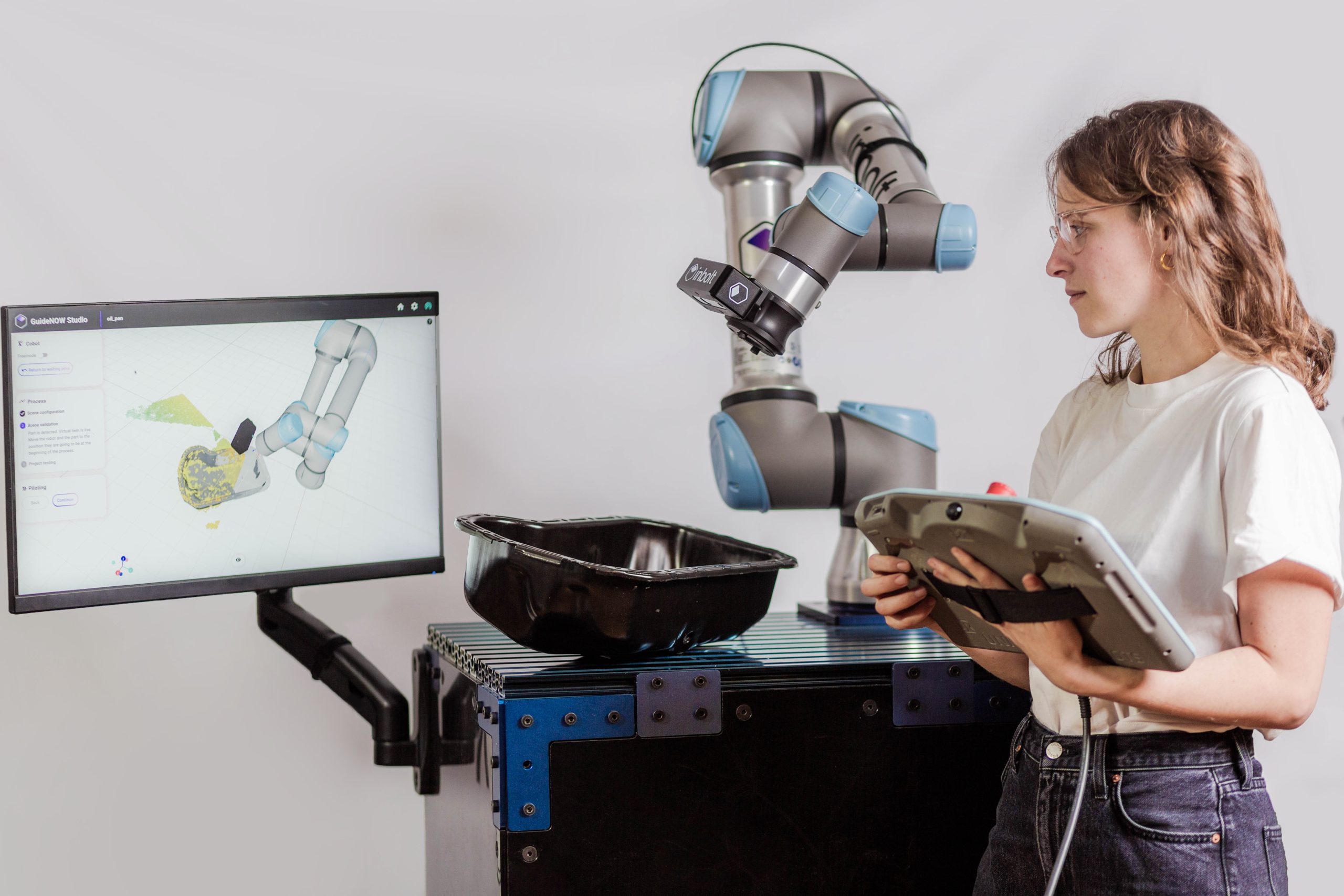
Inbolt, founded in 2019 by Albane Dersy, Louis Dumas, and myself, develops real-time robotic guidance solutions based on 3D vision and artificial intelligence. We are based in Paris and currently have 25 employees, with a goal to double our workforce by mid-2025. We offer computer vision solutions for guiding robotic arms in the industrial sector. Our technology enables industrial robots to dynamically adapt to their environment, making automation more flexible, reliable, and efficient. Our solution primarily targets manufacturing industries, such as automotive and electronics, where automation is often rigid and costly.
Concretely, we equip robotic arms with smart cameras. By analyzing visual data in real-time using our proprietary algorithms, robots dynamically adjust their trajectories. This solves a central problem in current robotization: “blind” machines unable to adjust if a part is offset, in motion, or shows variations.
What unique aspect of your industry drove you to integrate AI, and how has it transformed your operations?
In the manufacturing industry, robotization relies on rigid, predefined environments. A traditional robotic arm cannot adapt: if it needs to apply glue to a smartphone, the device must be perfectly positioned between wedges. If the part moves or dimensions change, the robot fails. This requires high costs to rigidify factories, reduce errors, and ensure precision.
We wanted to reinvent this approach by giving robots the vision and intelligence needed to adapt in real-time. Thanks to our solution, the camera installed on the robot analyzes the field of vision, detects the part to be worked on, and adjusts the trajectory instantly. For example, in an automotive factory, if a car on an assembly line is slightly offset, the robot automatically adjusts its movement. This enables flexible automation without requiring constrained environments. We provide a reduction in infrastructure costs. Thanks to Inbolt, robots are more accurate even in a moving environment.
This level of adaptability is a game changer for industries. Today, we have deployed our technology in over 25 factories in Europe and the United States, notably with clients like Stellantis for automotive or Whirlpool for home appliances.
Which AI solutions have you selected?
We developed our own algorithms over 4 years of R&D.
We combine:
- Computer vision: Our cameras capture the environment in real-time.
- Digital models: Clients provide us with CAD models of the parts to be processed.
- High-frequency processing: We analyze visual data at a very high rate to precisely guide the robot.
Our algorithms operate locally to meet factory cybersecurity requirements. We install physical controllers directly next to the robotic arms.
We are also working on innovations related to generative AI.
What technical challenges did you encounter when implementing AI solutions?
The main challenge was ensuring absolute reliability. Classic AI models, such as those based on deep learning, often reach 95% accuracy, which is insufficient for manufacturing. Manufacturers require 99.99% reliability. A single error can stop an entire production line and be very costly.
To meet this challenge, we adopted a hybrid approach: our AI building blocks are combined with physical and deterministic constraints. This allows us to ensure rigorous and reliable results at very high frequency.
Another challenge was latency. To guide a robot in real-time, extremely fast calculations are required. Our algorithms are optimized to operate with near-instantaneous response times. We have also gradually expanded the scope of our solution: initially, we were limited to certain sizes. Today, we work on parts of all dimensions, small or large, while maintaining perfect accuracy.
What positive changes have you observed in your team dynamics thanks to AI?
The integration of AI has enabled our team to gain productivity and efficiency. Our developers use GitHub Copilot to code faster while focusing on complex tasks. Adoption happened naturally, thanks to a young and curious team, but we organized sharing sessions to spread best practices and encourage tool usage.
What essential advice would you give to SMEs hesitating to take the leap into AI?
AI may seem complex, but it delivers tangible benefits quickly. My advice: start small. Identify simple, repetitive tasks to automate, such as email writing, administrative optimization, or customer service.
AI doesn’t replace experts, but it enables you to go faster, be more accurate, and explore new opportunities. In a world where the gap widens between those who adopt AI and others, it’s essential to test and learn. The key is to remain curious and constantly seek methods to improve your daily operations.
What are your next challenges at Inbolt?
We are working on two fronts: first, extending our integrations with major robotic arm manufacturers. Today, four major brands dominate the market: Universal Robots, Fanuc, KUKA, and ABB. Once our solution is integrated with one brand, we can operate with all their robots. And we are developing new improved models combining computer vision and decision-making to enable robots to intelligently interact with their environment.
We envision a future where robots will be capable of learning through observation, somewhat like humans, to accomplish increasingly complex tasks.